blog-post // Jul 4, 2026
The 5 Skateboard Trick Families Every Skater Should Know
Skateboard tricks fall into 5 families: flatground, grinds, slides, manuals, and transition. Here's what defines each and where to start learning them.
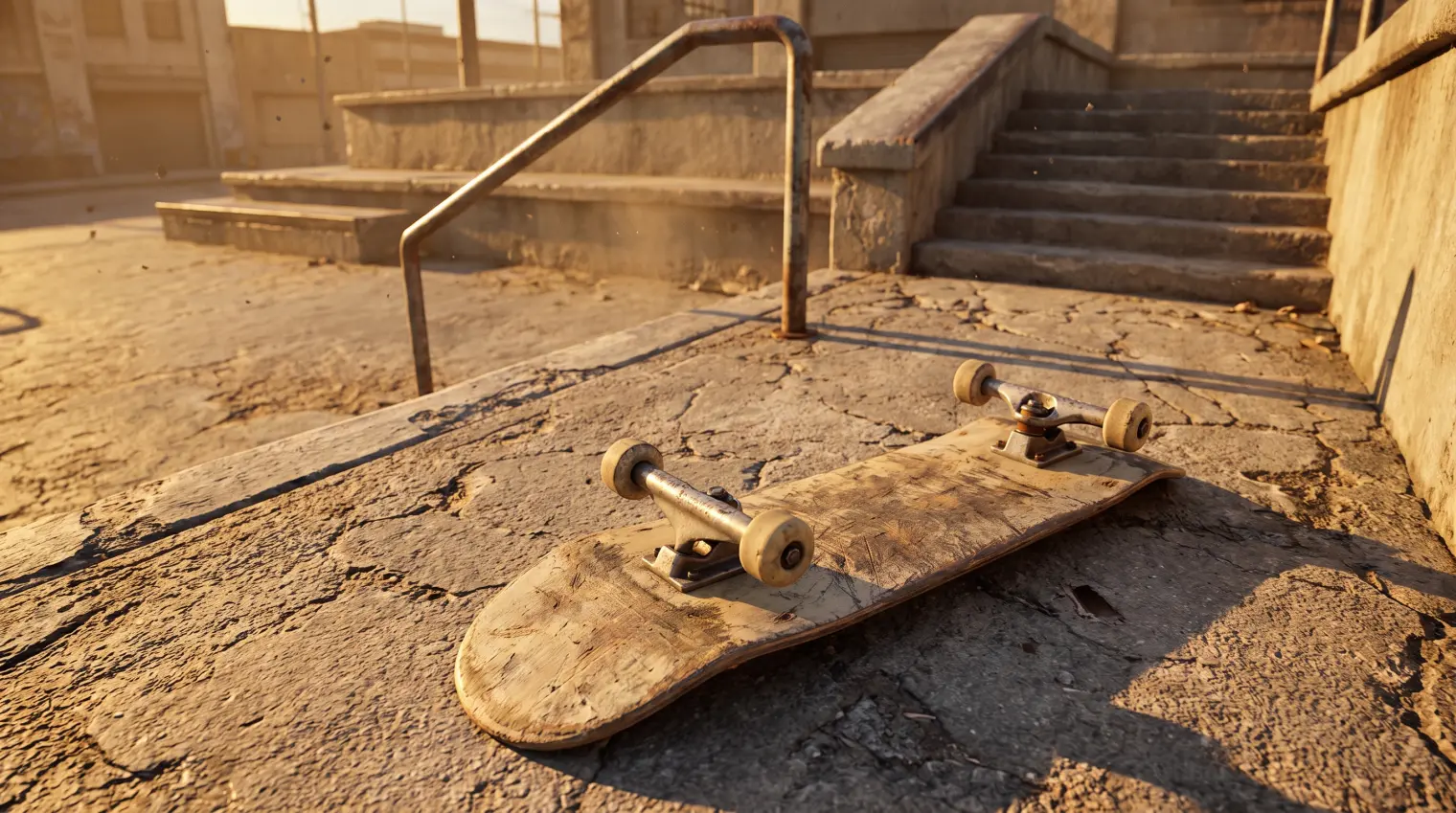
Skateboard tricks split into five families: flatground, grinds, slides, manuals, and transition. Nearly everything you'll ever learn is a variation, combination, or extension of a trick in one of these five buckets. Knowing which bucket a trick belongs to tells you what skill it's actually testing, and that's the fastest way to figure out what to practice next.
This matters more than it sounds like it should. A lot of skaters get stuck not because a trick is impossibly hard, but because they're trying to learn it without the underlying skill from its family. Understanding the five families turns a wall of trick names into a map you can actually navigate, which is exactly what the skill tree on Onbolts is built to show.
Flatground: the trick family everything else builds from
Flatground tricks happen, as the name says, on flat pavement, no ramps or ledges required. This is where almost every skater starts and where the ollie lives. The ollie is the base jump: pop the tail, slide your front foot up, level the board out in the air. Onbolts' learning data lists it as beginner difficulty with a typical learning window of 1 to 4 weeks, and it's a direct prerequisite for a huge share of everything else in this family, including pop shove-it, frontside 180, backside 180, and kickflip.
Flip tricks are the flashiest subset of flatground: the board rotates under your feet while you're airborne. Kickflip (intermediate, 1 to 6 months) and heelflip (intermediate, 1 to 4 months) are the two foundational flips, and nearly every advanced flip trick, from varial kickflip to tre flip to hardflip, is a kickflip or heelflip combined with a shove-it style rotation. If you can ollie consistently, flatground is where you'll spend most of your first year.
Grinds: balancing on the trucks
Grinds happen when your trucks (not the deck) make contact with a ledge, rail, or curb and you slide along it. The entry point is the 50-50 grind, listed as beginner difficulty with a 2 to 6 week learning window, requiring only the ollie as a prerequisite. Once you can lock into a 50-50, the grind family opens up fast: the nosegrind and 5-0 grind both build directly on 50-50, and from there you can branch into crooked grinds, smith grinds, feeble grinds, and further.
Grinds are a different skill than flip tricks. You're not flicking the board, you're managing weight distribution and trucks-on-metal friction while committing your whole body weight to an edge. That's why a skater who's great at flip tricks can still struggle with their first grind, and vice versa. If ledges and rails intimidate you, starting with a low curb and a basic 50-50 is the standard entry point.
Slides: balancing on the deck
Slides are grinds' cousin: instead of the trucks touching the ledge, the deck itself slides along it. Boardslide and noseslide are the two foundational slides, both intermediate difficulty, both requiring an ollie to get up onto the ledge in the first place. A boardslide has you 90 degrees to the ledge with the middle of the board sliding across it; a noseslide is a similar idea but balanced on the nose.
Once you have a boardslide and noseslide, combining them unlocks tricks like the bluntslide, which the Onbolts skill tree lists as requiring both. Slides tend to feel scarier than grinds at first because more of the board's surface, and more of your balance, is riding on the ledge contact. Most riders find their footing faster if they've already got a solid 50-50 grind under their belt, even though it's not a formal prerequisite.
Manuals: balance without popping anything
Manuals are the odd one out: no ollie required, no ledge, no ramp. A manual is simply riding on your back two wheels, balanced, for as long as you can hold it. It's beginner difficulty with a 2 to 6 week learning window in Onbolts' data, and the skill it teaches (weight-shifting to hold balance on a rolling board) doesn't show up anywhere else in quite the same way.
The nose manual is the front-wheel version, listed as beginner difficulty but a longer 3 to 8 week window since balancing over your front trucks is less natural. Manuals matter beyond their own family too: skaters use manual-to-trick combos (manual into a kickflip, manual into a shove-it) as a way to link tricks together in a line, so the balance skill pays off even in runs that are mostly flatground and grinds.
Transition: ramps, bowls, and vert
Transition tricks happen on curved surfaces: mini ramps, bowls, vert ramps. This family starts even before the ollie, with things like drop in (learning to roll into a ramp) and kickturn (turning on the transition). From kickturn, riders build into rock to fakie, then into grabs like indy grab and tailgrab, and eventually into aerial and inverted tricks.
Transition is the most physically distinct family on this list. It has its own vocabulary (coping, tranny, pump) and its own fear factor, since you're dealing with height and rolling surfaces instead of flat pavement. A lot of street skaters never spend serious time here, and that's fine. It's a parallel track, not a required one.
How the families connect to each other
The families aren't fully separate. The ollie is the single biggest connector: it's a prerequisite for tricks across flatground, grinds, and slides. That's why Onbolts' ollie foundation guide treats it as the one trick worth prioritizing above all others before branching out.
Beyond the ollie, families cross over constantly. A frontside 180 (flatground) combined with a kickflip (flatground) gives you kickflip backside 180. A 50-50 (grind) combined with the same weight-shifting skill from a nosegrind teaches you the crooked grind. Manuals connect to flip tricks in combo lines even though they're not formal prerequisites. Recognizing these overlaps is why the skill tree view is more useful than a flat trick list: it shows you the actual dependency structure instead of an arbitrary alphabetical order.
Common mistakes when moving between families
A recurring pattern with skaters who've been riding for a few months: they get one flatground flip trick landed, kickflip most often, and assume that skill transfers directly into grinds or slides. It doesn't, not fully. The pop and the flick that make a kickflip work don't teach you anything about locking your trucks onto a ledge or committing your weight to a slide. What does transfer is confidence and general board control, but the specific mechanic has to be built fresh in each family.
The opposite mistake also happens: skaters who get comfortable in one family, grinds for example, and avoid flatground flips because the two feel unrelated and intimidating in different ways. Since the ollie sits underneath both, neglecting flatground for too long usually means the ollie itself starts to get rusty, which then makes new grinds harder too, since a strong ollie is what gets you cleanly up onto the ledge in the first place. The families are separate in terms of specific skill, but they share enough of a root that ignoring one for too long usually shows up as weakness in another.
How the five families map to real skate spots
This breakdown isn't just theoretical. Walk into any skatepark or street spot and you can usually see all five families represented in the terrain itself: flat open pavement for flatground, ledges and rails for grinds and slides, curbs and manual pads for manuals, and ramps or bowls for transition. A well-designed session often rotates through terrain rather than sticking to one feature, partly for variety and partly because your legs get tired doing the same motion repeatedly.
If you're planning a session and only have access to flat ground, that's not a limitation, it's still enough terrain for the ollie, flip tricks, and manuals, three of the five families. Grinds and slides need a ledge or rail, and transition needs a ramp or bowl, so those two families are more location-dependent than the other three.
Using this to plan your own progression
A practical way to use the five families: pick one flatground trick, one grind or slide, and keep working the ollie until it's automatic. Don't try to conquer all five families at once. Most skaters who plateau early are spreading their practice time too thin across tricks that don't share prerequisites yet.
Onbolts tracks your status per trick on a 5-level scale, learning, landed once, occasional, consistent, and mastered, so you can see honestly where you stand in each family rather than assuming you've "got" a trick after one lucky landing. Check your progress dashboard to see which family you're leaning on and which ones are still empty.
Where to start today
If you're brand new, start with the ollie and stay in flatground until it's consistent. If you already have an ollie, pick one grind (50-50) and one slide (boardslide) to work in the same session, since they share the ledge-approach skill even though the balance itself differs. If transition interests you, drop-in and kickturn don't need an ollie at all, so you can start that track in parallel.
Browse the full trick list at /tricks filtered by category to see exactly which tricks live in which family, and how many steps separate you from the ones you actually want to land.
Frequently asked
- What are the main categories of skateboard tricks?
- Most skateboard tricks fall into five families: flatground (ollies, flips, shove-its done on flat ground), grinds (sliding on the trucks along an edge), slides (sliding on the deck along an edge), manuals (balancing on two wheels), and transition tricks (ramps, bowls, and vert). Every trick you learn belongs to one of these, and progress in one family often carries over to the next.
- Which trick family should a beginner learn first?
- Flatground, starting with the ollie. The ollie is a direct prerequisite for the majority of flatground tricks in the Onbolts skill tree and also unlocks the entry points into grinds (50-50) and slides (boardslide, noseslide). According to Onbolts' learning data, most riders spend their first 1 to 4 weeks here before branching out.
- Do grinds and slides require different skills than flip tricks?
- Yes. Flip tricks (kickflip, heelflip) are about flicking the board under your feet while airborne. Grinds and slides are about balance and commitment while the board or trucks are in contact with an edge. Both trace back to the ollie, but they build different muscle memory, which is why many skaters work on one flatground flip trick and one grind or slide in parallel.
- What is the difference between a grind and a slide in skateboarding?
- A grind happens on the trucks (the metal parts under the board), like a 50-50 or nosegrind. A slide happens on the deck itself contacting the edge, like a boardslide or noseslide. Both need an ollie or ollie-adjacent pop to get onto the ledge or rail, and both start with flatground balance drills before you add the ledge.
- Are manual tricks part of a separate skill tree?
- Manuals are their own family but they still connect to the rest. A manual (riding on the back two wheels) and a nose manual (riding on the front two wheels) are foundational balance tricks that also show up as connector tricks in combos, like a manual into a kickflip out. Onbolts tracks manual progression separately because the balance skill transfers less directly to flip tricks than it does to other families.
- How long does it take to get through all 5 trick families?
- There's no single timeline since each family has its own depth, but most riders spend their first month or two almost entirely in flatground basics (ollie, shove-it, 180s) before splitting time across grinds, slides, manuals, and transition. The Onbolts skill tree tracks this per trick with real learning-time estimates, so you can see where you actually stand instead of guessing.