blog-post // Jul 5, 2026
50-50 Grind: The First Grind Every Skater Should Learn (And Why)
The 50-50 grind is skating's foundation grind: both trucks locked on the ledge or rail. Learn why it comes first, what it unlocks, and how long it really takes.
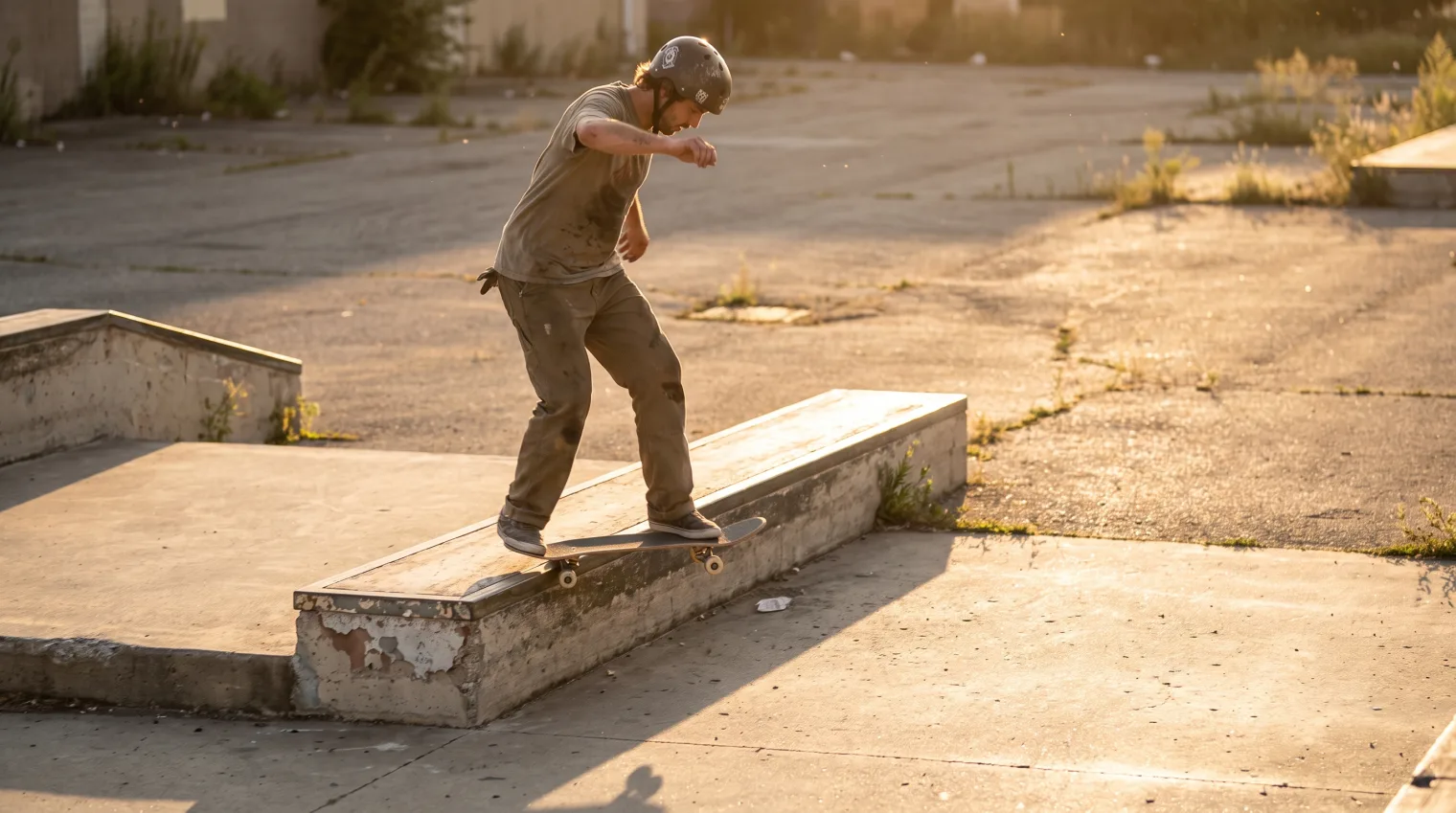
The 50-50 grind is the first grind almost every skater learns, and for good reason: it is the simplest way to feel what "locked in" on a ledge or rail actually means. Both trucks land on the obstacle at once and slide together, no rotation, no balancing on one truck. Onbolts' learning data puts a consistent 50-50 at 2–6 weeks once you already have a solid ollie, which makes it one of the more approachable tricks past flatground.
This guide covers what a 50-50 actually is, why it is the right starting point for grinding, the mechanics that make it click, and what to do once you have landed one.
What a 50-50 grind actually is
A 50-50 is named for its weight distribution: 50 percent on the front truck, 50 percent on the back. You ollie onto a ledge, curb, or rail so both trucks land on top of it at the same time, then slide across before popping back off. No rotation happens mid-grind. That is what separates it from a 5-0 (back truck only, nose lifted) or a nosegrind (front truck only, tail lifted).
Because both trucks are doing the work together, the balance point is more forgiving than either single-truck grind. That is exactly why it comes first in the skill tree: it teaches your body what grinding metal-on-metal (or metal-on-concrete) feels like without also asking you to balance on one truck at a time.
Why ollie comes before 50-50
In the Onbolts skill tree, ollie is a direct prerequisite for 50-50, not a suggestion. You need the ollie to get your board up onto the ledge or rail in the first place, and you need it to be consistent enough that you can control where you land, not just how high you get. A shaky ollie means an inconsistent 50-50, because any hesitation or lean at the top of the pop carries straight into the landing.
Onbolts' learning data estimates the ollie itself at 1–4 weeks for a first-timer. Add the 2–6 weeks for the 50-50 on top of that and you are looking at roughly one to two months from zero to a landed 50-50, assuming regular sessions.
The mechanics that make it click
Three things separate a clean 50-50 from a sketchy one:
Height and distance. Your ollie needs to clear the height of the ledge or rail with a little room to spare, and it needs to travel far enough that both trucks land on top of the obstacle, not just the front one. Undershooting is the single most common reason beginners bail out of a 50-50 attempt.
Landing both trucks together. This is the part that separates 50-50 from every other grind. If your back truck lands a beat after your front truck, the board will twist and kick out from under you. Practice popping level, not angled, so both trucks arrive at the same time.
Staying centered through the slide. Once you are locked in, resist the urge to lean forward or lock your knees. Keep a soft, centered stance and let the board slide under you. Most falls happen because riders brace for the slide instead of riding through it.
Where to start (before you touch a rail)
Do not learn your first 50-50 on a metal rail or a waxed skatepark ledge. Start on something low, wide, and grippy: a parking block, a low curb, or a manual pad if your park has one. The goal in your first sessions is not speed or slide distance, it is repeatable landings. Once you can lock in and ride out ten times in a row on something forgiving, moving to a real ledge or rail is a much smaller jump than starting there.
A flat, wide manual pad also doubles as good crossover practice. If you already have a manual down, you already understand riding on a narrow balance point, which carries over directly to grind balance.
Common mistakes and how to fix them
Popping too close to the ledge. If you ollie right at the edge instead of a foot or two before it, you will not have enough air time to get both trucks up and over. Give yourself more approach distance than feels necessary at first.
Looking down at your feet. Your body follows your eyes. Look at where you want to land on the ledge, not at your board, and your weight distribution follows more naturally.
Riding away too early. A lot of beginners pop off the grind the instant they feel locked in, before they have actually slid anywhere. Give the grind a beat to happen before you pop out.
Wrong speed. Too slow and you will stall out mid-grind; too fast and you will overshoot the landing. Start slower than feels natural, since a stalled 50-50 is a much safer fall than an overshot one.
What 50-50 unlocks next
Once you can land 50-50s consistently, the Onbolts skill tree opens up two direct next steps: the 5-0 grind (back truck only, front lifted) and the nosegrind (front truck only, back lifted). Both use the same approach and landing mechanics you just built, but ask you to balance on a single truck instead of two, which is a real jump in difficulty. From nosegrind, the crooked grind is the next logical step for riders chasing more technical ledge tricks.
Rate your own 50-50 progress honestly on the 5-level scale (learning, landed once, occasional, consistent, mastered) rather than calling it done after the first landing. A grind you land once under perfect conditions is a different trick than one you can do on command, and the difference matters for what you attempt next.
Tracking your progress
If you are logging tricks in progress, the 50-50 is a good one to track honestly through all five stages. "Landed once" on a soft parking block and "consistent" on a real skatepark ledge are very different skill levels, and the Onbolts scale is built to capture that gap rather than flatten it into a single checkbox.
The 50-50 rewards patience more than raw ability. Most of the learning curve is repetition: popping consistent height, landing level, and getting comfortable with the specific feeling of metal or concrete sliding under your trucks. Put in the sessions and the 2–6 week window in the ollie to 50-50 pipeline holds up for most riders.
Ready to start? Check the full trick list for other beginner-friendly tricks to pair with your 50-50 sessions, or head to the skill tree to see exactly where 50-50 sits relative to everything else you are working on.
Reading the obstacle before you commit
Not every ledge or rail is a good place to learn a 50-50. Height, edge sharpness, and surface material all change the difficulty far more than beginners expect. A rounded concrete ledge at knee height with a clean edge is close to ideal: it is forgiving if you land slightly short and grippy enough that your trucks catch instead of skate past. A thin metal rail with a sharp edge asks for precision you probably do not have yet, and a chipped or cracked ledge edge can catch a wheel wrong and stop your board dead. Spend a minute looking at an obstacle before you try it: run your hand along the edge, check the height against your ollie, and look for anything that could snag a wheel mid-slide.
How wax changes the trick (and when to use it)
Skate wax reduces friction between your trucks and the obstacle, which makes the slide portion of a 50-50 smoother and more forgiving of small landing errors. For a first-timer, a lightly waxed ledge can make the difference between constant slide-outs and a trick that starts to feel repeatable. The tradeoff is that wax also makes the ledge feel slicker and less predictable if you have not built the balance to handle a faster slide yet. A reasonable approach: learn your first few 50-50s on an unwaxed or lightly waxed low ledge, then use wax more deliberately once you are choosing to move to a harder obstacle, not as a crutch on the easy one.
Body position through the whole trick, not just the landing
Most 50-50 breakdowns get treated as landing problems, but body position matters through the entire arc of the trick, not just the moment your trucks touch down. Going into the pop, your shoulders and hips should already be squared up to the ledge, not still rotating from your approach. During the slide, keep your arms loose and slightly out for balance rather than locked at your sides, and resist the instinct to look down at your trucks, since that pulls your weight forward and off center. Coming off the ledge, pop off the back of the obstacle the same way you would pop a normal ollie, rather than just riding off the end and letting gravity do the work. Riders who treat the exit as an afterthought tend to land awkwardly even after a clean slide.
A short practice progression that actually works
If you are starting from zero, this rough progression tends to compress the 2 to 6 week window rather than stretch it. First, drill your ollie onto a low, flat surface like a curb with no grinding involved, just landing both trucks on top and riding off, to build the height and distance judgment you need. Next, move to a low parking block and focus purely on locking both trucks at the same time, even if you only slide a few inches before bailing off. Only after that is repeatable should you add real slide distance or move up to a taller ledge or a rail. Skipping straight to a rail because it looks like the real trick is the most common way beginners stall out for months instead of weeks.
Frequently asked
- What is a 50-50 grind in skateboarding?
- A 50-50 grind is when both trucks lock onto a ledge, curb, or rail at the same time and slide along it evenly. The name comes from the weight being split 50/50 between the front and back truck. It is the base grind that every other grind variation (5-0, nosegrind, crooked grind) builds from.
- Do I need to know how to ollie before learning 50-50?
- Yes. The 50-50 requires an ollie to get onto the ledge or rail, so it is listed as a direct prerequisite in the Onbolts skill tree. Onbolts' learning data puts the ollie at 1–4 weeks and the 50-50 at 2–6 weeks after that, so budget roughly a month total if you are starting from zero.
- How long does it take to learn a 50-50 grind?
- Onbolts' learning data estimates 2–6 weeks for a rider who already has a consistent ollie. The range depends on how much ledge or rail time you get and whether you start on something low and forgiving, like a curb, versus jumping straight to a skatepark ledge.
- Why does the board slide out during a 50-50?
- Almost always because the ollie into the grind was not high enough or straight enough, so one truck lands before the other and knocks the board off balance. Locking both trucks on at the same height and keeping your shoulders parallel to the ledge fixes most slide-outs.
- What tricks does 50-50 unlock?
- In the Onbolts skill tree, landing a consistent 50-50 unlocks the 5-0 grind (back truck only) and the nosegrind (front truck only), since both build directly on the balance and truck feel you develop from 50-50s.
- What is the difference between a 50-50 and a boardslide?
- A 50-50 grinds on the trucks with the board parallel to the obstacle. A boardslide turns 90 degrees so the underside of the deck slides across the obstacle instead of the trucks. Both are beginner-to-intermediate ledge tricks, but they use completely different balance points, so one does not automatically transfer to the other.