blog-post // Jun 11, 2026
Why Board Pop Is the Most Underrated Skill in Flatground Skating
Board pop drives every flatground trick, yet most skaters never train it directly. Here is what pop actually is, why it matters, and how to build it up.
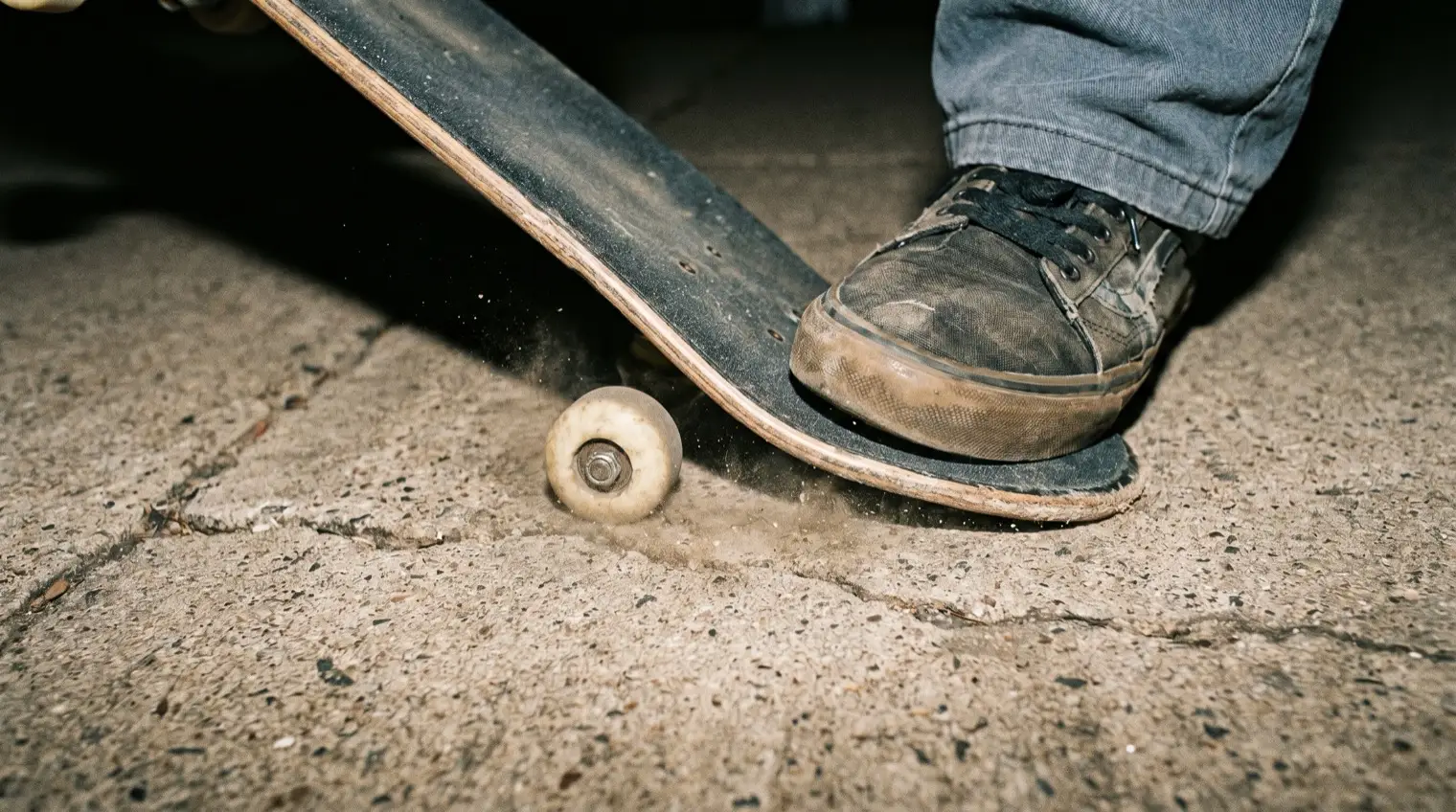
Board pop is what launches every flatground trick. It is not a jumping skill. It is not a timing trick. It is a stomp -- a fast, hard tail strike against the pavement that compresses the board and releases stored elastic energy upward. Every ollie, kickflip, pop shove-it, and heelflip starts with that same stomp. Skaters who have weak pop spend months fighting the symptoms without ever fixing the source.
What Is Board Pop, Technically?
When the tail hits the ground, the wood compresses slightly. The board's concave channels that released energy upward in a predictable arc. Your back foot's stomp initiates this. The faster and harder the snap, the more energy transfers into the board. This is why the Onbolts ollie breakdown says it directly: "the tail snap compresses the board against the ground, releasing stored elastic energy" and "the faster and harder the snap, the more height."
Pop is not a jump. The jump happens at the same moment, but the jump only lifts your body. The stomp is what lifts the board.
Why Height Comes From Pop, Not From the Flick
This is where most beginners make the wrong diagnosis. You watch someone with a big ollie and think their front foot is doing something impressive. It is not. The front foot's job during an ollie is guidance -- dragging the board level so it does not fly off at an angle. The height is already set by the time the front foot does anything.
The ollie step data makes this plain: Step 3 is "slam the tail into the ground with your back foot and jump straight up" and only Step 4 is "slide your front foot diagonally toward the nose." The sequence matters. If your pop is weak, the front foot cannot compensate. It can only redirect the energy that pop already created.
The same logic applies to kickflips. The kickflip breakdown is specific: "your back foot pops for height -- identical to an ollie. Your front foot's flick is the key." But the flick only works if the board is rising. If pop is shallow, the board is still at ankle height when the flick should happen, and the foot is forced to flick into the pavement instead of into the air.
How Weak Pop Shows Up as Other Problems
Skaters rarely identify weak pop as the cause of their struggles because the symptoms look like something else entirely.
In ollies: The nose dips immediately after the pop (a "rocket ollie" in reverse). The board slides forward instead of rising. You land with your weight on the back trucks. All of these point to a stomp that ran out of energy too early.
In kickflips: The flip is slow, the board barely rotates before hitting the ground, or the flip goes sideways instead of clean. The kickflip tip is explicit about this: "wait for the board to rise before you flick: popping and flicking at the same time causes rocket kickflips." If the board is not rising, there is nothing to wait for.
In rotation tricks: Backside 180s and frontside 180s both require enough hang time for your body to rotate over the board. Weak pop kills hang time. You rush the rotation, it comes up short, and you land on an angle.
The Weight Distribution Factor
The ollie biomechanics note something that applies to every pop-based trick: "you need to be over the board (centered) at takeoff, not leaning back. Leaning back kills height and causes the nose to dip."
This matters because a lot of skaters unconsciously lean back before the stomp as a fear response -- they want distance from the board in case something goes wrong. That lean transfers weight off the tail just before the stomp, which is the opposite of what you need. More weight over the tail at the moment of snap means more compression and more rebound.
Stay centered. Keep your shoulders square. The board is supposed to go up, and it can only do that if you are over it.
How to Actually Train Pop
Drill the stomp alone. Stand on a carpet or grass and practice snapping the tail without the intention of landing. Focus entirely on the downward speed of the stomp through the ball of your foot and toes. You are not jumping. You are slamming.
Use a railing. Hold a fixed object and practice ollies without the commitment of landing. This removes the fear response (the unconscious lean-back) and lets you focus on maximizing snap speed.
Film your tail strike in slow motion. Look at the angle of your back ankle at the moment of contact. A stiff ankle absorbs energy. A snapping ankle releases it. The difference is visible on video.
Stationary pop reps. Before every session, do ten stationary ollies on flat ground with no forward roll. Stationary forces you to rely entirely on pop quality because there is no rolling momentum to help.
Pop before you flick. For kickflips specifically, the tutorials are unanimous: the flick direction is "upward and forward" and it must happen "after the board has left the ground and begun to rise, not at the moment of pop." If you are flicking at the same time you pop, your pop is not high enough or fast enough to separate the two motions.
Why Pop Gets Ignored
Most skateboarding instruction focuses on foot placement and flick mechanics because those are visible and describable. Pop is a feeling -- a speed and a pressure that is harder to explain without biomechanics context.
The result is that beginners spend weeks adjusting front foot angle when the real problem is a stomp that runs out of energy in the first two inches of travel. Fix the source, and the symptoms usually fix themselves.
The Leverage Point for Everything Above Ollie Level
The skill tree on Onbolts is built on prerequisites. The kickflip requires the ollie. Varial kickflips and hardflips require consistent kickflips. Every step up the tree adds a new mechanical demand on top of the ones below. Pop is the foundation that all of those demands rest on.
If your ollie is inconsistent, the kickflip will be inconsistent at twice the difficulty. If your kickflip is low and slow, the tricks that come after it will feel impossible -- not because they are, but because the base layer is not solid enough yet.
Build the pop. Everything above it gets easier.
See where the ollie sits in the progression and what it unlocks: explore the skill tree to map out your next move.
Frequently asked
- What exactly is board pop in skateboarding?
- Pop is the elastic rebound you get when you slam the tail against the ground. The tail compresses against the pavement, stores energy, then releases it upward through the board's concave. It is the power source behind every flatground trick that gets the board airborne.
- Does pop come from jumping or from the foot stomp?
- The stomp drives pop. You jump simultaneously, but the tail snap is what launches the board. Your back foot stomps the tail before your feet leave the ground -- that sequence is what creates height, not the jump itself.
- Why does weak pop cause problems with kickflips?
- A kickflip needs the board to be rising before you flick. If pop is weak, the board barely leaves the ground, and you end up flicking into the ground instead of into the air. The flip looks clunky or incomplete because there is no height budget for the rotation to finish.
- How do I know if my pop is the problem and not my front foot?
- Try an [ollie](/tricks/ollie) without the front foot drag -- just stomp and jump. If the board barely gets knee height, pop is the issue. If it pops cleanly but lands crooked, the front foot is the issue. Isolating the two lets you fix the right thing.
- Can I improve pop without changing my foot placement?
- Yes. Pop improvement is mostly about ankle snap speed and timing. Drill the stomp on a soft surface like carpet to feel the compression. Practice stationary pops focused on the downward snap through the ball of your foot and toes, not just the jump.
- Does board setup affect pop?
- Yes. A fresh tail with sharp edges pops cleaner than a worn, rounded one. Harder wheels on rough concrete kill the snap energy before it travels through the board. Setup matters, but it only amplifies or masks the technique you already have.