blog-post // Jul 8, 2026
Fakie Explained: What It Is, Why It Feels Different, and Where to Start
Fakie means riding backward in your normal stance, feet unchanged. It feels harder than it should because it flips your spatial sense of the board.
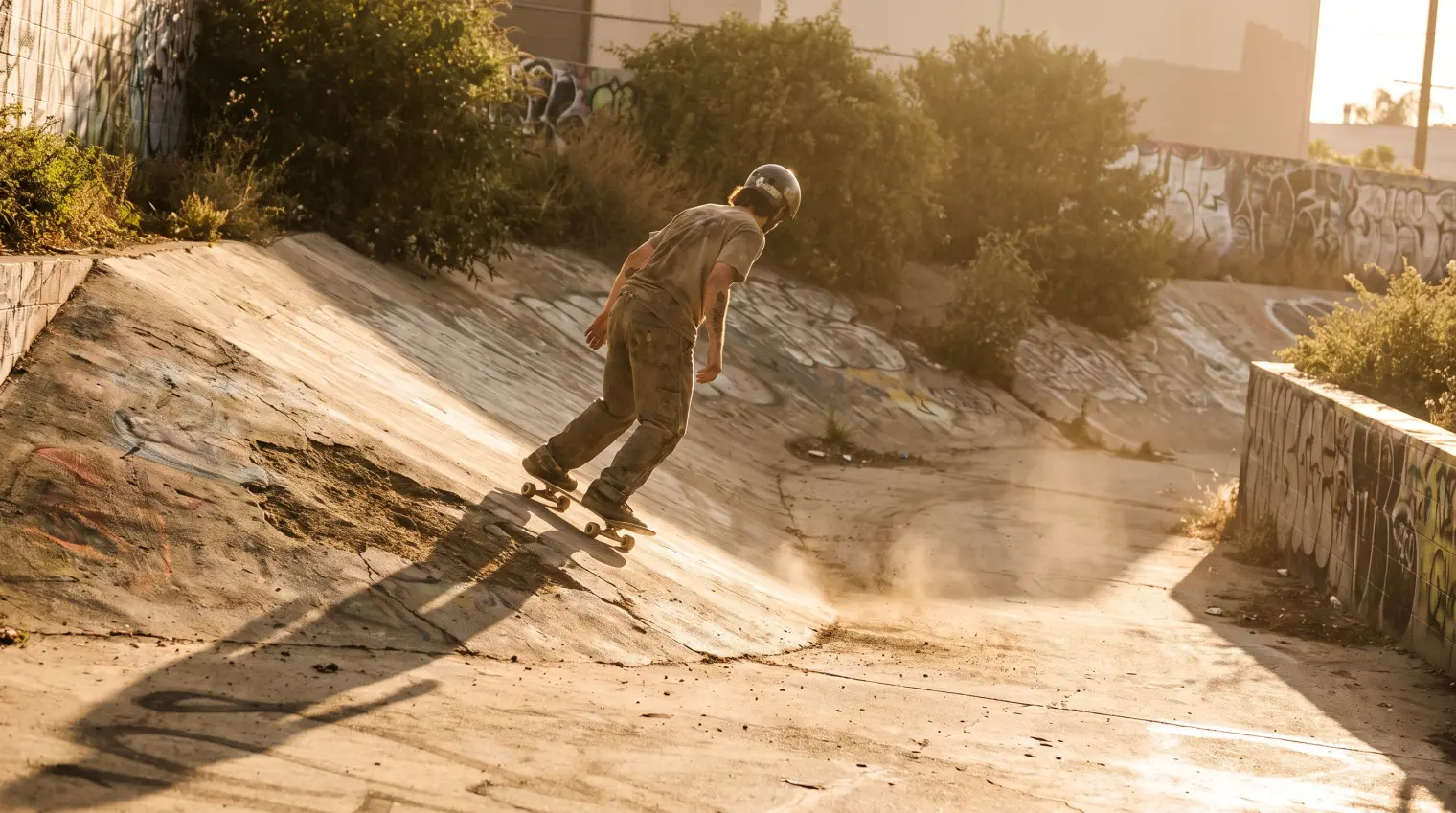
Fakie means riding backward while staying in your normal stance, your front foot's side of the board is still leading the trick, just moving the opposite direction you are used to. It feels different because your board's nose and tail have effectively swapped jobs, even though your feet have not moved.
If you have landed your first ollie and started poking around the rest of the skill tree, "fakie" is probably the first unfamiliar word you have run into that is not a trick name by itself. It is worth understanding clearly before you go further, because a surprising number of tricks further up the tree either require it or build directly on it.
What fakie is, precisely
Fakie is riding backward in your natural stance. If you are a regular-stance skater (left foot forward), riding fakie means you are rolling in the direction your tail normally points, but your feet stay exactly where they always are: left foot toward what is now the front of travel, right foot toward the back. Nothing about your stance changes. What changes is your direction of travel relative to the board's nose and tail.
This is different from switch, which is riding in your opposite stance entirely (goofy-footed if you are naturally regular), and different from nollie, which is popping off the nose instead of the tail while still facing your normal direction. Fakie, nollie, and switch are three separate variations, and mixing them up is one of the most common points of confusion once beginners start exploring beyond flatground basics.
Why fakie feels so different even though your feet do not move
The disorientation is real and it is not just in your head. Every visual and proprioceptive cue you built while learning your first tricks (which way is "forward," where the nose is relative to your vision, which way your body naturally rotates for a frontside turn) gets flipped when you ride fakie. Your feet are in a familiar position, but your brain's spatial map of the board is now backward. This is why skaters who can already ollie confidently sometimes find a fakie ollie noticeably harder than expected, even though the foot mechanics are nearly identical.
The pop mechanics themselves barely change. What changes is everything around them: your sense of speed, your read of the ground ahead, and your instinct for which way to rotate on a spin trick.
Where fakie sits in the skill tree
Fakie is not a single trick, it is a riding mode that unlocks an entire branch of variations. On Onbolts, a fakie ollie requires only the regular ollie as its prerequisite, since the pop mechanics transfer directly. From there, the tree opens up: fakie shove-its, fakie kickflips, fakie 50-50s, fakie boardslides, and eventually fakie versions of more advanced combination tricks, each one requiring the fakie-ollie foundation plus its regular-stance equivalent.
The pattern repeats throughout the tree: any trick with a fakie variant needs both the base trick (in your normal riding direction) and a fakie ollie before the fakie version becomes realistic to attempt. This mirrors how nollie and switch tricks are structured too, each riding mode builds its own parallel branch off the same core trick vocabulary.
Half-cab: the trick that makes fakie click for a lot of skaters
One of the more common early fakie tricks is the half-cab, a 180-degree rotation starting from fakie and landing forward (in regular stance). It only requires a fakie ollie as its prerequisite. A lot of skaters find that learning the half-cab is what makes fakie riding feel natural, because it gives you a reason to be moving backward with a clear task in mind, rather than just rolling fakie aimlessly to get used to it.
How to start practicing fakie riding
Before attempting any fakie trick, spend time just rolling fakie: pushing backward, cruising, turning, getting comfortable with your field of vision facing the "wrong" way relative to your feet. This sounds almost too simple to matter, but skipping it is the most common reason fakie tricks take longer than expected. Skaters who jump straight to a fakie ollie without first being comfortable just rolling fakie are essentially trying to learn two new skills (backward riding and a new pop direction) at the same time.
Once rolling fakie feels unremarkable, not scary, not disorienting, just normal, that is the signal you are ready to attempt a fakie ollie.
Common mistakes specific to fakie tricks
Looking over the wrong shoulder. Riding fakie flips which shoulder naturally wants to check for obstacles or spot a landing. Beginners often keep looking over the same shoulder they use riding forward, which now points away from where they are traveling.
Popping with reversed instinct. Because the nose and tail have effectively swapped roles in terms of direction of travel, some skaters catch themselves trying to pop off what is now functionally the wrong end out of pure habit, especially in the first few sessions.
Rushing to fakie flip tricks too early. A fakie ollie needs to be truly comfortable, not just landed once, before adding a flip or rotation on top of it. Trying to skip from "landed a fakie ollie once" straight to a fakie kickflip usually means troubleshooting three problems at once instead of one.
Why fakie is worth learning even if you are not chasing specific fakie tricks
Some skaters treat fakie as an optional detour, something to learn only if a specific trick on their list happens to require it. That undersells what fakie riding builds. Because fakie forces your spatial sense of the board to work in reverse, time spent comfortable in fakie tends to improve general board control and balance beyond just the tricks that are explicitly labeled fakie. Skaters who avoid fakie entirely often carry a subtle asymmetry in their overall riding, more confident and more responsive facing one direction than the other, that eventually limits how naturally they can flow between tricks in a real skate session rather than a stationary drill.
This is also part of why fakie sits early on the post-ollie portion of the skill tree rather than being treated as an advanced specialty. It is foundational in the same way the ollie itself is foundational: not because it is used directly in every trick, but because so much else is built assuming it is already comfortable.
How long fakie comfort typically takes
Fakie does not have its own difficulty rating or learning-time estimate on Onbolts the way named tricks do, since it is a riding mode rather than a discrete trick, but the general pattern reported by skaters is that basic fakie comfort (rolling, turning, stopping, all without feeling disoriented) develops faster than most beginners expect, often within a handful of sessions once they commit actual practice time to it rather than only riding fakie by accident when a trick goes wrong. A fakie ollie specifically usually takes noticeably less time than the original ollie did, since the pop mechanics are already known; what is being relearned is mostly the spatial orientation, not the trick itself.
How this relates to your stance
Fakie is layered on top of whichever natural stance you already have, regular or goofy, it does not change or interact with your stance itself. A goofy-stance skater's fakie riding is simply the mirror image of a regular-stance skater's fakie riding, following the same logic described above. If your stance is still not fully settled, sort that out first since it is the foundation everything else, including fakie, is built on.
The takeaway
Fakie is riding backward in your normal stance, not a different stance and not the same as switch or nollie. It feels harder than it should at first because it flips your spatial sense of the board even though your feet stay put. The fix is time spent just rolling fakie before attempting any fakie trick, starting with a fakie ollie once backward riding feels unremarkable.
Once you are comfortable, a fakie ollie opens up an entire parallel branch on the skill tree, including the half-cab and everything built on top of it. Browse the full tricks list to see where fakie variations sit relative to what you already know, and track your progress from learning to mastered on your progress page.
Frequently asked
- What does riding fakie mean in skateboarding?
- Fakie means riding backward while staying in your normal stance. If you are regular stance, your feet stay in the exact same position, left foot forward, right foot on the tail, you are just traveling in the direction your tail normally points instead of your nose. Nothing about your stance changes, only your direction of travel.
- What is the difference between fakie, nollie, and switch?
- Fakie is riding backward in your normal stance. Nollie is popping off the nose instead of the tail while still facing your normal direction. Switch is riding in your opposite stance entirely, deliberately. All three are separate trick variations layered on top of your natural stance, and mixing them up is a common early source of confusion.
- Why does fakie feel so much harder than riding forward?
- Your feet are in a familiar position, but riding fakie flips your brain's spatial map of the board: which way is forward, where the nose is relative to your vision, and which direction feels natural to rotate. That disorientation is real, not imagined, which is why even skaters who can already ollie confidently sometimes find a fakie ollie noticeably harder than expected.
- What trick should I learn first to get comfortable with fakie?
- Start by simply rolling fakie, pushing backward and cruising, until it feels unremarkable rather than disorienting. Once that feels normal, a fakie ollie is the natural next step, since it only requires the regular ollie as its prerequisite on the Onbolts skill tree. The half-cab, a 180-degree rotation from fakie back to forward, is a common trick that follows directly from a fakie ollie.
- Do I need to relearn foot placement for fakie tricks?
- No. Foot placement stays the same as your normal stance tricks, since fakie does not move your feet. What changes is everything around the mechanics: your read of the ground, your instinct for which way to rotate, and which shoulder naturally wants to check for obstacles.
- Is fakie related to my regular or goofy stance?
- Fakie is layered on top of whichever natural stance you already have and does not interact with or change your stance. A goofy-stance skater's fakie riding is simply the mirror image of a regular-stance skater's. If your stance is not fully settled yet, sort that out first since it is the foundation fakie is built on.