blog-post // Jul 11, 2026
The Grind Trick Progression: From 50-50 to Nosegrind in Order
The real grind progression, from 50-50 to 5-0 to nosegrind to crooked grind, based on Onbolts' prerequisite data and learning-time estimates.
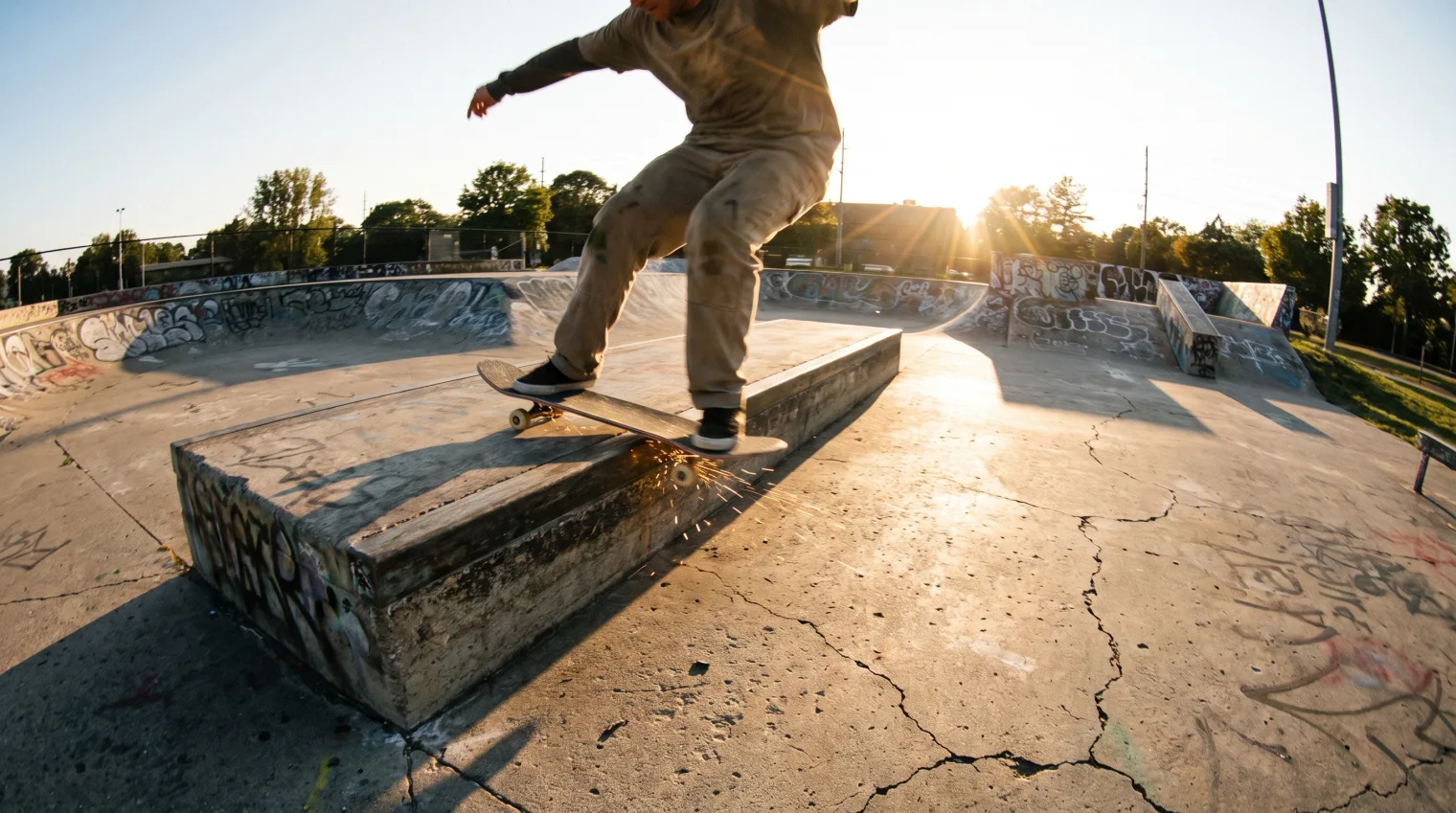
The grind progression, based on Onbolts' prerequisite data, runs: ollie, then 50-50 grind, then 5-0 grind and nosegrind in parallel, then crooked grind, then the deeper branches like smith, feeble, salad, suski, and overcrook. Every one of those tricks depends on the ones before it in the tree, not by convention but because each new grind removes a contact point or changes your weight distribution relative to the one before it. Skip a step and you're not just attempting a harder trick, you're attempting a trick your balance hasn't been trained for yet.
Here's the actual order, why it's ordered that way, and what to expect at each stage.
Step 1: Ollie, the entry ticket to every grind
Before any grind, you need a consistent ollie. Onbolts' data rates it beginner difficulty with a 1 to 4 week learning window, and it's the direct prerequisite for 50-50, the first grind in the family. The ollie is what gets your trucks up onto the ledge or rail in the first place. If your ollie height and consistency aren't there, you'll either come up short and hit the ledge with your wheels, or overshoot and land past it.
This isn't a formality. Grinding requires popping onto a raised or edged surface, which is a harder version of the same pop you use on flat ground, since you now need height, distance, and accuracy all at once. Get comfortable ollieing up onto a curb before you try to grind it.
Step 2: 50-50 grind, the foundation of the whole family
The 50-50 grind is the only beginner-difficulty grind in Onbolts' data, with a 2 to 6 week learning window and ollie as its sole prerequisite. It's called a 50-50 because your weight is split evenly, 50/50, between your front and back trucks as you slide along the ledge on both.
This is the grind every other grind in the tree traces back to. Both 5-0 grind and nosegrind list 50-50 as their direct prerequisite, which means the tree treats 50-50 as the actual gateway skill for the entire grind family, not just a nice first trick. The main thing 50-50 teaches that carries forward: locking your trucks onto the ledge on the pop, staying centered, and riding out the slide with your weight balanced.
Practical note: most riders start on a low, rounded curb or a skatepark ledge with a mellow angle before moving to anything sharper. The trick is the same everywhere, but a forgiving surface means fewer bad bails while you're dialing in the truck-lock.
Step 3: 5-0 grind, removing your front trucks from the equation
Once 50-50 is consistent, the tree splits. One branch is 5-0 grind, intermediate difficulty, 2 to 6 weeks per Onbolts' data. A 5-0 lifts the nose so only your back truck stays on the ledge, which shifts your whole weight distribution backward and demands more precise balance than the evenly-split 50-50.
The reason 5-0 comes right after 50-50 and not before it: you need to already know what a locked-in grind feels like before you try to hold that lock with half the contact points. Riders who try 5-0 before nailing 50-50 usually just slip off the ledge, because they're solving two problems (the lock and the balance) at once instead of one at a time.
Step 4: Nosegrind, the front-truck mirror of 5-0
The other branch off 50-50 is nosegrind, intermediate difficulty with a 3 to 8 week learning window, slightly longer than 5-0's window. A nosegrind is the opposite of a 5-0: your back trucks lift and only the front truck grinds. Most riders find this less intuitive than 5-0 because you're leaning your weight over the nose, further from your natural center of balance on the board.
You don't need 5-0 before nosegrind or vice versa; both branch independently from 50-50 in Onbolts' data. Some riders work on them in the same sessions since the ledge-approach mechanics are identical and only the weight shift differs.
Step 5: Crooked grind, the payoff for a solid nosegrind
The crooked grind requires nosegrind as its direct prerequisite and is rated advanced difficulty with a 2 to 5 month learning window, a real jump up from the 3 to 8 weeks of nosegrind itself. A crooked grind is a nosegrind with your board angled diagonally across the ledge instead of straight, which changes the whole feel of the lock and makes it easier to slip out if your nosegrind fundamentals aren't solid.
This is a good checkpoint for the "consistent, not just landed" rule that runs through the whole skill tree: if your nosegrind is shaky, don't expect crooked grind to go well. Get nosegrind to the point where you can hold it and control the exit before adding the angle.
Step 6 and beyond: smith, feeble, salad, suski, overcrook
From 5-0 grind, four separate advanced grinds branch out in parallel: smith grind, feeble grind, salad grind, and suski grind. Each one changes the board angle or foot position relative to a straight 5-0, similar to how crooked grind angles a nosegrind. None of these require each other, they're parallel branches off the same 5-0 base, so you can pick whichever variation appeals to you once 5-0 is consistent.
From crooked grind, the tree extends one step further into overcrook grind, which requires crooked grind directly. This is about as deep into the grind family as most street skaters go, though the pattern (lock, then remove a contact point, then angle it) keeps repeating if you push further.
Why the order actually matters
It's tempting to look at a grind you like the look of and just try it, skipping the buildup. The problem is that each step in this progression is teaching a specific sub-skill: 50-50 teaches the lock, 5-0 and nosegrind each teach single-truck balance in opposite directions, crooked grind teaches angle control on top of that balance. Skip a step and you're stacking an unlearned skill on top of another unlearned skill, which is exactly the situation that leads to slipping out mid-grind.
Onbolts tracks your status on each grind using the same 5-level scale as every other trick: learning, landed once, occasional, consistent, mastered. Treat "consistent" as your real bar for moving to the next grind in the chain, not "landed once." Check your progress dashboard to see where each grind in this chain currently sits for you.
Building slides alongside grinds
Grinds aren't the only thing you can do on a ledge. Slides, where the deck itself rides across the edge instead of the trucks, are a parallel family that also traces back to the ollie rather than to 50-50 directly. Boardslide requires only ollie, the same as 50-50 does, which means you don't have to finish the grind progression before starting on slides. Plenty of riders work both in the same sessions on the same ledge, since the approach, popping up and locking onto the edge, is close enough between a 50-50 and a boardslide that practicing one tends to sharpen the other.
That said, the actual balance mechanics diverge quickly. A 50-50 has your trucks doing the sliding, metal on the ledge, which gives a fairly forgiving, locked-in feel once you're on. A boardslide has the underside of your deck sliding, with your body positioned across the board rather than along it, which most riders find less intuitive at first. If you're deciding where to spend limited practice time, there's no wrong order here, but don't assume comfort in one automatically means comfort in the other.
What a plateau in the grind family usually means
If you've had 50-50 consistent for a while but 5-0 or nosegrind isn't clicking, the most common cause isn't lack of practice, it's rushing the entry. Both 5-0 and nosegrind ask you to balance on a single truck instead of two, and if your ollie-onto-the-ledge approach is inconsistent, you'll never get a clean enough entry to focus on the balance itself. Slow the approach down, focus on landing centered and locked before worrying about height or speed, and the single-truck balance tends to click faster once the entry stops being the variable that's failing.
A similar plateau shows up between nosegrind and crooked grind. Riders often try to add the angle before their straight nosegrind can survive a slight miscalculation in speed or pop. If crooked grind attempts are ending the same way every time, board sliding out from under you at the same point, that's usually a sign to spend another few sessions on straight nosegrinds until the lock feels automatic even when the approach isn't perfect.
Where to start today
If you can already ollie up onto a curb reliably, 50-50 is your next move. If you've had 50-50 locked in for a few weeks, pick either 5-0 or nosegrind based on which feels more natural when you try it, both are valid next steps and neither blocks the other. From there, crooked grind is the next real jump in difficulty, so give yourself the full 2 to 5 month window Onbolts' data suggests rather than rushing it.
See the full grind family and every other prerequisite chain at /tricks, or view it visually in the skill tree.
Frequently asked
- What is the correct order to learn grind tricks?
- Based on Onbolts' prerequisite data, the order is: ollie first, then 50-50 grind, then either 5-0 grind or nosegrind (both branch from 50-50), then crooked grind (which requires nosegrind), then smith, feeble, salad, or suski grind (all branching from 5-0), and finally overcrook grind (which requires crooked grind). Every grind in this chain traces back to a consistent ollie.
- Is 50-50 really the easiest grind to learn?
- Yes, according to Onbolts' data. 50-50 grind is rated beginner difficulty with a 2 to 6 week learning window, the only beginner-level grind in the dataset. Every other grind, including 5-0 and nosegrind, is rated intermediate or above, and all of them require 50-50 as a prerequisite.
- What is the difference between a 50-50 and a 5-0 grind?
- A 50-50 balances on both trucks evenly along the ledge or rail. A 5-0 grind balances only on the back truck, with the nose lifted. The 5-0 is Onbolts' data lists as intermediate difficulty with a 2 to 6 week learning window, and it requires a consistent 50-50 first, since you need the same ledge-approach and balance skill before removing half your contact points.
- How long does it take to learn a nosegrind after 50-50?
- Onbolts' data lists nosegrind at intermediate difficulty with a 3 to 8 week learning window, slightly longer than 5-0 grind's 2 to 6 weeks. Nosegrind balances on the front truck instead of the back, which most riders find less intuitive since you're leaning over the nose while approaching switch-footed relative to a 5-0.
- What comes after nosegrind in the grind family?
- Crooked grind, which Onbolts' data lists as advanced difficulty with a 2 to 5 month learning window and requires nosegrind as its direct prerequisite. From crooked grind, the tree extends further into overcrook grind. Separately, once you have 5-0 grind, that trick branches into smith, feeble, salad, and suski grinds, which are parallel advanced-difficulty tricks rather than a single line.
- Do I need a boardslide before I can grind?
- No. Grinds and slides are separate branches that both trace back to the ollie independently. Boardslide requires only ollie, and 50-50 requires only ollie. You don't need one to get the other, though many riders work on both around the same time since they share the skill of committing to a ledge.