blog-post // Jun 13, 2026
How Long Does It Take to Learn a Kickflip: An Honest Answer
Most skaters take 1 to 6 months to land a consistent kickflip. Onbolts' learning data explains what drives that range and what mistakes slow you down.
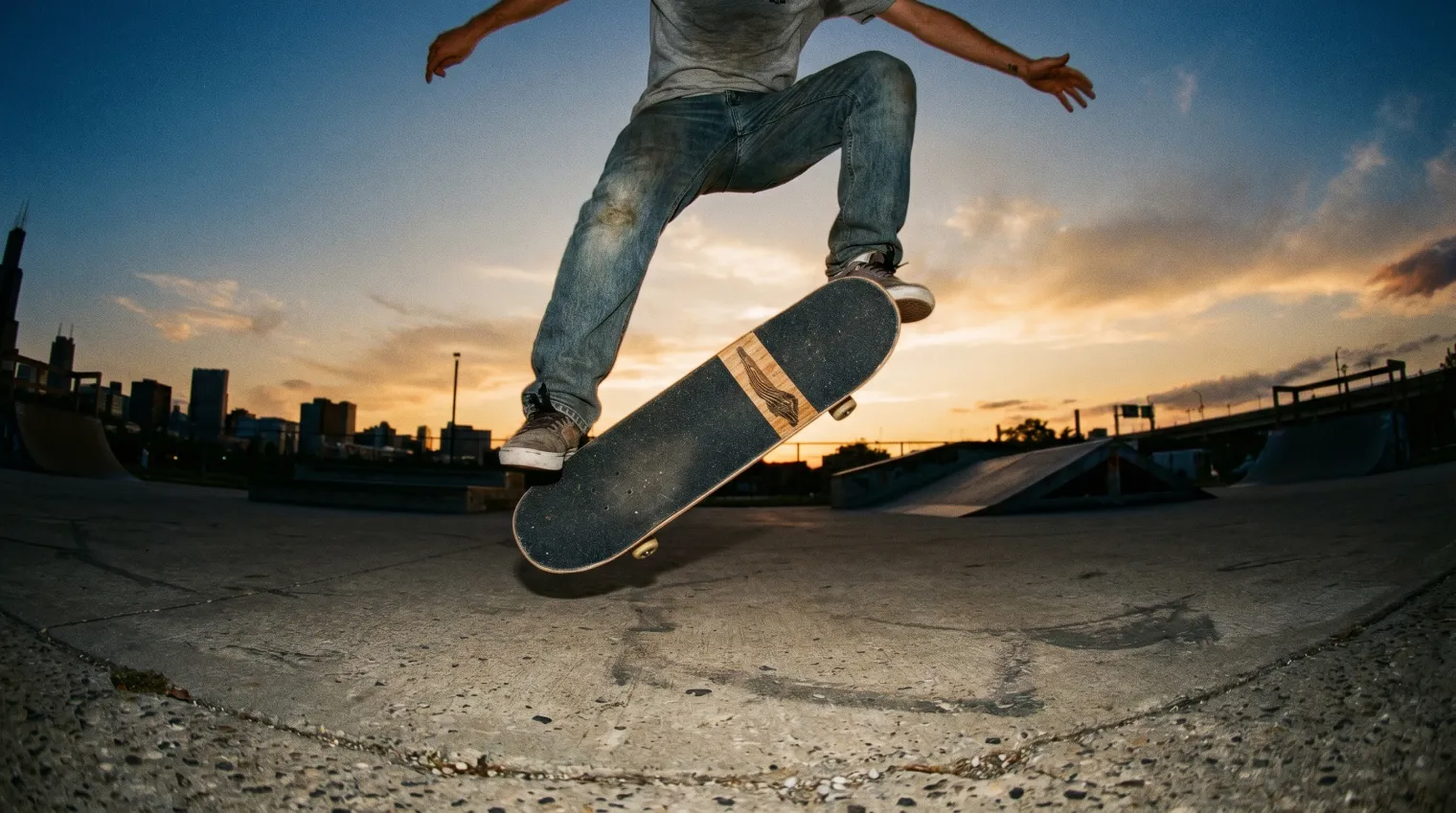
Most skaters take 1 to 6 months to land a consistent kickflip. That is not a hedge - it is what Onbolts' learning data shows, and the range is real. If you are asking this question for the first time, the honest answer depends on three things: how solid your ollie already is, how often you skate, and whether your front foot mechanics click early or late.
Why 1 to 6 months? What drives the gap?
The kickflip is rated intermediate difficulty on Onbolts. The ollie - its only prerequisite - is rated beginner with a learning time of 1 to 4 weeks. The gap between those two numbers tells you something: the kickflip is not just a harder ollie. It is a different skill sitting on top of the ollie foundation.
The pop mechanics are identical. Your back foot snaps the tail the same way it does in an ollie. What changes is what the front foot does: instead of sliding straight up toward the nose, it flicks off the toe-side edge of the board to spin it 360 degrees along its length. That flick requires muscle memory that most people do not have on day one - and building it takes time.
Skaters who already have a consistent ollie and skate 3 to 5 sessions per week typically land their first kickflip within 4 to 8 weeks. Skaters with a shaky ollie or who skate once a week can take 4 to 6 months. Both are normal.
The ollie is the prerequisite - no shortcuts
Onbolts' skill tree has one direct prerequisite for the kickflip: the ollie. This is not arbitrary. The kickflip borrows the entire pop sequence from the ollie. If your back foot snap is weak or your timing is off, you will not have enough air time for the board to complete the flip. If you are leaning back at takeoff, the board will fire forward when you add the flick.
Before you start kickflip attempts, make sure your ollie is reliable - not perfect, but consistent. You should be able to land it 7 out of 10 times on flat ground before the kickflip will cooperate.
What the 5 steps actually require
The Onbolts breakdown of the kickflip has 5 steps:
- Foot placement - Front foot lower than an ollie, about a third of the way up, toes near the toe-side edge. This position is critical: too high and you will not generate the flick.
- Pop hard - Same tail snap as your best ollie. Many beginners reduce the pop when they start trying to flip. Do not. The flip needs height to have time to complete.
- Flick the front foot - Slide up, then at the nose, snap your toes off the toe-side corner. The side of your shoe's toe catches the concave and spins the board. It is a snap, not a kick.
- Suck up your feet - Pull both feet upward so the board has room to rotate fully underneath you. Your back foot needs to come up as high as your front foot.
- Catch and land - Watch for the grip tape coming back around, then stomp both feet onto the board over the bolts.
None of these steps are complicated in isolation. The difficulty is synchronizing all five in under half a second.
The 4 mistakes that eat the most time
Onbolts tracks the most common kickflip mistakes. These four account for the bulk of stuck sessions:
Jumping forward off the board. You leap forward and the board stays behind. Cause: leaning forward to "help" the flip. Fix: jump straight up. The flip happens because of the flick, not because of your lean.
Inconsistent landings. Sometimes it works, sometimes it does not. Cause: inconsistent foot placement going into the trick. Fix: before every attempt, physically look at your front foot and confirm the position.
Board not completing the flip. The board only does a half rotation. Cause: the flick is too early or too weak. Fix: delay the flick slightly - wait until your foot has slid all the way to the nose before snapping off.
Board flipping at an angle. The board spins diagonally. Cause: the flick is going sideways instead of along the board's length. Fix: flick directly off the toe-side corner, not across the board.
If you are stuck on any of these, the fix is repetition of that specific sub-motion, not more full attempts.
How many sessions are realistic?
A useful way to think about learning time is in sessions, not calendar weeks. If you skate three times per week for 90 minutes and dedicate 30 minutes of each session to kickflip attempts, you are putting in roughly 90 minutes of focused practice per week.
At that rate:
- First shuv-it style half-flip: likely in week 1 or 2
- Board going over your feet occasionally: weeks 2 to 4
- First landed kickflip: weeks 4 to 12 for most skaters
- Consistent kickflips (7 out of 10): 3 to 6 months from first attempts
If you skate once a week, scale these numbers up by 3x. If you skate every day, scale down.
What "consistent" actually means
Landing a kickflip once is not the milestone. On Onbolts' 5-level skill scale, the stages are: learning, landed once, occasional, consistent, and mastered. Reaching "occasional" (landing it sometimes) is the first real proof-of-concept. Reaching "consistent" - landing it reliably - is what unlocks tricks that depend on the kickflip.
The jump from "occasional" to "consistent" often takes as long as getting the first land. Do not be surprised if you land your first kickflip in week 6 and are still inconsistent at month 3. That is the normal curve.
What comes after the kickflip
Once the kickflip is consistent, Onbolts' skill tree points to two main directions: the heelflip (intermediate, 1 to 4 months estimated) and eventually the tre flip (advanced, 6 to 18 months). The heelflip mirrors the kickflip in the opposite direction and most skaters find one or the other clicks faster based on their style.
The short version
If you already have a consistent ollie and skate regularly, budget 1 to 3 months to your first reliable kickflip. If your ollie is still shaky or you skate once a week, budget 3 to 6 months. Neither timeline makes you slow - they reflect the actual difficulty of the trick.
The kickflip is genuinely one of skateboarding's hardest beginner-to-intermediate jumps. Respect the timeline and diagnose mistakes rather than grinding through hundreds of failed attempts without changing anything.
Track where you are in the progression and log your practice on Onbolts.
Frequently asked
- How long does it take to learn a kickflip?
- Onbolts' learning data estimates 1 to 6 months for most skaters. The wide range reflects session frequency, whether the ollie is already consistent, and individual body mechanics. Skaters who train 3 to 5 times per week and already have a solid ollie typically land their first kickflip within 4 to 8 weeks.
- Do you need a consistent ollie before learning a kickflip?
- Yes. The ollie is the only direct prerequisite for the kickflip in Onbolts' skill tree. The kickflip uses the same pop mechanics - your back foot snaps the tail identically. The difference is entirely in what the front foot does. If your ollie is shaky, the kickflip adds a second variable (the flick) on top of an unstable base.
- Why do some people learn kickflips faster than others?
- Three factors drive the gap: how solid the ollie already is (a stronger ollie gives the board more air time for the flip to complete), front foot flexibility and flick precision, and session volume. Skaters putting in 5 hours per week consistently reach their first landed kickflip faster than those skating once a week for the same calendar time.
- What are the most common reasons a kickflip is not landing?
- The four most common mistakes in the Onbolts database are: jumping forward off the board (fix: jump straight up), inconsistent foot placement (fix: physically check front foot position before every attempt), the board only half-flipping (fix: delay the flick until the foot reaches the nose), and the board flipping at an angle (fix: flick directly off the toe-side corner, not across the board).
- Is the kickflip harder than the ollie?
- Yes. The ollie is rated beginner difficulty with an estimated learning time of 1 to 4 weeks. The kickflip is rated intermediate with an estimated 1 to 6 months. Both tricks share the same pop mechanics - the extra difficulty comes entirely from the front foot flick and the timing required to catch a spinning board.
- What should I learn after the kickflip?
- Onbolts' skill tree points to the heelflip (1 to 4 months, intermediate) as the natural next step - it mirrors the kickflip motion in the opposite direction. The tre flip (6 to 18 months, advanced) also branches from the kickflip but requires a pop shove-it to be solid first.