blog-post // Jun 14, 2026
How Long Does It Take to Learn an Ollie: What the Data Says
Onbolts' learning data puts the ollie at 1 to 4 weeks for most beginners. Here is what affects that range, which mistakes extend it, and what comes after.
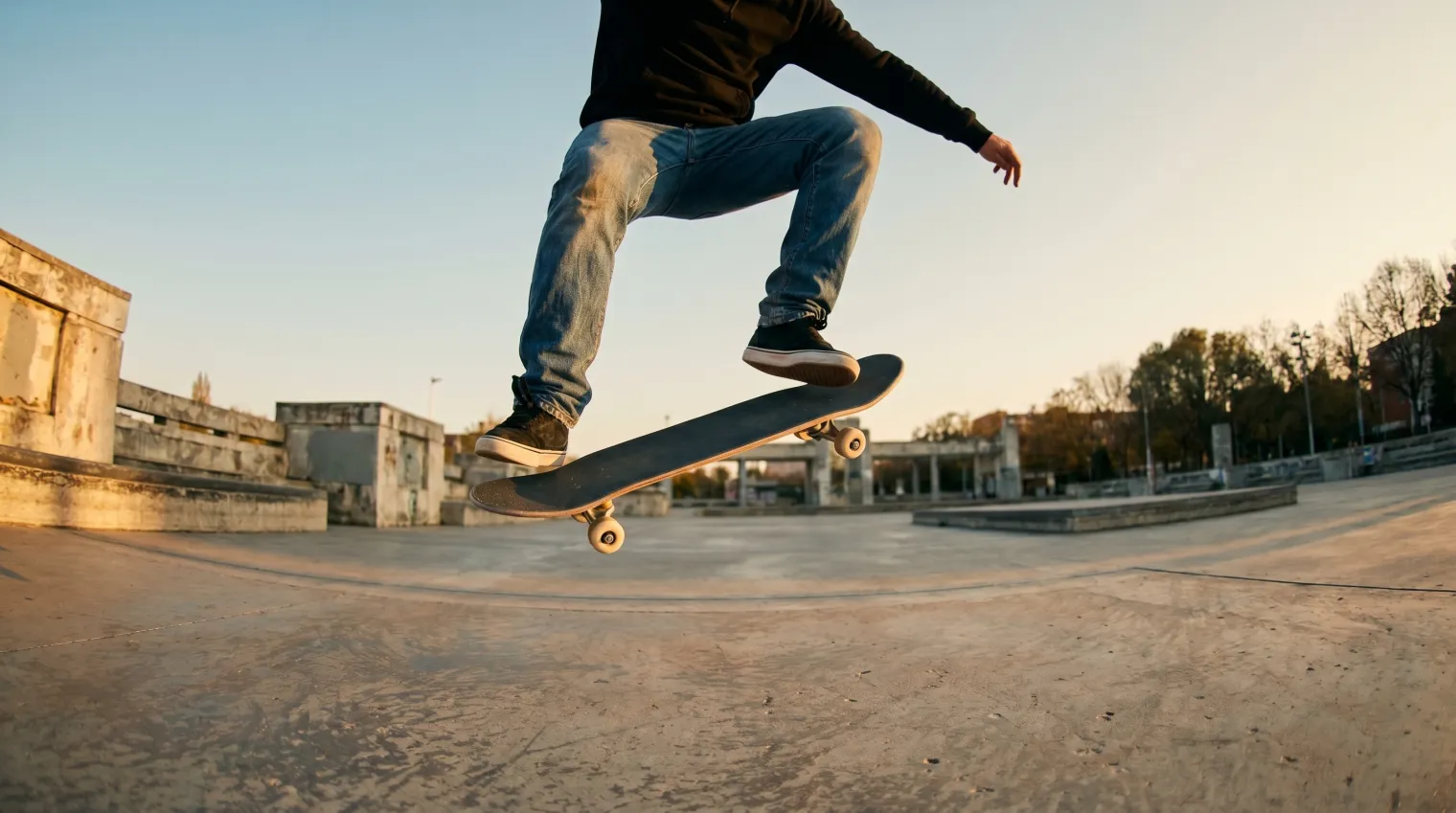
The ollie takes 1 to 4 weeks for most beginners who skate 3 to 5 times per week. That is Onbolts' estimated learning time for the trick, and it lines up with how most people describe their own experience when they are honest about their practice frequency.
If you skate once a week, that window stretches to 1 to 3 months for the same milestone. The trick does not get harder - the learning time just scales directly with practice hours.
Why the ollie is where every skater starts
The ollie is the first trick on Onbolts' skill tree and the prerequisite for nearly everything else in street skating. Its beginner difficulty rating reflects that the mechanical concept is simple: snap the tail, jump, slide the front foot, land. But "simple" does not mean instant. The ollie asks you to synchronize three separate motions in under half a second, all while staying centered over a moving board.
For most people, the coordination challenge is bigger than the strength or fitness challenge. The ollie does not require much power. It requires timing.
What the 5 steps actually demand
Onbolts breaks the ollie into 5 steps:
- Foot placement - Back foot centered on the tail, ball of your foot over the edge for maximum snap leverage. Front foot at roughly 45 degrees just below the front bolts.
- Bend your knees - Crouch and load your legs. Weight centered, not leaning back. Spine vertical the whole time.
- Snap and jump - Slam the tail into the ground with your back foot while jumping straight up. The pop happens before your feet fully leave the ground - it is a stomp first, then a jump.
- Slide your front foot - As the board rises, slide the front foot diagonally toward the nose. You are dragging the board up with your sole - think "scrape up," not kick.
- Level out and land - At peak height, both feet should be over the bolts with the board level. Absorb the landing by bending your knees.
The step that takes the most time for most beginners is step 4. The slide feels unnatural. You are fighting the instinct to kick or jump away from the board instead of staying over it.
The 4 mistakes that extend the timeline
Onbolts tracks which mistakes appear most often during the ollie learning phase. These four show up consistently:
Crooked landing. The board rotates slightly and you land at an angle. Cause: front foot dragging off-center, or your shoulders rotating during the pop. Fix: keep shoulders square to the board and practice looking straight down at it.
No height. The board barely leaves the ground. Cause: weak tail snap, or the snap and jump are out of sync. Fix: practice the pop motion alone - just snap the tail rhythmically without jumping. This builds the muscle memory for a sharp, committed snap.
Board shooting forward. The board fires out in front of you on landing. Cause: jumping backward instead of straight up, or weight shifted back during the pop. Fix: spot a target on the ground and aim to land on the exact spot you took off from.
Landing on the tail. The nose dips and you land only on the tail. Cause: the front foot did not slide far enough, or you leaned back at takeoff. Fix: focus on sending the front foot all the way to the nose screws. Practice on carpet first to slow down the motion.
If your timeline is extending past 4 weeks with regular practice, one of these four is almost certainly the culprit. The fix is to diagnose which one and isolate it.
How to structure your practice sessions
A common mistake is spending an entire session on one failed attempt after another without isolating what is going wrong. A more efficient structure:
- First 10 minutes: stationary pop practice (no jumping, just snapping the tail to build the reflex)
- Next 20 minutes: full attempts, focusing on one specific fix if you know what is going wrong
- Last 10 minutes: rolling attempts at comfortable speed
At 3 to 5 sessions per week with this structure, most beginners hit their first consistent stationary ollie within 2 weeks and a rolling ollie within another week or two.
Stationary vs rolling: when to switch
Learn stationary until you are landing 7 out of 10 consistently, then move to rolling immediately. Do not stay stationary for weeks trying to perfect it. Rolling actually helps with one of the most common stationary mistakes (board shooting forward) because the momentum carries the board with you.
Most skaters find their ollie gets cleaner once they add speed. Push at a comfortable pace - not slow, not fast - and the timing often clicks faster than it did standing still.
What "learning the ollie" actually means
There are different definitions of "learned." Landing it once is not the milestone. On Onbolts' 5-level scale, the stages are: learning, landed once, occasional, consistent, and mastered.
For the ollie, "consistent" means landing it reliably while rolling, not just on flat ground in your driveway. Getting from "occasional" to "consistent" typically takes 1 to 2 additional weeks beyond the first land. That is the real milestone - the one that unlocks the tricks that follow.
What the ollie unlocks
Once the ollie is consistent, three direct paths open up on the skill tree. The pop shove-it (beginner, 1 to 3 weeks) is the fastest next win - it uses the same pop with your back foot adding a spin. The frontside 180 (beginner, 2 to 5 weeks) adds a body rotation. The kickflip (intermediate, 1 to 6 months) is the bigger milestone and the most searched trick on Onbolts.
Those three tricks represent different directions in the skill tree: shove-its lead to board spins and eventually varial tricks; 180s lead to all of the body-rotation tricks; kickflips open the flip trick branch.
The honest summary
If you skate 3 to 5 times per week and put in focused practice, the ollie takes 1 to 4 weeks. If you skate once a week, plan for 1 to 3 months. If you are past 4 weeks with regular sessions and still stuck, diagnose the specific mistake - do not just keep repeating full attempts.
The ollie is beginner difficulty but that does not mean it is instant. Every skater who goes on to land kickflips, boardslides, and grabs started in the same place: trying to figure out why the board keeps shooting forward. Give it the time it actually needs.
Track your progress and see what comes next on the skill tree at Onbolts.
Frequently asked
- How long does it take to learn an ollie?
- Onbolts' learning data estimates 1 to 4 weeks for most beginners skating 3 to 5 times per week. Skaters who only get on a board once a week can take 1 to 3 months for the same outcome. The ollie is the first trick in the skill tree rated as beginner difficulty.
- What makes the ollie take longer for some people?
- Three things stretch the timeline: how often you skate (session volume is the biggest factor), whether you are practicing stationary or rolling (rolling makes the ollie work differently and adds a timing challenge), and weight distribution habits (leaning back at takeoff - the most common mistake - can persist for weeks if you do not diagnose it early).
- What are the main steps to learning an ollie?
- The Onbolts breakdown has 5 steps: (1) foot placement - back foot centered on the tail, front foot at 45 degrees below the front bolts; (2) bend your knees, weight centered; (3) snap the tail and jump simultaneously; (4) slide the front foot diagonally toward the nose to level the board; (5) land over the bolts with bent knees.
- What is the most common ollie mistake?
- Leaning back at takeoff. This kills height and causes the nose to dip on the way down. The fix is to keep your weight centered over the board - imagine your spine staying vertical throughout the pop. The second most common mistake is weak tail snap: the board barely leaves the ground. Practice the pop motion alone, without jumping, to build the muscle memory.
- Should I learn the ollie stationary or while rolling?
- Learn stationary first until the motion is consistent (landing 7 out of 10), then immediately move to rolling. The stationary ollie and the rolling ollie use the same mechanics, but skating with momentum prevents the board from shooting forward on landing - one of the most common stationary mistakes. Most skaters find their ollie actually gets cleaner once they add speed.
- What should I learn after the ollie?
- The Onbolts skill tree shows three direct next tricks from the ollie: the pop shove-it (beginner, 1 to 3 weeks estimated), the frontside 180 (beginner, 2 to 5 weeks estimated), and the kickflip (intermediate, 1 to 6 months estimated). Pop shove-it is the fastest next win; kickflip is the bigger milestone.