blog-post // Jul 16, 2026
Kickflip Fundamentals: What Most Beginners Get Wrong
The kickflip takes most skaters 1-6 months per Onbolts' learning data. Here are the flick, pop, and catch mistakes that stretch that timeline out.
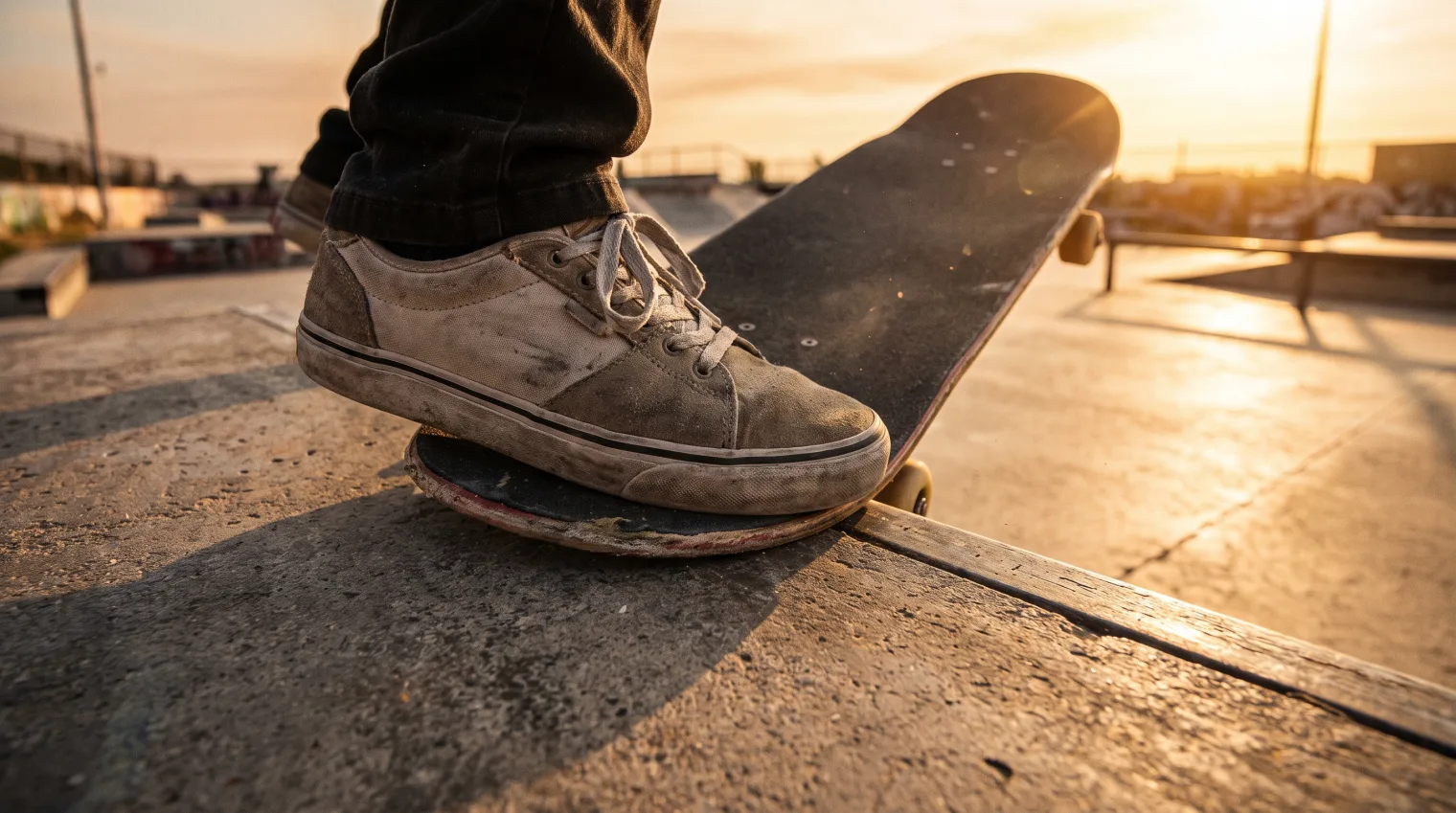
The kickflip takes most riders 1 to 6 months to land consistently, according to Onbolts' learning data, and nearly all of that spread comes from three fixable habits: flicking too hard, catching too early, and skipping ollie repetition before adding the flip. If you've been stuck at "board flips but I bail the landing" for weeks, you're not behind. You're hitting the same wall almost everyone hits.
The kickflip sits at an intermediate difficulty on the skill tree, right after the ollie, which is its only hard prerequisite. That's not a formality. The kickflip is really an ollie with a flick layered on top, and if the ollie part isn't automatic yet, your brain is trying to solve two new problems at once instead of one.
The three mistakes that stretch out the timeline
Flicking too hard. New skaters treat the flick like it needs force. It doesn't. The flip comes from your front foot dragging off the edge of the board in a quick, controlled motion, not from kicking the nose sideways. Too much force sends the board spinning past a clean 360 and out from under you before your feet can catch up.
Catching before the rotation finishes. This is the single biggest time-sink in Onbolts' data on this trick. You pop, the board starts flipping, and your instinct is to jump toward it immediately. But the board needs to complete its full rotation first. Watch it. If you're catching blind, you're catching early.
Skipping ollie reps. If your ollie height and pop are inconsistent, every kickflip attempt is really two experiments at once: can I pop right, and can I flick right. Isolate the variables. Spend a session just popping ollies until the height and snap feel boring and automatic, then add the flick back in.
Break the trick into three checkpoints
Rather than grading each attempt pass or fail, check three things separately:
- Pop: is your back foot popping the tail the same way it does on your ollie, with your front foot starting its drag at the same moment?
- Rotation: is the board completing a full flip, or stalling out sideways (usually a sign the flick came from the ankle instead of dragging the whole foot)?
- Catch: are your feet meeting the board after it's flat again, or while it's still mid-spin?
Most riders are failing at only one of these three, but because a kickflip happens in under a second, it feels like everything is going wrong at once. Slowing it down mentally into pop, rotation, catch is the fastest way to isolate which piece needs the actual work.
Foot position matters more than people admit
Your front foot needs to sit at an angle across the board, usually just behind the front bolts, with your toes hanging slightly off the edge near the middle of the deck. Too far forward and you can't get a clean flick. Too far back and you're fighting the pop instead of helping it. Small adjustments here (half an inch either way) change the whole feel of the trick, so if you've been stuck at the exact same spot for two weeks, check your foot placement before you assume it's a flick problem.
Your back foot matters just as much, even though it gets less attention. It should sit on the tail with your heel hanging slightly off the back edge, angled so the pop drives straight down rather than off to one side. A back foot that's too far forward on the tail robs you of leverage, which shows up as a weak, low pop that doesn't give the board enough time in the air to complete a full rotation before you're already coming back down.
Speed changes the trick more than beginners expect
A kickflip attempted from a dead stop behaves differently than one attempted while rolling. Standing still, your body has nothing to work with, so most of the trick's height and rotation has to come purely from your legs. Rolling at a moderate pace gives you a small amount of natural lift and momentum that makes the pop easier to time and the catch easier to land back into a rolling stance. If you've only ever tried kickflips standing still, moving to a slow roll is often the single biggest unlock available, even though it feels like it should make things harder.
The mental side of a plateau
Most riders hit at least one stretch where nothing seems to be working, often somewhere in the middle of that 1-to-6-month window. This is usually when people start second-guessing fundamentals that were already fine, changing stance width, board setup, or even their whole approach, when the actual issue is one specific habit repeating attempt after attempt. Before making a big change, go back to filming and isolate exactly which of the three checkpoints above is failing most often. A plateau is almost always one specific, nameable problem, not a sign the whole approach needs to change.
Board setup can quietly work against you
Wheel size, deck width, and how loose or tight your trucks are set all affect how a kickflip feels. Looser trucks make the board easier to flip but harder to control on landing, while tighter trucks give you more stability but demand a slightly stronger flick. If you're riding a setup borrowed from someone else, or a board noticeably wider or narrower than what you learned to ollie on, it's worth ruling out setup as a factor before assuming the problem is purely technique. This is a secondary check, not a first move: most kickflip struggles come down to technique, not equipment, but it's a quick thing to eliminate if you've addressed everything above and you're still stuck.
Filming yourself is not optional
Everyone thinks they know what their kickflip looks like. Almost nobody does. Film from the side, at board height if you can manage it, and watch in slow motion. You'll usually spot the actual issue (early catch, weak flick, back foot popping off-center) within a few clips. This is the fastest debugging tool available and it costs nothing.
Watch specifically for where your eyes are during the flip. A lot of beginners look down at their feet the instant they pop, which means they're not actually watching the board rotate and are reacting on pure guesswork. Keeping your eyes on the board, not your feet, is a small adjustment that noticeably speeds up how fast the catch timing clicks into place.
What comes after the kickflip
Once you're landing kickflips consistently, the Onbolts skill tree opens up two natural next steps: the heelflip, which uses a similar flick mechanic off the opposite edge, and eventually the tre flip, which requires both the kickflip and the pop shove-it as prerequisites. The kickflip is one of the more connected nodes in the flatground branch of the tree precisely because the flick-and-catch skill it teaches transfers to a lot of what comes next.
Track it instead of guessing at progress
Onbolts uses a 5-level scale for every trick: learning, landed once, occasional, consistent, and mastered. Landing one kickflip is a real milestone, but it isn't the same as having it in your bag. Logging where you actually are on that scale (rather than mentally rounding up after one clean clip) gives you an honest read on when you're ready to move to the next trick, and the progress dashboard tracks that over time instead of relying on memory.
When to actually move on
A common mistake is chasing a second or third trick before the first is consistent. If you're at "landed once" on the kickflip, that's not the moment to start splitting practice time with the heelflip. Get to "occasional" at minimum, ideally "consistent," before you divide your attention. The skill tree is built around this idea: prerequisites aren't checkboxes, they're skills the next trick actually depends on.
It also helps to separate "I can do this on a good day" from "I can do this on command." A lot of riders land a kickflip once during a great session, feel like they've arrived, and then go weeks without landing another. That gap between one clean clip and real consistency is exactly what the 5-level scale is designed to make visible instead of letting it hide behind a single highlight.
Watching tutorials with intent
Generic "how to kickflip" videos are everywhere, but the useful ones focus on one specific failure mode at a time; catch timing, flick angle, foot placement, rather than a full narrated walkthrough. Browse the video library and look for breakdowns that match the specific mistake you're seeing on your own film, not just the highest view count.
If you're just getting into flip tricks, start with the full tricks list to see where the kickflip sits relative to everything else on flatground, and build from there.
Frequently asked
- How long does it take to learn a kickflip?
- Onbolts' learning data puts the kickflip at 1-6 months for most riders, which is the widest range on the beginner-to-intermediate part of the skill tree. The spread comes down almost entirely to how solid your ollie is before you start flicking, and how much you practice the flick motion off the board.
- Do I need to be able to ollie before I try a kickflip?
- Yes. The kickflip's only prerequisite on the Onbolts skill tree is the ollie, and it is a hard requirement, not a suggestion. Your back foot needs to pop consistently without you thinking about it, because a kickflip adds a flicking front foot on top of an ollie you should already have on autopilot.
- Why does my board flip but I land on the griptape wrong?
- This is almost always a catch problem, not a flip problem. Beginners watch the board flip and get excited, then jump their feet toward where the board WAS instead of tracking where it's going to be. Slow the whole motion down and watch the board complete its full rotation before your feet commit.
- Should I learn kickflip or heelflip first?
- Kickflip first is the more common path and the one Onbolts' skill tree defaults to, since heelflip technique often gets compared against it. Both only require the ollie as a prerequisite, so there is no hard sequencing rule, but most riders find the kickflip's flick motion (dragging the front foot off the toe edge) a little more intuitive to isolate than the heelflip's heel-drag.
- What tricks does the kickflip unlock?
- On the Onbolts tree, landing a consistent kickflip opens up the heelflip and the tre flip as next suggestions, and it's also a hard prerequisite (alongside the pop shove-it) for the tre flip specifically. It's one of the most connected nodes in the whole flip-trick branch.
- Why do I keep sliding off the board (Peter Pan-ing)?
- That's a scoop problem. If your back foot pops too hard and too far back without your front foot dragging along for the flick, you launch off the tail and the board shoots forward without you. Shorten your pop, and make sure your front foot's flick starts before the board has fully left the ground.