blog-post // Jul 19, 2026
Should You Learn Tricks Stationary or Moving: The Honest Answer
Learn the motion stationary first, then move to rolling as soon as you land it consistently. Waiting too long to add speed is a common way beginners stall.
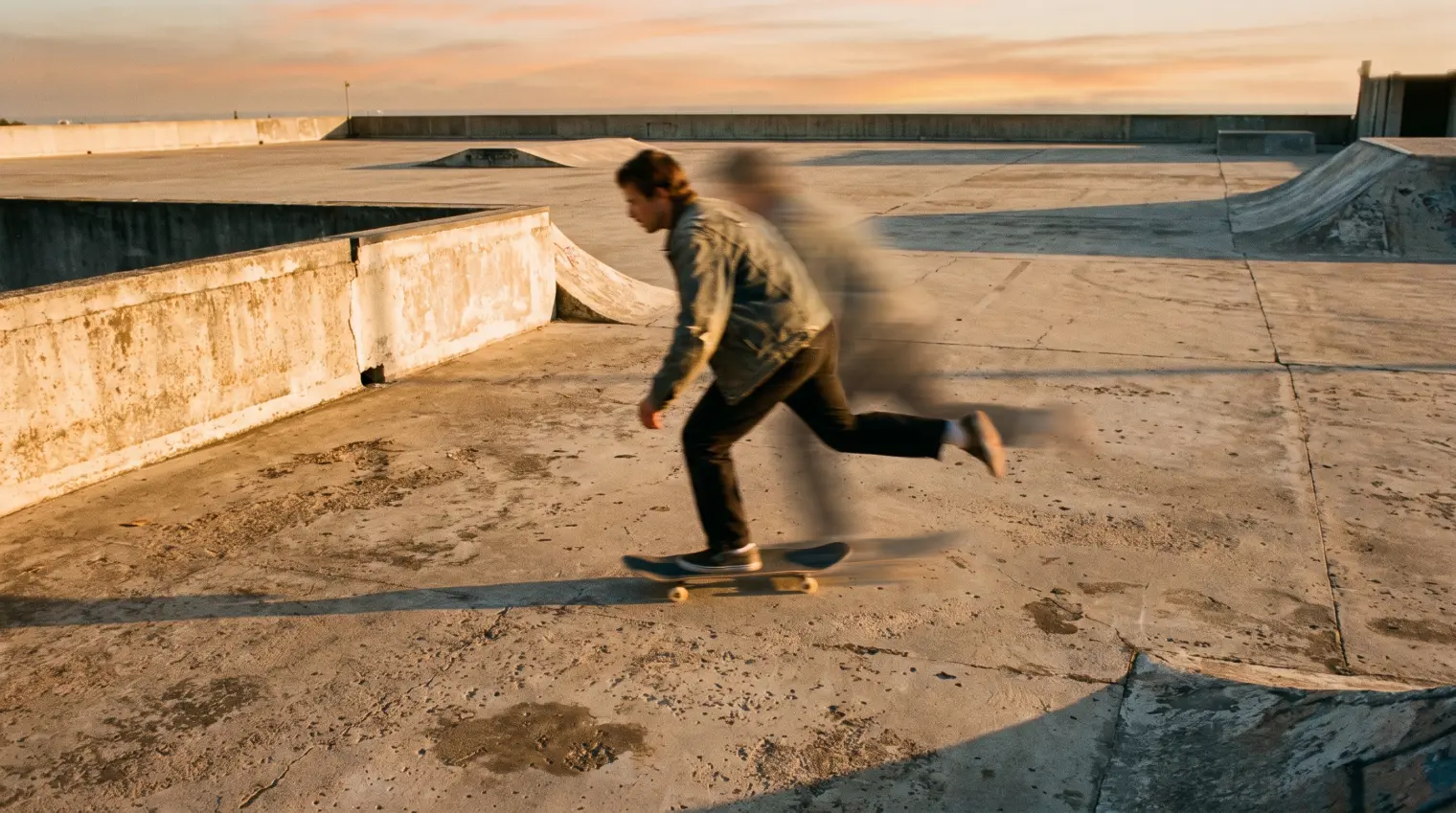
Learn the motion stationary first, then move to rolling as soon as you are landing it consistently, not after you have "perfected" it. Waiting too long to add speed is one of the most common ways beginners stall out on a trick they have technically already learned.
This question comes up constantly, and the honest answer is that it depends on the trick, but the general pattern holds across almost everything on the skill tree: stationary practice teaches the motion, rolling practice teaches the trick. Skipping either stage causes predictable problems.
Why stationary practice exists at all
Standing still removes one variable: momentum. When you are not rolling, you do not have to worry about your speed carrying the board out from under you, and you can isolate the actual mechanics of the pop, flip, or slide without the added complexity of balance-while-moving. This is why almost every tutorial, including the ones on Onbolts, teaches the ollie stationary first: it lets you build the muscle memory for the snap-jump-slide sequence without also learning to ride at the same time.
Stationary practice is faster for building the raw motion. Most beginners hit a consistent stationary ollie inside the first one to two weeks of a 1 to 4 week overall learning window.
Why staying stationary too long backfires
Here is the part tutorials rarely explain clearly: some of the most common trick mistakes are easier to fix while rolling, not harder. The board shooting out forward on landing, one of the most frequently logged mistakes on the ollie, often improves once you add rolling speed, because the forward momentum absorbs some of the energy that would otherwise send the board flying. Skaters who stay stationary for too long, trying to get a "perfect" static ollie, sometimes find that their rolling attempts still feel foreign weeks later, because they never practiced the balance-while-moving piece at all.
The rule of thumb: once you are landing a trick 7 out of 10 attempts stationary, move to rolling immediately. Do not wait for 10 out of 10.
Tricks where rolling is not optional
Some tricks cannot really be learned stationary in any meaningful way, because the trick's mechanics depend on momentum. A boardslide (intermediate, 2 to 6 weeks estimated) or any 50-50 grind (beginner, 2 to 6 weeks estimated) requires approach speed to lock onto a ledge or rail; there is no stationary version that teaches the actual balance you need mid-slide. For these, stationary practice is limited to rehearsing the pop and the foot placement on flat ground, with the real learning happening only once you are rolling at an obstacle.
The manual (beginner, 2 to 6 weeks estimated) sits in an interesting middle ground: you can practice the balance point stationary, rocking on your back wheels, but a rolling manual is a meaningfully different skill because you are also managing your line and speed at the same time.
Tricks where stationary practice does most of the work
Flip tricks and pop tricks on flat ground benefit the most from stationary drilling, because the core skill is a repeatable motion rather than a balance-over-time skill. The kickflip (intermediate, 1 to 6 months estimated) and the pop shove-it (beginner, 1 to 3 weeks estimated) both reward isolating the pop and flick stationary until it is consistent, because the flip mechanics themselves do not change much with speed. What changes with speed is your ability to react and adjust your body position on landing, which is a separate skill layered on top.
A practical session structure
For most flat-ground tricks, a session that mixes both stages tends to progress faster than a session that is entirely one or the other:
- Warm-up stationary reps to reset the motion, especially after a few days off the board
- The bulk of the session rolling, at a comfortable and consistent speed, not maximum speed
- A few stationary reps at the end if something specific broke down (foot slipping, weak pop) to isolate and fix it
Rolling at a consistent, moderate speed is more useful than rolling fast. Speed variation adds a variable you do not need while you are still learning the core motion.
What "moving" needs to mean
Rolling does not mean bombing a hill. For nearly every flatground trick on Onbolts, a slow, controlled push-and-glide speed, the kind you would use just cruising down a driveway, is enough to get the balance benefits of momentum without adding real risk. Beginners sometimes assume rolling practice means going fast, then avoid it because it feels unsafe. It does not need to be fast to work.
How this connects to weight distribution
Stationary and rolling practice expose different weight distribution habits. Stationary, you will notice if you lean back at takeoff because there is no forward momentum to mask it. Rolling, you will notice if you are drifting your weight forward or backward relative to your line of travel, a different failure mode entirely. Skaters who only ever practice one mode often have a blind spot for the mistakes that only show up in the other.
Why "I can do it stationary but not rolling" is not a contradiction
A lot of beginners treat this gap as confusing or even discouraging, as if landing something stationary but failing it rolling means they have not really learned it. That framing is not accurate. Stationary and rolling are different skills that share a mechanic, not the same skill in two settings. Landing a stationary ollie proves you have the pop, the timing, and the foot slide down. It does not prove you can hold your balance while your body and the board are both already in motion before the trick even starts.
This is closer to the difference between hitting a target while standing still versus hitting the same target while walking. The core motion (the swing, the throw, the pop) barely changes, but coordinating it with your own movement is a separate layer of difficulty that stationary practice cannot teach, because stationary practice removes that layer on purpose.
Understanding this gap matters because it changes how you respond to it. If your rolling attempts are failing in a completely different way than your stationary ones (for example, stationary problems were height-related but rolling problems are balance-related), that is expected, not a sign you regressed. Keep the stationary reps as a warm-up, but put most of your session time into rolling once the stationary version is consistent, since that is where the actual remaining skill gap lives.
What the estimated learning-time windows already assume
Onbolts' estimated learning-time windows, like 1 to 4 weeks for the ollie or 1 to 3 weeks for the pop shove-it, are built around a normal mix of stationary and rolling practice, not stationary practice alone. A skater who only ever practices stationary and never transitions to rolling will not fit inside those windows, because the rolling component is not optional overhead, it is part of what the estimate is measuring. If your timeline is running long, checking whether you have spent meaningful time rolling, not just stationary, is often the fastest diagnostic before assuming the trick itself is the problem.
When to go back to stationary after you have moved on
If a trick that was working while rolling suddenly falls apart, for example after switching boards or coming back from time off, a quick return to a few stationary reps is a fast way to check whether the core motion is still there before troubleshooting the more complex rolling version.
The honest answer
Start stationary to build the motion. Move to rolling as soon as you are landing it most of the time, not after you feel it is flawless. For tricks that require momentum (slides, grinds, moving manuals), treat stationary practice as a warm-up for the footwork, not a substitute for the real thing. The tricks that stall out the longest are almost always the ones where a skater stayed stationary far past the point it was still helping.
Log your reps and rate your progress from learning to mastered on any trick page, and see what is next on the skill tree once a trick moves from occasional to consistent. Full list of tricks to work through: Onbolts tricks.
Frequently asked
- Should I learn the ollie stationary or rolling?
- Learn it stationary first until you are landing it 7 out of 10 attempts, then move to rolling right away. The ollie (beginner, 1 to 4 weeks estimated on Onbolts) uses the same mechanics in both cases, but rolling often fixes one of the most common mistakes, the board shooting forward on landing, because momentum absorbs some of that energy.
- Can every trick be learned stationary?
- No. Tricks that depend on momentum, like the 50-50 grind (beginner, 2 to 6 weeks estimated) or the boardslide (intermediate, 2 to 6 weeks estimated), cannot really be learned stationary in any meaningful sense. You can rehearse the pop and foot placement standing still, but the actual balance-on-a-moving-obstacle skill only develops while rolling at speed.
- Does rolling practice need to be fast?
- No. For nearly every flatground trick, a slow, controlled push-and-glide speed is enough to get the balance benefits of momentum. Beginners sometimes assume rolling practice means going fast, then avoid it out of caution. It does not need to be fast to be effective.
- How long should I stay in the stationary phase before adding speed?
- Until you are landing the trick consistently, roughly 7 out of 10 attempts, not until it feels flawless. Staying stationary far past that point is one of the most common reasons a trick that looked 'learned' on flat ground still feels foreign the first time a skater tries it rolling.
- Why does a trick sometimes fall apart when I add rolling speed?
- Rolling introduces a new variable: balancing while your line of travel and your board's momentum are both changing. If a trick was only ever practiced stationary, that balance-while-moving skill simply has not been built yet. It is not that the trick was learned wrong, it is that one stage of practice was skipped.
- Is the manual different from other tricks in terms of stationary vs rolling?
- Yes. The manual (beginner, 2 to 6 weeks estimated) can be practiced stationary to build the balance point, but a rolling manual is a meaningfully different skill because you are managing your line and speed at the same time as the balance itself. Both stages matter here more than for a typical pop trick.