blog-post // Aug 5, 2026
The Hardflip Explained: Why It Breaks What You Learned From Kickflip
Hardflip fuses a kickflip's flip with a frontside shove-it's rotation. Onbolts rates it advanced, with an estimated learning time of 4–12 months.
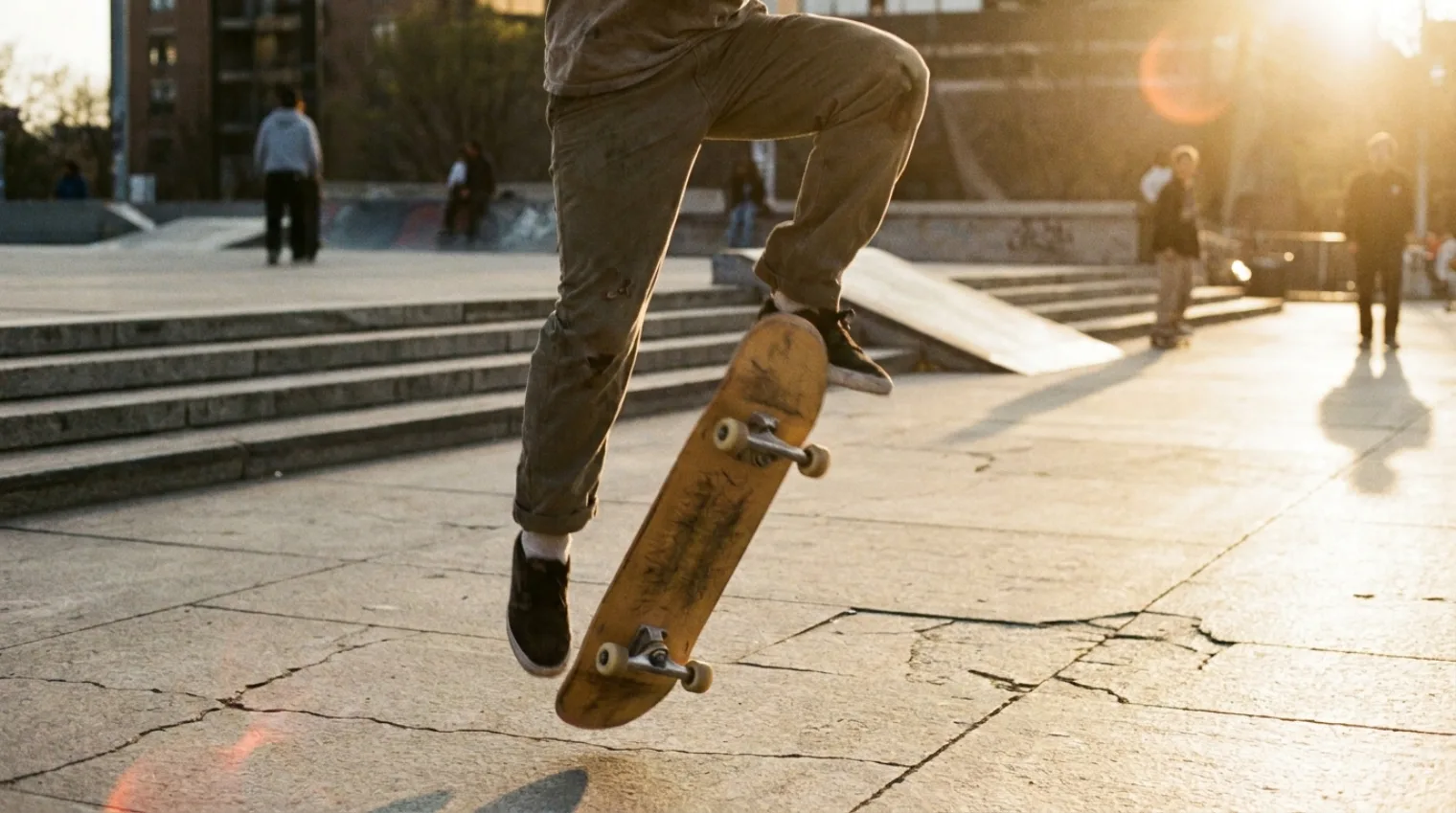
A hardflip is not a scaled-up kickflip. It fuses a kickflip's flip motion with a frontside shove-it's rotation, and that fusion is exactly why solid kickflip skaters still get stuck on it for months. Onbolts rates hardflip as advanced, with an estimated learning time of 4–12 months. Its two prerequisites on the skill tree are kickflip and frontside shove-it, and both are locked in for a reason you feel the moment you try to combine them.
What a hardflip asks your body to do
A kickflip flips the board along its long axis: a scoop off the front foot sends it spinning nose over tail. A frontside shove-it rotates the board 180 degrees flat, popped off the back foot, with no flip at all. A hardflip asks for both at once, and that single sentence is the whole difficulty spike.
Your front foot still does kickflip-style work, dragging up and off the edge of the board to start the flip. Your back foot, meanwhile, is doing frontside shove-it work: popping and scooping the tail so the board rotates frontside underneath the flip. Both motions have to start together and resolve together. Get the timing wrong and the board either flips clean without rotating, which looks like an overcomplicated kickflip, or rotates without fully flipping, which looks like a shove-it that stalled halfway.
Why kickflip habits work against you here
This is the part that trips up strong kickflip skaters specifically. Kickflip muscle memory tells your front foot to do all the work and your back foot to just pop straight up and out of the way. Hardflip needs your back foot to actively scoop the tail around, frontside, at the same time the front foot is flipping. Skaters who lean too hard on kickflip habit end up flipping the board cleanly but landing on it facing the wrong way, or catching it mid-rotation but barely flipped.
The adjustment that works, and it holds up across a lot of skater accounts: isolate the frontside shove-it half first until the rotation is automatic on its own, then reintroduce the kickflip flip on top of it. Trying to relearn both halves simultaneously from a kickflip starting point is why this trick burns through so many sessions with no visible progress.
Does your setup change anything?
Hardflip doesn't require different equipment than kickflip or frontside shove-it, but a stance that's a little too narrow makes the frontside shove-it half of the trick harder to generate, since there's less leverage for the back foot to scoop the tail through a full rotation. If your frontside shove-it already feels cramped on its own, that's worth fixing on the isolated trick before folding it into hardflip, rather than assuming hardflip's difficulty is entirely about combining motions you already have.
How hardflip compares to varial kickflip
If you have already worked through a varial kickflip, you already know the general shape of shove-it plus flip. The varial kickflip guide breaks down how that trick pairs a kickflip with a full pop shove-it rotation. Hardflip is a different pairing: it uses the smaller, sharper rotation of a frontside shove-it rather than a full pop shove-it, and that changes the timing window considerably. It's a related family of motion, not the same trick with a different name, and treating it as just a bigger varial kickflip is a common way skaters misjudge the learning curve.
Common mistakes when kickflip skaters try to shortcut it
A few patterns show up constantly in hardflip attempts:
- Popping too hard off the back foot, a frontside shove-it habit that overshoots the rotation before the flip has caught up.
- Flipping late, where the front foot scoop starts a beat after the back foot pop, so the board rotates most of the way before it even starts flipping.
- Catching with the front foot only, a pure kickflip habit, when hardflip needs both feet actively catching a board that is both rotated and flipped.
- Standing too square over the board instead of opening the shoulders slightly frontside to help guide the rotation, a habit plain kickflip never demands.
- Slowing down for the trick instead of keeping a bit more roll speed than a static kickflip attempt, which gives the board more time in the air to complete both motions before your feet come back down.
None of these are really about raw pop height. They are sequencing problems between two motions that used to be separate tricks in your legs, and a bit more roll speed buys the extra fraction of a second the sequencing needs.
A realistic timeline on the 5-level scale
Onbolts' learning data puts hardflip's estimated learning time at 4–12 months, roughly double to triple kickflip's own 1–6 month window. On the 5-level progress scale, learning, landed once, occasional, consistent, mastered, most skaters spend a disproportionate share of that window stuck between learning and landed once. Once you land a single clean catch, the jump toward occasional tends to move faster, because your body has finally found the timing rather than muscling through each attempt.
Don't read the wide 4 to 12 month range as a sign something is wrong if you're a few months in with no landed attempt yet. That range is unusually wide because hardflip depends so heavily on how clean your frontside shove-it already is going in, more than it depends on raw practice hours.
What opens up once you land it consistently
Hardflip is a gateway trick on the tree, not an endpoint. Once it sits at consistent, 360 hardflip becomes reachable, since it requires hardflip plus a 360 shove-it. Forward flip, dolphin flip, and ghetto bird all list hardflip as a direct prerequisite too, so if any of those is the actual goal, hardflip is the trick you cannot route around. It sits in a similar tier to tre flip, and the tre flip timeline breakdown is worth reading if you're mapping out which advanced flip trick to chase first.
Hardflip across stances
Hardflip also exists on the tree in fakie, nollie, and switch versions, each its own trick with its own prerequisites: fakie hardflip needs fakie kickflip and fakie frontside shove-it, nollie hardflip needs nollie kickflip and nollie frontside shove-it, and switch hardflip needs switch kickflip and switch frontside shove-it. Onbolts rates all three as advanced, and none of them have a published learning-time estimate yet, so treat any specific number you see for those variants elsewhere as a guess, not tree data.
The fusion logic doesn't change between stances. What changes is how much of it your body already knows. If your regular hardflip is consistent but your switch kickflip is still shaky, switch hardflip is really two open problems stacked on top of each other, not one. It's usually worth getting the switch or nollie versions of both prerequisites to consistent first, the same rule that applies to the regular hardflip, rather than assuming the stance variant will be a quick reskin of a trick you already own.
A practice plan that respects the physics
Given what the trick asks of your body, this sequence tends to outperform grinding full attempts from day one:
- Drill frontside shove-it in isolation until the rotation is automatic and the board lands square with no wobble.
- Add the kickflip flip motion slow and small, accepting a rotated-but-under-flipped board at first. That's progress, not failure.
- Increase flip commitment only once the rotation timing feels locked in, not before.
- Film your attempts. Hardflip's failure modes, late flip, overrotation, front-foot-only catch, are far easier to spot on video than to feel mid-trick.
- Warm up with a handful of frontside shove-its and kickflips in isolation before every hardflip session. Reactivating both motions separately right before combining them keeps the two torques from drifting out of sync over a long session.
Log every session on your progress tracker. Watching your status move from learning to landed once, even slowly, is a better read on real progress than counting failed attempts, and it's exactly the kind of pattern Onbolts' learning-time estimates are built from.
If you want a frame by frame look before your next session, check the hardflip tutorials or browse the rest of the tricks list to see where hardflip sits relative to everything else on the tree.
Frequently asked
- Is hardflip harder than tre flip?
- By Onbolts' data, hardflip (advanced, 4–12 months) usually takes less time than tre flip (advanced, 6–18 months), though both sit at the same difficulty tier. Hardflip's range is wide because it depends heavily on how clean your frontside shove-it already is, while tre flip's longer range reflects a harder full-rotation-plus-flip combination.
- Do I need pop shove-it before I can learn hardflip?
- Not directly. Onbolts' skill tree lists hardflip's prerequisites as kickflip and frontside shove-it, not plain pop shove-it. Since frontside shove-it itself only requires ollie, you don't need pop shove-it in your direct hardflip path, though most skaters pick it up naturally along the way.
- What's the difference between a hardflip and a 360 hardflip?
- A 360 hardflip adds a full 360 degree shove-it rotation on top of the hardflip's flip and shorter rotation. On the skill tree it's locked behind both hardflip and 360 shove-it, so it's explicitly a step beyond regular hardflip rather than a different trick entirely.
- Can I skip frontside shove-it and go straight from kickflip to hardflip?
- The skill tree won't unlock hardflip until both prerequisites, kickflip and frontside shove-it, are logged at consistent or mastered. Practically, skipping frontside shove-it just means you're learning its rotation for the first time inside a much harder combined trick, which tends to take longer overall.
- What tricks does landing hardflip unlock?
- Onbolts' tree lists forward flip, dolphin flip, and ghetto bird as tricks that require hardflip directly, plus 360 hardflip once you also have 360 shove-it. It's a hub trick for the harder end of the flip-and-rotate family.
- Why does hardflip feel so much harder than a regular kickflip?
- Because it isn't a bigger kickflip, it's two separate motions, a kickflip flip and a frontside shove-it rotation, running at the same time. Kickflip muscle memory only covers half of what the trick needs, which is why kickflip proficiency alone doesn't predict hardflip speed.