blog-post // Jul 20, 2026
Manual Tricks in Order: How to Progress From Manual to Nose Manual
The manual trick progression in order: manual first, then nose manual, manual 180 out, and one-wheel manual, based on Onbolts' prerequisite data.
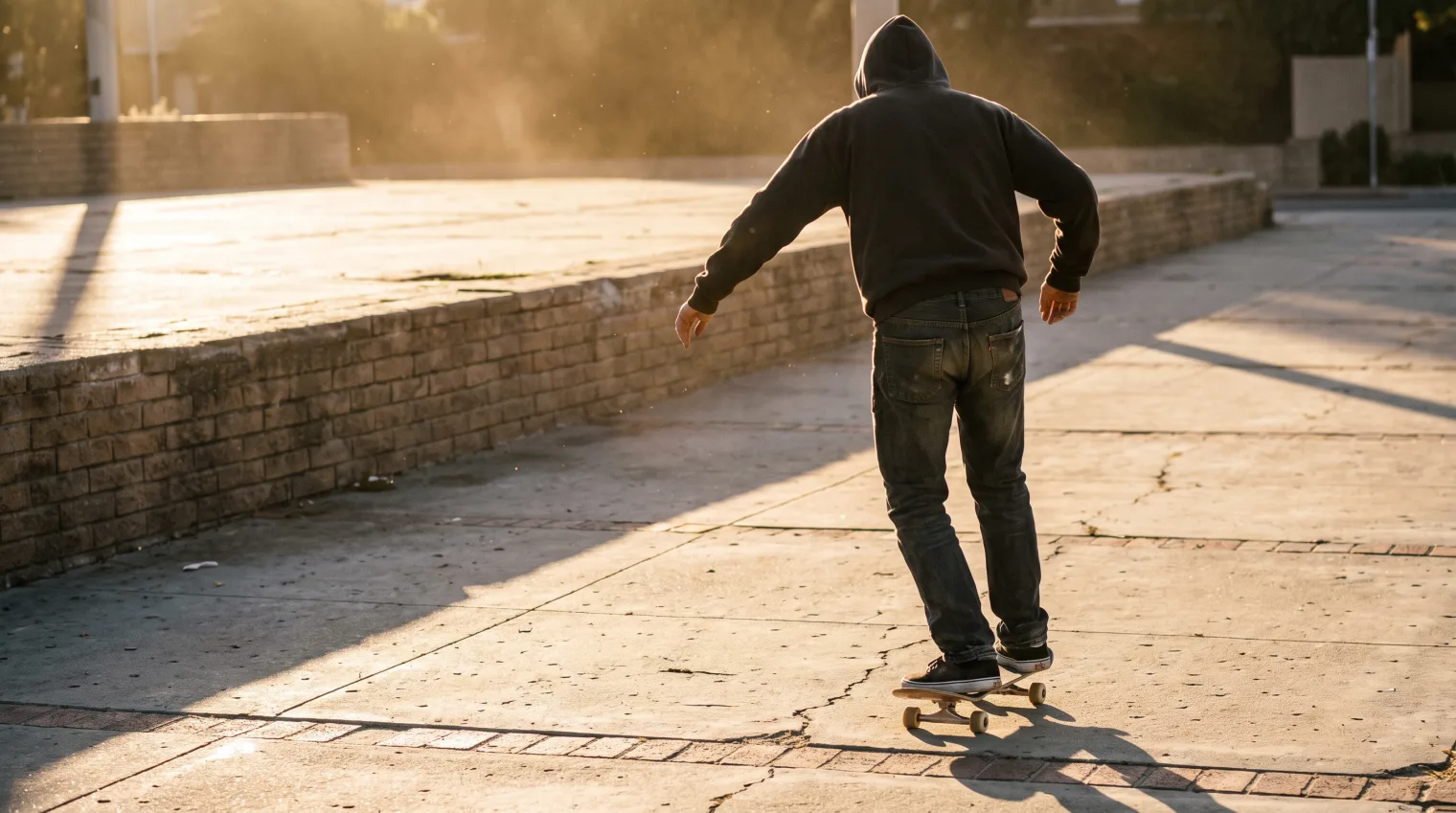
The manual progression runs: manual first, then nose manual, then manual 180 out and one-wheel manual as parallel next steps, then nose manual flip out. Unlike most of the Onbolts skill tree, this branch doesn't start with the ollie. A manual is a pure balance trick, riding on two wheels instead of four, and it can be learned from a standing start, which makes it one of the more approachable entry points for a brand-new skater.
Here's the order, what each step actually trains, and why nose manual gives more skaters trouble than the name suggests.
Step 1: The manual, a balance trick with no pop required
The manual is beginner difficulty with a 2 to 6 week learning window per Onbolts' data, and it has no prerequisite listed at all. That's unusual. Nearly every other trick in the tree traces back to the ollie in some way, but a manual is riding on your back two wheels, shifting your weight to hold the front end up, with no pop and no board rotation involved.
This makes manual a genuinely good first trick, alongside or even before the ollie. The two skills don't compete for the same muscle memory: the ollie is about popping and leveling out in the air, the manual is about static weight-shift balance while rolling. Some coaches recommend working manual and ollie in the same early sessions specifically because switching between them doesn't create the kind of interference that, say, kickflip and heelflip practice can.
What actually makes manual hard: it's not about strength, it's about micro-adjustments. Riders who muscle through with big weight shifts wobble and bail. The skaters who hold manuals the longest use small, continuous corrections, more like balancing a broomstick on your palm than a single deliberate lean.
Step 2: Nose manual, the front-wheel version
Once manual is consistent, the direct next step is the nose manual, which requires manual as its prerequisite. Onbolts' data lists it as beginner difficulty too, but with a longer 3 to 8 week window, nearly double manual's low end. A nose manual balances on your front two wheels instead of the back, which most riders find noticeably less stable.
The reason for the longer window comes down to body positioning. In a regular manual, your weight naturally sits closer to your back foot already, since that's roughly where your standing stance puts you. In a nose manual, you have to actively shift your weight forward, over the nose, which fights against your natural center of gravity on the board. It's the same balance skill as manual, but working against a less intuitive lean.
If you've got manual dialed but nose manual is going badly, the most common fix is slowing down. Riders often try nose manual at the same speed they hold a regular manual, but the tighter margin for error over the nose usually calls for a slightly slower, more controlled entry.
Step 3a: Manual 180 out, adding rotation to the balance
With manual consistent, one branch leads to manual 180 out, listed as intermediate difficulty with manual as its direct prerequisite. This trick has you rotate the board 180 degrees while you're still balanced on two wheels, then set the front wheels back down facing the opposite direction.
This is a genuine jump in difficulty because you're not just holding a static balance point anymore, you're actively rotating the board while maintaining it. The manual itself needs to be automatic before you add rotation, or you'll lose the balance the moment you start turning your shoulders and hips to initiate the spin.
Step 3b: One-wheel manual, the deeper balance challenge
The other branch off manual is one-wheel manual, advanced difficulty, also requiring manual as its direct prerequisite. Instead of balancing on two wheels, you're balancing on one, which removes an entire axis of stability. Where a standard manual lets you correct side-to-side wobble somewhat, a one-wheel manual doesn't give you that margin.
This trick is less commonly practiced than nose manual since it has less obvious application in combo lines, but it sits in the tree as a legitimate advanced step off the base manual, and it's a real test of whether your manual balance is precise or just good enough to get by.
Step 4: Nose manual flip out, combining families
Further down the branch, nose manual flip out requires nose manual directly. This is where the manual family starts to intersect with the flip trick family: you're holding a nose manual and popping into a flip trick to exit, rather than just riding out on four wheels. It's an advanced combination move that assumes both a solid nose manual and comfort with flip tricks like kickflip from a separate branch of the tree.
This is a good example of how the Onbolts tree isn't strictly linear within one family. Some tricks sit at the intersection of two branches, manuals and flatground flips in this case, the same way tre flip sits at the intersection of shove-its and kickflips.
Why manuals are worth learning even if you're not chasing them specifically
Even if landing a clean nose manual isn't a personal goal, the balance control it builds pays off elsewhere. Skaters commonly link a manual into another trick, a manual into a kickflip, a manual into a shove-it, as a way to connect tricks into a longer line without simply rolling between them. These combo lines aren't tracked as separate prerequisite entries in Onbolts' data, but the underlying skill transfer is real: the weight-shift precision you build holding a manual makes your board control tighter across the board.
What makes manuals feel different from every other trick
Most of the Onbolts skill tree rewards short, explosive effort: pop, flick, land, done in under a second. Manuals are the opposite. They reward sustained control over several seconds, which is a different kind of practice entirely. You can't really "attempt" a manual the way you attempt a kickflip, fail, and reset instantly. You have to hold the balance point, feel it start to drift, correct, feel it drift the other way, correct again, and the trick is really the sum of all those corrections rather than a single clean motion.
This is part of why manual progress can feel slower to notice than flip trick progress, even when it's happening. A kickflip either lands or it doesn't, which gives you a clear signal every attempt. A manual gives you a much fuzzier signal: did you hold it for one second or three, and was that better or just luck. Onbolts' 5-level scale helps here specifically because it forces you to be honest about which of those outcomes you're actually getting on a regular basis, rather than mentally rounding up to "I can manual" after a single good attempt.
A practical drill for building manual balance faster
One thing that speeds up manual progress: practicing the balance point standing still before adding any rolling speed. Stand on the board with the front wheels lifted, using a curb or a friend's hand for support if needed, and just feel where your weight needs to sit to keep the front end up without support. Once that static position feels familiar, rolling manuals tend to click faster, because you're not learning the weight placement and the rolling balance at the same time.
The same idea applies to nose manual. Since the forward weight shift is what makes nose manual harder than a regular manual, practicing that forward lean while stationary, even just rocking the board onto its nose and holding it, builds the specific muscle memory you'll need once you're moving.
Using your progress data
Because manual doesn't require an ollie, it's easy to start working on early and easy to let stagnate once you've landed it once. Onbolts' 5-level scale, learning, landed once, occasional, consistent, mastered, is useful here specifically because "landed once" on a manual often means you held it for half a second before bailing, not that you actually own the balance. Push toward "consistent" before attempting nose manual or manual 180 out. Check your progress page to see where your manual status actually sits.
Where to start today
If you're brand new to skating, manual is a reasonable first or second trick to work on alongside your ollie, since the two don't interfere with each other. If you've already got a solid manual, nose manual is the next real step, budget the full 3 to 8 week window and expect the forward weight shift to feel foreign at first.
See the manual family laid out visually in the skill tree, or browse every trick by category at /tricks.
Frequently asked
- What is the correct order to learn manual tricks?
- Based on Onbolts' prerequisite data, start with the manual (beginner, 2 to 6 weeks), then move to nose manual (beginner, 3 to 8 weeks), which requires manual first. From there, manual 180 out and one-wheel manual both branch from manual directly, and nose manual flip out requires nose manual. There's no ollie requirement for the base manual, it's one of the few tricks that starts from zero.
- Do you need to know how to ollie before learning a manual?
- No. The manual is not listed as requiring the ollie in Onbolts' prerequisite data, which makes it one of the few beginner tricks you can start on day one alongside or even before your ollie. The two skills, popping and balancing, don't overlap much, so working on both in the same session is common.
- Why is nose manual harder than a regular manual?
- A regular manual balances on your back two wheels, which is closer to your natural standing position over the board. A nose manual balances on the front two wheels, over the nose, which most riders find less stable and harder to hold. Onbolts' data reflects this: manual is 2 to 6 weeks while nose manual is 3 to 8 weeks, both beginner difficulty but with a noticeably longer window for the nose version.
- What tricks can you combo with a manual?
- Manuals are commonly used as connector tricks in longer combos, like a manual into a kickflip or a manual into a shove-it, even though these combos aren't formally tracked as separate prerequisite chains in Onbolts' data. The core value of a strong manual is the balance and weight-shift control that transfers into holding your board steady during other tricks.
- What is manual 180 out and how hard is it?
- Manual 180 out is a manual where you rotate the board 180 degrees while still balanced on two wheels before setting back down. Onbolts' data lists it as intermediate difficulty and requires a manual as its direct prerequisite. It's a step up from holding a straight manual because you're adding rotation without losing the balance point.
- Is one-wheel manual a real progression step or a trick show-off move?
- It's a genuine step in the tree, listed as advanced difficulty and requiring manual as its prerequisite. A one-wheel manual balances on a single wheel instead of two, which demands significantly more precise weight control than a standard manual. It's less commonly practiced than nose manual but sits in the same branch of the skill tree.