blog-post // Aug 7, 2026
Nollie Tricks: What They Are, Why They Are Hard, and How to Begin
Nollie means popping off the board's nose instead of the tail. Onbolts data puts a basic nollie at 1–3 months, about triple a regular ollie's timeline.
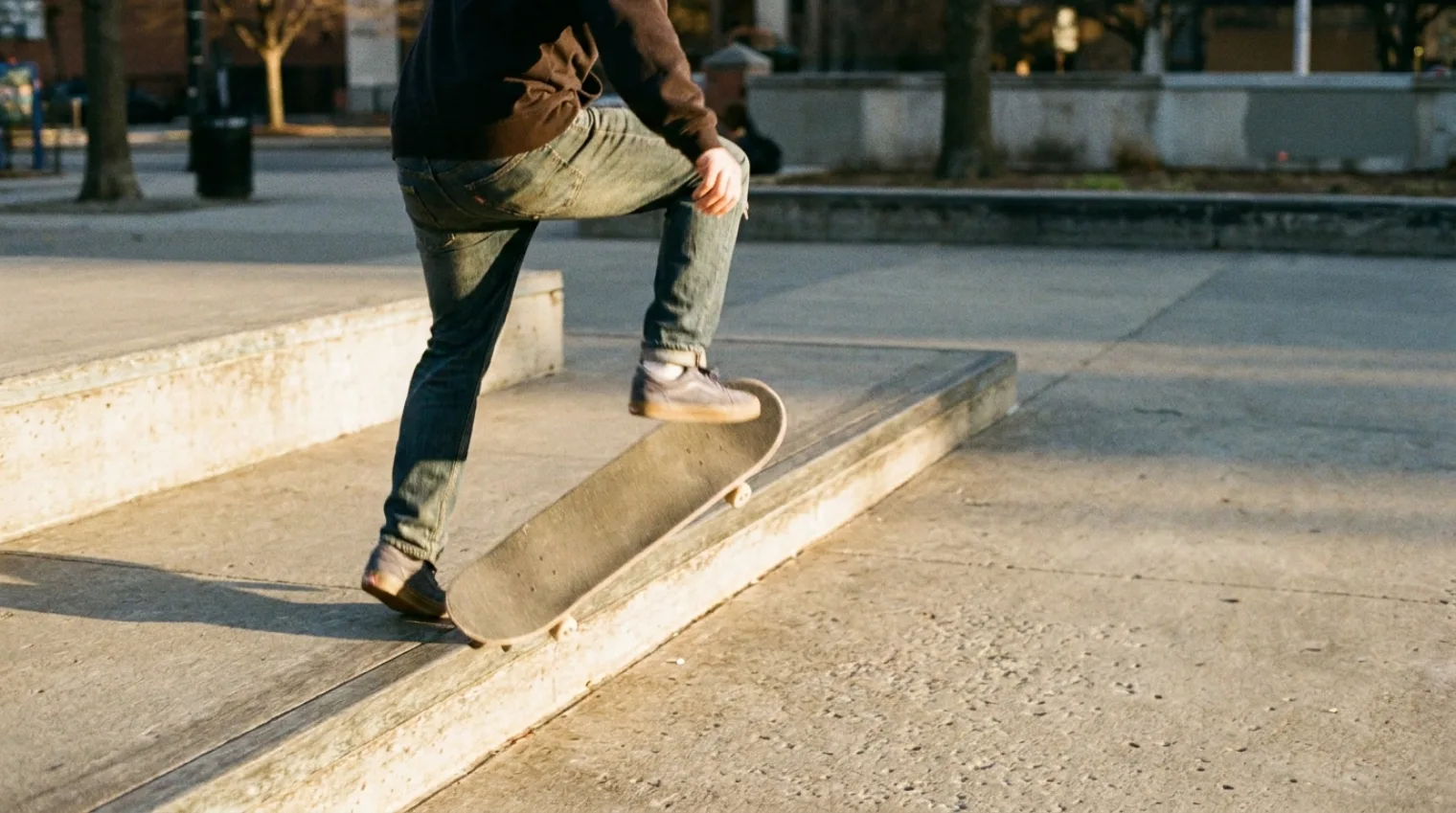
A nollie is an ollie popped off the nose of the board instead of the tail, while you keep riding your normal direction in your normal stance. Onbolts' learning data rates a basic nollie as intermediate at 1–3 months, close to triple the 1–4 weeks a regular ollie takes most beginners, because you are relearning your pop mechanics from the opposite end of the board rather than repeating something you already know.
What a nollie is
The word is short for nose ollie. Instead of snapping the tail down and sliding your front foot up the grip tape, you snap the nose down with your front foot and guide the board up with a different kind of drag from your back foot. Your stance does not change. Your direction of travel does not change. You are still facing forward, still riding the way you always ride, the only thing that changes is which end of the board is doing the popping.
This is where a lot of skaters get their stance-variant vocabulary tangled. Fakie means riding backward in your normal stance, feet unchanged. Switch means riding in your opposite stance entirely. Nollie keeps your stance and your direction the same, and only swaps which end pops. All three sit as separate rows on the Onbolts skill tree, with their own slugs, their own prerequisites, and in nollie's case, a meaningfully longer learning window than the trick it is based on.
Why nollie is harder than it looks from the outside
An ollie and a nollie look almost identical to a bystander: a small pop, a flat spin of the board, a landing. The mechanics underneath are not identical at all. Popping off the nose puts your front foot in charge of the pop instead of your back foot, which means the foot that used to just guide the board now has to generate the snap, and the foot that used to snap now has to guide. For most skaters this is not a small adjustment, it is closer to relearning the ollie from a mirrored setup, using timing you have not built the same reps on.
Balance shifts too. Standing centered over the nose before popping feels less stable for most people than standing centered over the tail, since your back foot has less board underneath it to work with during the pop. That is a real mechanical difference that takes real repetitions to adjust to, not a confidence problem you push through.
What the data says about nollie's learning curve
Onbolts' learning data puts the ollie itself at 1–4 weeks for most beginners. The nollie sits at 1–3 months, rated intermediate rather than beginner. That gap is the clearest evidence that nollie is not the same trick from the front, it is a distinct skill with its own curve, even for skaters who already ollie confidently and consistently.
The pattern continues once you move into nollie flip tricks. Nollie kickflip does not carry a learning-time estimate in Onbolts' data yet, since it varies more by skater than tricks with tighter bands, but it is rated intermediate, the same tier as a regular kickflip, so it is a realistic next step once the base nollie is solid. Nollie heelflip, by contrast, is rated advanced at 3–8 months, notably higher than the 1–4 months a regular heelflip takes. The jump in both difficulty tier and time reflects that a nollie heelflip requires both the nose-pop foundation and the heelflip's flick, stacked together, rather than either skill alone.
Where nollie sits on the skill tree
On the skill tree, the base nollie has exactly one prerequisite: a solid regular ollie. Nothing else. Once it is landing consistently, three tricks open up directly: nollie shove-it, nollie frontside 180, and nollie kickflip. From there the tree branches further into nollie backside 180 and nollie 50-50, and eventually into grinds and slides. A nollie boardslide and nollie noseslide both list the base nollie as their sole prerequisite, for example, no extra slide-specific step required first.
This structure repeats a pattern you will also see in fakie and switch: a single foundational pop unlocks a whole branch, and each further trick usually needs both that foundation and its non-nollie counterpart already landed.
The first nollie tricks to attempt, in order
Start with the nollie itself, straight up and down, no rotation, no flip, just popping off the nose cleanly and landing centered. Do not move on until this feels close to automatic, the way a regular ollie eventually does. Rushing this step is the most common reason nollie flip tricks take longer than the data above suggests they should.
Once the base nollie is consistent, nollie shove-it is a natural next trick, since it only adds a board rotation without asking your feet to do anything new with flicking. Nollie frontside 180 is a similar step, body rotation layered on a pop you already trust. Only after one of these feels comfortable does it make sense to add a flip, at which point nollie kickflip is the standard entry point into nollie flip tricks.
Nollie flip tricks and where they lead
Nollie kickflip opens into nollie tre flip, which lists nollie shove-it and nollie kickflip as its two prerequisites, essentially asking you to combine the rotation and the flip you already learned separately. From there, Onbolts' tree points toward nollie hardflip and nollie laser flip, both advanced tricks that stack a nollie kickflip's mechanics on top of additional rotation or a heelflip-style flick.
If you are chasing nollie heelflip instead, it needs both a regular heelflip and the base nollie already landed, not either one alone, which is part of why it carries that 3–8 month window instead of matching the kickflip line's shorter timeline.
Nollie grinds follow the same pattern
The difficulty jump you see in flip tricks shows up in grinds too. Nollie 50-50 requires only the base nollie, same as the other first-tier nollie tricks. From there, nollie nosegrind and nollie 5-0 grind both require a landed nollie 50-50 first, and nollie crooked grind sits one step further, requiring nollie nosegrind specifically rather than either of the other two. None of these carry a published time window yet, but the prerequisite chain itself tells you what to expect: each step assumes real consistency in the one before it, not just a landed attempt.
This matters for planning your practice. If nollie 50-50 is still landing inconsistently, spending serious time on nollie nosegrind is premature, the tree is not being arbitrary about the order, it reflects that nosegrind adds a new balance point on top of skills the 50-50 has not fully settled.
Common mistakes when learning nollie
Trying to nollie before the regular ollie is automatic. If you still have to think about your regular ollie, adding a mirrored pop on top of that is asking for trouble. Get the ollie to the point it happens without conscious effort first.
Overcompensating with the back foot. Because the back foot loses its usual pop role, a lot of skaters swing it too aggressively trying to compensate, which throws off the flat landing. The back foot's job in a nollie is guidance, not power.
Skipping straight to nollie flip tricks. A straight, no-flip nollie needs to be landing consistently, not just once, before adding a kickflip or heelflip on top. Combining two half-learned skills rarely goes faster than learning them in sequence.
Why nollie is worth learning even beyond specific tricks
Some skaters treat nollie as an optional detour, something to learn only if a specific trick on their list happens to require it. That undersells what nollie riding builds. Because it forces you to generate pop from a different point on the board, time spent comfortable with nollie tends to improve overall board control and front-foot precision, not just the tricks explicitly labeled nollie. Skaters who avoid it entirely often carry a subtle gap in their pop vocabulary that eventually limits how naturally they string tricks together in a real skate session.
The takeaway
A nollie is a nose-popped ollie, same stance, same direction, different end of the board doing the work, and it deserves its own dedicated practice time rather than an assumption that it will come free once your regular ollie is solid. Onbolts' data backs that up directly: a 1–4 week trick becomes a 1–3 month trick once you flip which end pops.
Log your nollie attempts using the 5-level scale on your progress page, from learning through to consistent and mastered, and once the base nollie is locked in, browse the rest of the tricks list to see the full branch of nollie tricks waiting on the other side of it.
Frequently asked
- What does nollie mean in skateboarding?
- Nollie is short for nose ollie: you pop off the nose of the board instead of the tail, while still facing and riding in your normal direction. It looks similar to a regular ollie but uses the opposite end of the board to generate pop, which changes your foot pressure, your balance point, and how the board flips underneath you.
- Is nollie the same as switch or fakie?
- No. Fakie is riding backward in your normal stance with your feet unchanged. Switch is riding in your opposite stance entirely. Nollie keeps your stance and your direction of travel the same as normal, the only change is which end of the board you pop from. All three are separate variants with their own rows on the Onbolts skill tree.
- How long does it take to learn a nollie?
- Onbolts' learning data puts a basic nollie at 1–3 months for skaters who already have a solid regular ollie, compared to 1–4 weeks for the original ollie itself. The gap is the clearest evidence that nollie is a distinct skill with its own curve, not a free extension of an ollie you already have.
- What is the first nollie trick I should learn?
- The nollie itself, a straight nose-pop version of the ollie, is the only prerequisite the Onbolts skill tree lists for every other nollie trick. Once it is landing consistently, nollie shove-it, nollie frontside 180, and nollie kickflip all open up directly from it.
- Why do nollie flip tricks take longer than their regular-stance versions?
- Popping from the nose changes your front foot's flicking angle and shifts your weight distribution earlier in the trick, so tricks you can already do regular, like a kickflip or heelflip, have to be relearned from a different balance point rather than simply repeated. Onbolts rates nollie heelflip as advanced at 3–8 months, compared to intermediate at 1–4 months for the regular heelflip.
- Do I need switch or fakie skills before learning nollie?
- No. Nollie only requires a solid regular ollie on the Onbolts skill tree, not fakie or switch riding. It is a separate branch that happens to follow the same pattern as fakie and switch: a base pop unlocks flip and grind variations built on top of it.