blog-post // Jul 21, 2026
The Ollie: Why It Is the Foundation of Every Skateboard Trick
The ollie unlocks more tricks than any other move in skateboarding. Here's the real data on what it leads to, and why it's worth mastering before anything else.
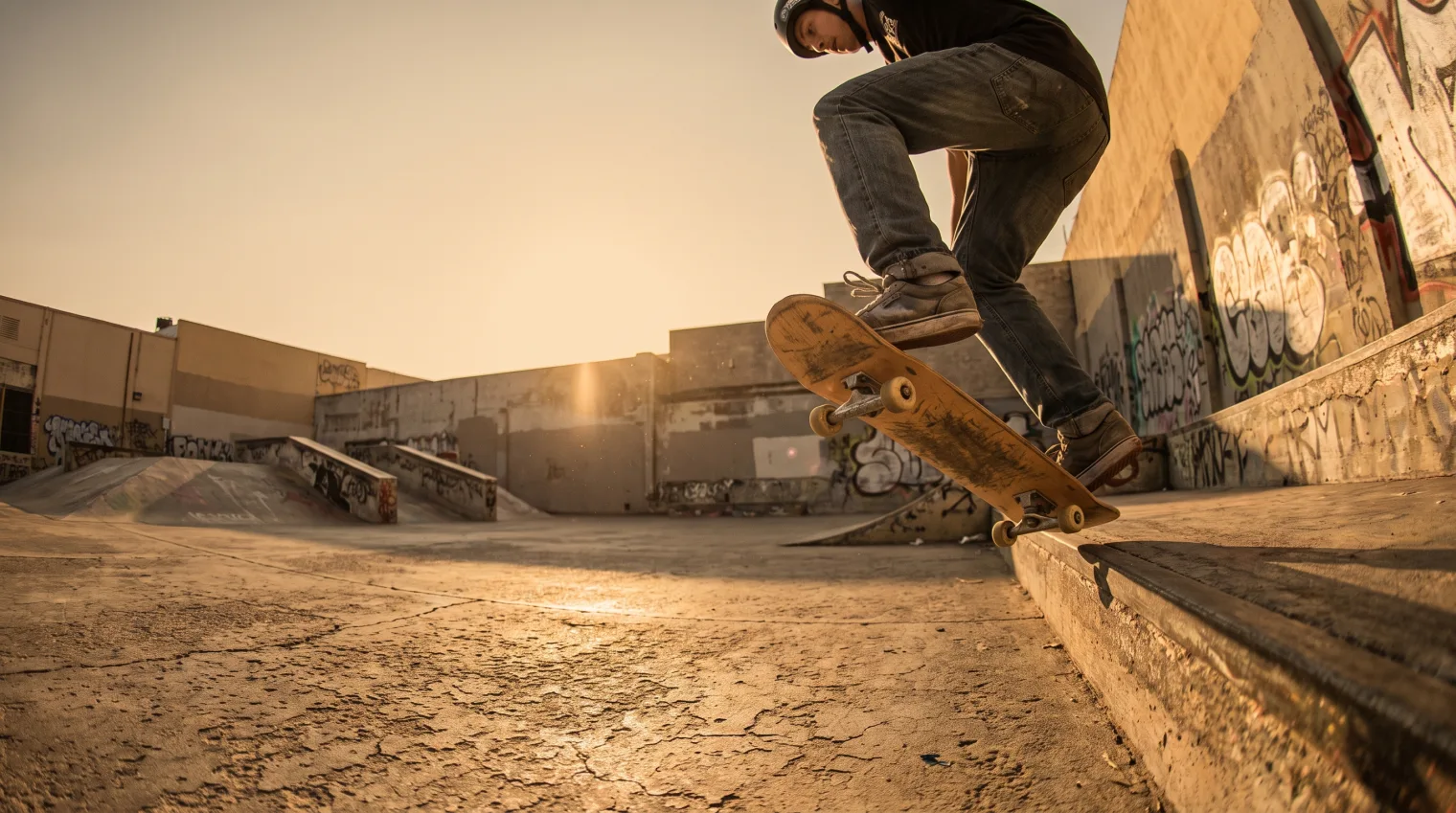
The ollie is the foundation of skateboarding because more tricks are built directly on top of it than any other single trick. It's not a subjective opinion, it's a structural fact of how tricks work: popping the tail and leveling the board out in the air is the physical basis for flip tricks, most grinds, most slides, and a large share of flatground spins. Onbolts' prerequisite data lists the ollie as a direct requirement for kickflip, heelflip, pop shove-it, 50-50 grind, boardslide, noseslide, frontside 180, backside 180, and more. No other trick in the tree has that many direct dependents.
Here's what the ollie actually teaches, why so many other tricks need it, and how to know when yours is good enough to build on.
What the ollie actually is
Stripped down, the ollie is four motions in sequence: pop the tail down sharply, slide your front foot up the board as it rises, level the board out in the air by adjusting your back foot, and land with your feet roughly over the bolts. Onbolts' data lists it as beginner difficulty with a 1 to 4 week learning window, which sounds fast for something so central, but the window reflects how mechanically simple the motion is even though it takes real repetition to make automatic.
The part that trips people up isn't usually the pop, it's the slide. If your front foot doesn't slide up far enough or fast enough, the nose never catches up to level the board, and you end up with a weak hop instead of an ollie. This is the single most common reason beginners plateau: they've got the pop down but the slide is too tentative.
Why the ollie is a prerequisite for so much
Look at what an ollie actually contains: a controlled pop, a leveled board in the air, and a clean landing. Every trick that requires the ollie is reusing one or more of those three pieces.
- Kickflip and heelflip reuse the pop and the airborne leveling, then add a flick that spins the board. If the pop isn't reliable, adding rotation just makes an unreliable pop worse.
- Pop shove-it reuses the pop, but spins the board 180 degrees under your feet using your back foot instead of flipping it. Same airborne control, different input.
- 50-50 grind, boardslide, noseslide all need the ollie to get your trucks or deck up onto the ledge or rail in the first place. Without a reliable pop and height, you either come up short or overshoot the ledge.
- Frontside 180 and backside 180 reuse the pop and add a full-body rotation while airborne, which is only controllable if the base pop and landing are already automatic.
This is the actual logic behind the skill tree's prerequisite structure, not tradition, but shared mechanics. Master the ollie and you're not just learning one trick, you're pre-training the hardest part of a dozen others.
The three most common ollie mistakes
Weak or late pop. If you're popping the tail too softly, or too late relative to your front foot's slide, the board won't get enough height or won't level correctly. This usually shows up as a board that stays angled nose-down through the whole jump.
Not sliding the front foot far enough. The slide is what drags the nose up to meet the tail in the air. A short, timid slide leaves the board permanently tail-heavy, so it either doesn't level or clips the ground on landing.
Leaning back instead of jumping level. Many beginners instinctively lean their whole body back as they pop, thinking it helps get the board up. It usually does the opposite: it throws your weight off the board's center and makes a clean, level landing much harder to control.
Each of these is fixable in isolation. Slow the whole motion down, exaggerate the front-foot slide more than feels necessary at first, and focus on jumping straight up rather than back. Speed and height come later; the shape of the motion comes first.
How to know your ollie is ready for the next trick
This is the part most guides skip. Landing an ollie once is not the bar. Onbolts tracks progress on a 5-level scale, learning, landed once, occasional, consistent, mastered, and the prerequisite relationships in the tree really mean "consistent," not "landed once."
A practical test: can you ollie the same height and land the same way, five times in a row, without adjusting your setup between attempts? If yes, you're at consistent, and that's genuinely a reasonable point to start layering a flick (kickflip), a rotation (pop shove-it or 180), or a ledge approach (50-50, boardslide) on top of it. If you're still landing sideways or bailing every third attempt, more ollie reps will pay off faster than jumping ahead.
What unlocks once your ollie is consistent
Once your ollie hits consistent, an entire section of the skill tree opens up at once, not sequentially. You don't have to master kickflip before trying pop shove-it, or land 50-50 before trying frontside 180. These are parallel branches that all share the same root, so you can rotate through several new tricks in the same week without any of them blocking the others.
This is actually the most efficient way to train post-ollie: pick one flip trick, one rotation trick, and one ledge trick, and work all three in the same sessions. They'll reinforce different aspects of the same base pop, and progress in one tends to show up as small improvements in the others.
Deeper into the tree: what the ollie eventually leads to
Follow the chain far enough and the ollie's influence reaches tricks that don't look anything like it anymore. Impossible and tailslide both list ollie as a direct prerequisite. Kickflip leads to varial kickflip and eventually tre flip. 50-50 leads through the entire grind family, 5-0, nosegrind, crooked grind, and beyond. None of that is reachable without the root trick being solid first.
Even manual, which doesn't require an ollie at all, benefits from the general board control an ollie builds, even though the two skills are formally independent in the tree.
Why the ollie learning window is wider than it looks
A 1 to 4 week window sounds precise, but it hides a lot of variance in how riders actually get there. Some of that variance is about practice frequency, someone skating daily will obviously move faster through the window than someone skating once a week, but a meaningful chunk of it is about how the practice itself is structured. Riders who isolate the pop, then isolate the slide, then combine them tend to land in the front half of the window. Riders who just try full ollies repeatedly without breaking the motion down tend to land in the back half, or sometimes push past it entirely.
The reason isolation works faster: a full ollie attempt gives you one combined signal, good or bad, but doesn't tell you which of the three components (pop, slide, landing) actually broke down. Filming yourself, even on a phone at normal speed, and watching your foot position at the top of the jump usually reveals which part is weak faster than another twenty blind attempts would.
The ollie as a diagnostic tool later in your skating
Even once you've moved well past the ollie into grinds, flips, and slides, it stays useful as a diagnostic. If a more advanced trick suddenly stops working the way it used to, a rusty ollie is a common, boring, and easy-to-overlook cause. Fatigue, a new board setup, or just time away from skating can quietly degrade your pop without you noticing, since the advanced trick you're working on has enough other moving parts to mask where the actual breakdown is happening.
When troubleshooting a stalled trick anywhere in the skill tree, it's worth asking a basic question first: is my ollie still as good as it was when I first landed the trick that depends on it? If the honest answer is no, that's usually the fastest fix available, faster than trying to isolate a problem in a much more complex trick.
Where to start today
If you haven't landed an ollie yet, that's the only trick worth focusing on right now. Don't split practice time with kickflip attempts or grind attempts until the pop, slide, and landing are automatic. If you already have a shaky ollie, going back to basics for a week, just popping and leveling, without trying to add anything on top, is usually the fastest path forward, even though it feels like a step backward.
Once your ollie is consistent, check the skill tree to see the full set of tricks that just opened up, or browse /tricks to pick your next one. Track your own status on the 5-level scale at /progress so you know when you've actually crossed from "landed once" to "consistent."
Frequently asked
- Why is the ollie considered the most important skateboard trick?
- Because more tricks depend on it than on any other single trick in the skill tree. According to Onbolts' prerequisite data, the ollie is a direct requirement for kickflip, heelflip, pop shove-it, frontside 180, backside 180, 50-50 grind, boardslide, noseslide, impossible, tailslide, and one-foot ollie, among others. No other trick has that many direct dependents.
- How long does it actually take to learn an ollie?
- Onbolts' learning data lists the ollie as beginner difficulty with a 1 to 4 week window. That's a range, not a guarantee, and it assumes regular practice. Some riders land their first ollie in a single session and spend the rest of the window making it consistent enough to use in other tricks, which is really the bar that matters.
- What should I be able to do before moving past the ollie?
- Consistency, not a single landing. Onbolts tracks progress on a 5-level scale: learning, landed once, occasional, consistent, mastered. A trick you've landed once is not reliable enough to build a kickflip or a 50-50 grind on top of. Most riders should aim for consistent ollies, not just occasional ones, before attempting a dependent trick.
- Does the ollie unlock grinds and slides too, or just flip tricks?
- Both. The ollie is the direct prerequisite for 50-50 grind, the entry point into the entire grind family, and for boardslide and noseslide, the entry points into slides. It also unlocks flatground tricks like frontside 180, backside 180, and pop shove-it. It's the single most connected trick across every family in Onbolts' data.
- Why do so many skaters get stuck on their ollie?
- Usually because of one of three habits: not sliding the front foot up enough (so the board doesn't level out), popping the tail too softly, or leaning back instead of jumping level. These show up as a board that either doesn't get airborne or flips out from under the rider. None of them are fixed by trying harder, they're fixed by isolating and drilling the specific motion that's off.
- Should I keep practicing the ollie after I've moved on to other tricks?
- Yes, especially if you plan to combine tricks later. A shaky ollie that was 'good enough' to land a kickflip once will show its limits when you try to combine tricks, ollie up a curb, or grind a ledge with any real commitment. Revisiting your ollie periodically as your board control improves overall tends to raise the ceiling on everything built on top of it.