blog-post // Jul 22, 2026
Ollie Mechanics: Why Pop Timing Matters More Than Height
Ollie height is the wrong thing to chase first. Here is how pop timing, the slide, and leveling out actually create the ollie, and why height follows.
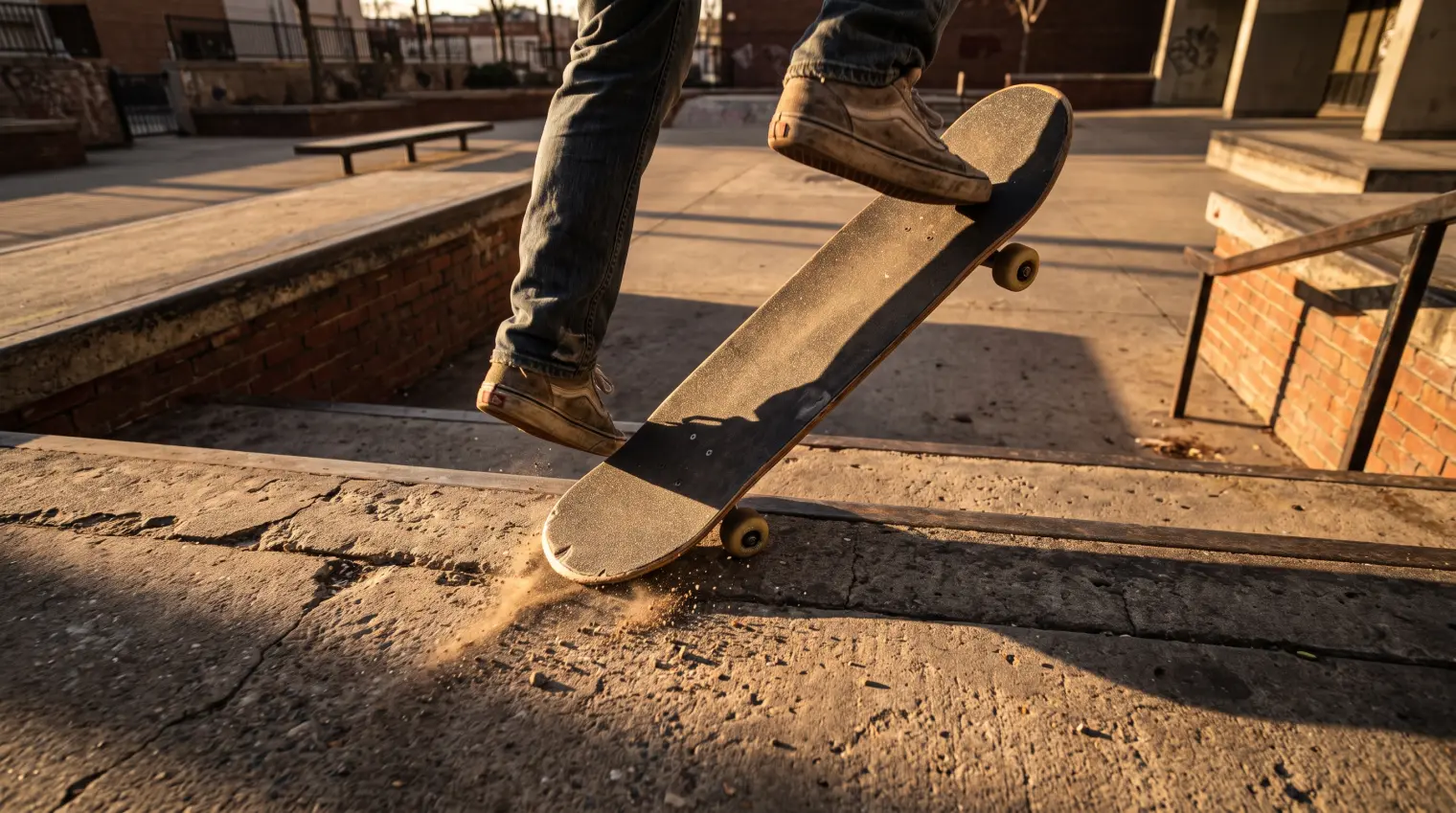
Ollie height is a result, not a goal: it comes from correct pop timing, not from popping harder. The ollie is listed as beginner difficulty with an estimated 1–4 weeks to learn in the Onbolts skill tree, but most of that time goes toward fixing timing, not building leg strength. Chasing height before timing is a common reason beginners plateau early.
This post breaks the ollie down into its actual mechanical sequence, explains why timing beats raw pop power, and covers the specific errors that keep an ollie low even when a rider is trying hard.
The ollie in four connected motions
An ollie is not one motion, it is four that overlap almost entirely:
1. Crouch. Bend your knees to load up, back foot on the tail, front foot roughly in the middle of the board.
2. Pop. Your back foot snaps down on the tail, hard and fast, while your back leg is already starting to lift.
3. Slide. As the tail pops, your front foot drags up the board toward the nose, using the side of your foot, not a stomp.
4. Level and land. In the air, you level the board out by pulling your knees up, then land with bent knees roughly over your original foot placement.
The mistake almost every beginner makes is treating these as four separate steps done in sequence. They are not. The pop and the slide need to start together, within a fraction of a second of each other, or the height and the leveling both suffer.
Why pop timing matters more than pop power
Popping the tail harder without correct timing does not produce a higher ollie, it produces a louder one. The height of an ollie comes from the combination of how sharply the tail pops down and how quickly your front foot slides up the board to drag the nose up behind it. If your front foot slide is late, even by a small fraction of a second, the board has already started to fall back down by the time your front foot starts doing its job, and you lose most of the height the pop generated.
This is why a rider who has been skating for years can ollie higher with what looks like less effort than a beginner popping as hard as they can. It is not more power, it is tighter timing between the pop and the slide.
The slide: the part beginners skip or rush
The front foot slide is where a lot of ollie problems actually live, not the pop itself. Your front foot needs to travel in a straight line up the grip tape toward the nose, using the side edge of your shoe to drag the board level. Two common errors show up here:
Sliding too late. If your front foot does not start moving until after the tail has already popped and started to rise, you miss most of the window where the slide actually adds height and levels the board.
Sliding at an angle. If your foot travels diagonally instead of straight up the deck, the board twists sideways instead of leveling out cleanly, which is a common cause of the board flipping out from under you mid-ollie.
Why height should not be your first metric
New riders often judge ollie progress purely by how high they are getting off the ground. This is the wrong first metric. A consistent, well-timed ollie at a moderate height that lands centered and controlled every time is more valuable than an inconsistent high ollie that only works one attempt in five. The kickflip, 50-50, and frontside 180 all list the ollie as a direct prerequisite in the Onbolts skill tree, and all of them depend on a reliable, repeatable pop far more than a maximum-height one. Height naturally increases as your timing gets tighter, so it improves as a side effect of getting the sequence right, not as a separate thing to force.
Common mechanical errors and their fixes
Jumping instead of popping. If you are trying to lift your whole body into the air with your legs while the board comes along for the ride, you are not doing an ollie, you are doing a jump with a board attached. Let the pop and slide lift the board; your legs mainly get out of the way and then pull back up to meet it.
Back foot leaving too early. Your back foot needs to stay in contact with the tail through the full pop, then come off cleanly, not lift before the tail has actually snapped down. Popping and lifting at the same time robs you of most of the tail's spring.
Landing too far forward or back. If you are consistently landing with your weight shifted off your bolts, your slide and pop are probably not happening at the same rate, throwing your balance off in the air. Check the timing before adjusting your landing stance.
What to drill instead of height
Practice the pop and slide together at a stationary stand-still first, focusing purely on the timing between your back foot's pop and your front foot's slide. Once that feels connected as one motion instead of two, add rolling speed. Filming yourself from the side is the fastest way to actually see whether your slide is starting on time, since the timing gap is often too small to feel accurately in the moment.
After the ollie
Once your ollie is consistent, not necessarily maximal, you are ready for the tricks that build directly on it. The pop shove-it isolates rotation on top of the same pop mechanics, and the 50-50 applies your ollie to landing on a ledge or rail instead of flat ground. Both use the exact timing you just built, applied to a new context rather than a new motion.
Log your ollie honestly through the Onbolts 5-level scale in progress, from your first landed attempt to full consistency. See where the ollie sits at the base of everything else in the skill tree, or check the full trick list for what to work on once your pop timing is solid.
The physics in plain terms
An ollie works because the tail hitting the ground acts like a lever, and your front foot's sliding motion acts like a second force that redirects that lever's energy into lifting the nose. If you pop without the slide, the tail springs back up but the board mostly just hops in place with the nose staying low. If you slide without a real pop, there is no stored energy for the slide to redirect, and nothing happens. Height comes specifically from how efficiently these two forces combine, which is why two riders with similar leg strength can have very different ollie heights based purely on how tightly their pop and slide are timed together.
Why speed changes the feel of an ollie
An ollie done from a stand-still and one done while rolling at speed use the same core mechanics but feel different, and beginners are often confused when a trick that works standing still falls apart the moment they add rolling speed. Rolling speed adds a small forward momentum that your body needs to account for in the landing, and it also compresses your reaction window slightly since the whole motion happens while the board is already moving forward. If your ollie mechanics are solid standing still but fall apart rolling, the issue is usually the added speed variable, not a flaw in the pop-and-slide timing itself. Practice the transition gradually: stationary, then walking pace, then a controlled push, before trying it at a speed that feels natural for rolling around.
Common height plateaus and what breaks through them
Many riders hit a specific height where their ollie stops improving for weeks even though everything else about their skating keeps progressing. This plateau is usually caused by one of two things: either the pop and slide timing has a small, consistent gap that has become a comfortable habit, or the rider has unconsciously started bracing for the landing mid-air, which cuts the ollie's rise short. Filming from directly the side, not at an angle, and comparing your best and worst attempts frame by frame usually reveals which of the two is happening. Riders who work through a height plateau almost always do it by fixing a timing detail, not by trying harder.
Ollie mechanics under your feet versus what it looks like from outside
It helps to separate what an ollie looks like to a spectator from what it actually feels like to execute, because chasing the visual (a board snapping up dramatically) can lead you toward exaggerated, less efficient movements. The riders with the most consistent, highest ollies tend to describe the motion as compact and almost quiet: a tight pop, a fast slide, minimal wasted movement. If your ollie attempts feel like a big, dramatic effort every time, you are likely working harder than the mechanics require, and tightening the motion rather than amplifying it is usually the faster path to real height.
Frequently asked
- What is the correct order of motions in an ollie?
- Crouch, pop the tail down with your back foot, slide your front foot up the board toward the nose while your back foot leaves the tail, then level the board out in the air and land with knees bent. The pop and the front foot slide happen almost simultaneously, not one after the other, which is the part beginners usually get wrong first.
- Why is my ollie so low even though I am popping hard?
- Low ollies are usually a timing problem, not a power problem. If your front foot starts sliding before the tail has actually popped, or your back foot lifts off before the pop is complete, you lose most of the height the pop could have generated. Fix the timing before trying to pop harder.
- Should I focus on ollie height before learning other tricks?
- No. Onbolts' skill tree lists the ollie as beginner difficulty with an estimated 1–4 weeks to learn, and it is the direct prerequisite for tricks like the kickflip, 50-50, and frontside 180. A consistent, well-timed ollie at moderate height unlocks those tricks faster than chasing maximum height on the ollie alone.
- Why does my board flip out from under me when I ollie?
- This usually means your front foot is sliding at an angle instead of straight up the board, which twists the board sideways as it rises. Check that your front foot's sliding motion travels straight along the length of the deck, not diagonally.
- How long does it typically take to get a consistent ollie?
- Onbolts' learning data estimates 1–4 weeks for a first-timer with reasonably regular practice. That range covers going from zero to a repeatable, controlled ollie, not necessarily a maximum-height ollie, which can keep improving well beyond that window.
- What is the biggest beginner mistake in ollie mechanics?
- Trying to jump the board into the air with your legs instead of letting the pop and the front foot slide do the work. An ollie is not a jump with your board attached to your feet, it is a controlled pop-and-slide motion, and treating it like a jump is the single most common reason beginners plateau.