blog-post // Jul 24, 2026
Regular vs Goofy Stance: What It Actually Means for Learning Tricks
Regular means left foot forward, goofy means right foot forward. Neither is easier to learn, but confusing stance with fakie or switch slows beginners down.
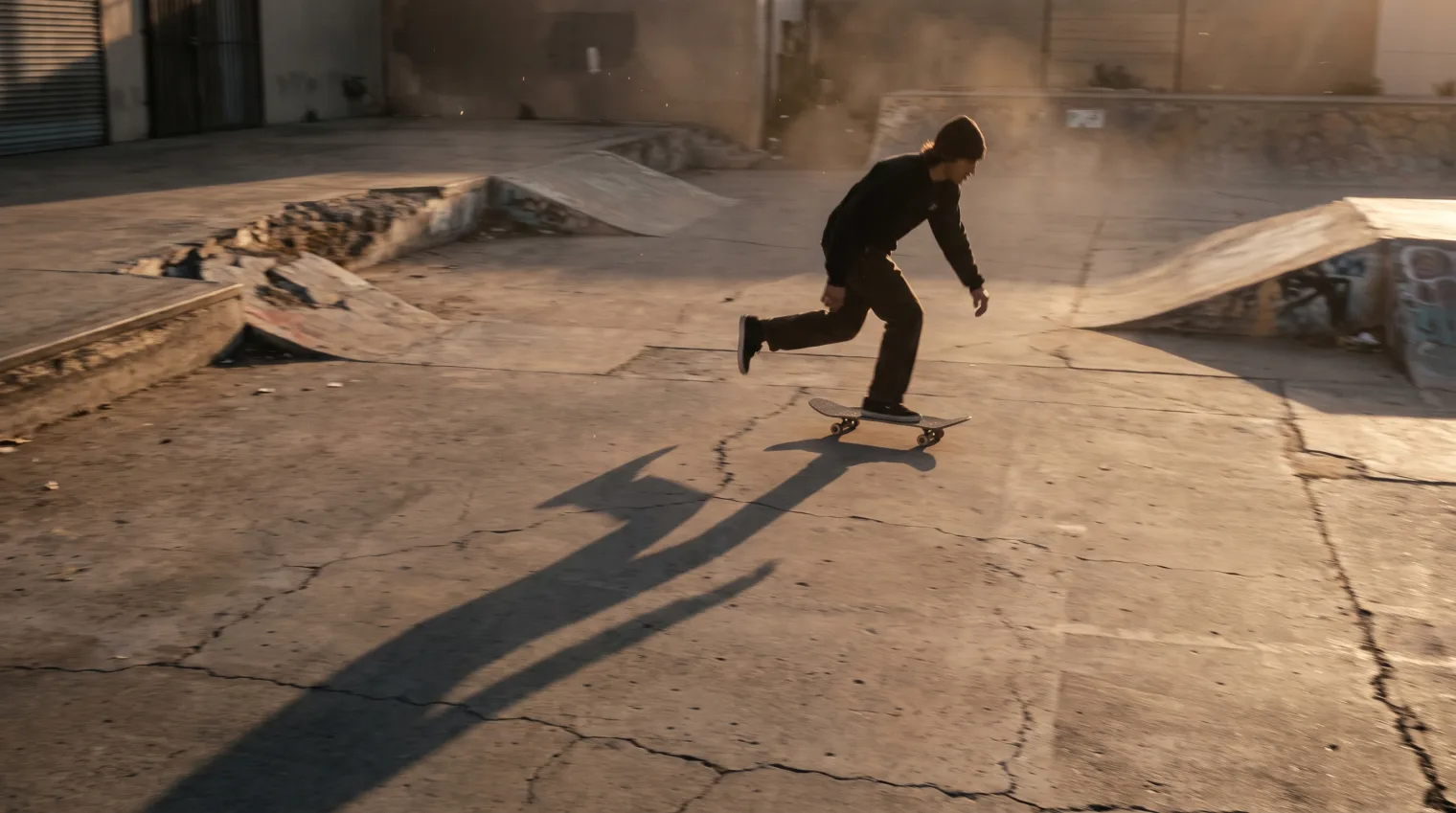
Regular stance means you ride with your left foot forward; goofy means your right foot leads. Neither is better, faster to learn, or more common in a way that matters for you personally, but getting it wrong early on makes every trick feel backward until you fix it.
Stance confusion trips up more beginners than almost anything else in this guide, mostly because the terms get thrown around without a clear definition, and because stance sounds like it should relate to skill level when it does not.
What regular and goofy mean
Regular stance: left foot forward, right foot back and driving the tail. Goofy stance: right foot forward, left foot back and driving the tail. That is the entire definition. It has nothing to do with which foot is dominant in daily life, nothing to do with handedness, and nothing to do with skill.
On Onbolts, every trick in the skill tree that has a directional foot requirement (which is most flatground and grind tricks) is modeled for regular stance by default, with the same trick logic mirrored for goofy skaters. A 50-50 grind, a kickflip, a boardslide: the mechanics are identical, just flipped left to right depending on which foot you push and pop with.
Why "which one is more common" does not matter
Regular is statistically more common, but that fact is irrelevant to how you should learn. You do not choose your stance the way you choose a favorite trick; your natural stance is the one that feels stable and controlled the first time you stand on a board, almost always discovered by accident rather than decided on purpose. Trying to force yourself into the "more common" stance because it seems easier to find tutorials for is a mistake that costs weeks of confused practice.
How to find your stance if you are not sure
The most reliable method is the push test: stand with your feet together, have someone gently push you from behind without warning, and notice which foot instinctively steps forward to catch your balance. That foot is your front foot. A second method: imagine sliding into home base in a game, whichever foot naturally slides forward first is usually your front foot.
If both tests feel roughly even, it is worth trying both stances stationary for a few minutes each before deciding. A small number of skaters do feel balanced both ways at first and only find a clear preference once they start attempting an actual trick like the ollie (beginner, 1 to 4 weeks estimated).
What changes between the stances (and what does not)
Nothing about difficulty, learning time, or trick mechanics changes based on stance. A kickflip is rated intermediate at 1 to 6 months estimated learning time on Onbolts regardless of which foot is forward. What changes is purely directional: mirror the footwork, mirror the rotation direction for spin tricks like the frontside 180 and backside 180 (both beginner, 2 to 5 weeks estimated), and you have the same trick.
This is why watching tutorial videos filmed by a skater of the opposite stance can feel disorienting at first. The trick is identical, but your brain has to actively mirror the footage instead of copying it directly. Some beginners find it helpful to mentally flip the video, imagining themselves in a mirror, rather than trying to translate left-right in real time while attempting the trick.
Stance versus fakie, nollie, and switch: the distinction that confuses people
This is where a lot of beginners run into trouble, so it is worth being precise. Regular and goofy describe your natural, permanent stance, the one you were born with in terms of comfort. Fakie, nollie, and switch describe temporary trick variations layered on top of whichever stance you already have.
Riding fakie means riding backward in your normal stance, still leading with your natural front foot's side of the board, just moving in the opposite direction. Switch means riding in the opposite stance from your natural one entirely, deliberately. Nollie means popping off the nose instead of the tail, while still facing your normal direction. None of these change your stance. They are all things a regular-stance skater or a goofy-stance skater can practice on top of their existing stance.
If you are just starting out, ignore fakie, nollie, and switch entirely. They come later, once your natural-stance tricks are consistent. Confusing "which stance am I" with "should I be practicing switch" is a common early mistake that slows down actual progress.
Does stance affect which tricks you should learn first
No. The recommended beginner path (ollie, then pop shove-it or frontside 180, then kickflip) is the same regardless of stance. On Onbolts, the entire beginner tier of the skill tree is built around the regular-stance trick data by default, but every trick page and every prerequisite works identically once you mentally mirror it for goofy. The learning-time estimates, the mistake lists, the step breakdowns: none of it shifts based on which foot is forward.
Why stance confusion causes more wasted practice than a wrong technique
Getting a technique wrong is usually a quick fix: you see the mistake, you correct it, you move on. Getting your stance backward in your head is a slower, quieter problem, because it does not look like a mistake from the outside. A skater who is truly goofy but has convinced themselves they are regular (often because a friend or a video described regular as the "normal" one) will spend weeks trying to force a front foot position that never quite feels stable, and will usually blame the trick rather than the stance.
The tell is usually consistency, not comfort. Almost every beginner feels a little unstable at first regardless of stance, so "does this feel a bit wobbly" is not a reliable signal. A better signal: after a few sessions of deliberate practice in one stance, are you making steady progress, or does the same specific instability keep showing up no matter how many reps you put in. Persistent, unchanging instability across multiple tricks is a stronger signal of a stance mismatch than of a technique problem.
Stance and which foot pushes
One detail that trips people up during the push test or early practice: your front foot in your stance is not necessarily the same foot you push with while cruising. Some skaters ride in their natural stance but push with their front foot rather than their back foot, a comfortable and completely normal variation that does not indicate anything is wrong with their stance. Do not use "which foot do I push with" as a way to determine stance; use the push test or the sliding-into-base instinct described above instead, since those isolate balance rather than pushing habit.
A note on switching stance later
Some skaters do eventually train switch stance seriously, usually well after their natural stance tricks are consistent to mastered on the 5-level scale (learning, landed once, occasional, consistent, mastered). That is a deliberate, separate skill-building project, not something that affects how you should approach your first ollie. Do not let the existence of switch stance make you second-guess your natural one.
A quick reference for common terms
Because this vocabulary gets used loosely elsewhere, it helps to have the plain definitions in one place:
- Regular: left foot forward, natural and permanent.
- Goofy: right foot forward, natural and permanent.
- Fakie: riding backward in your normal stance, feet unchanged.
- Nollie: popping off the nose instead of the tail, still facing your normal direction.
- Switch: riding in your opposite stance entirely, deliberately.
Only the first two, regular and goofy, describe your actual stance. The other three are trick variations any skater, in either stance, can eventually learn.
The takeaway
Find your natural stance with the push test, trust it, and stop worrying about whether it is the "right" one. Regular and goofy are just mirror images of the same trick set with identical difficulty and identical learning-time data. The real early mistake is not picking the wrong stance, it is confusing stance with fakie, nollie, or switch and trying to practice concepts you are not ready for yet.
Once your stance feels natural, start with the ollie and work through the tricks list in order. Track how you are progressing on the skill tree as each trick moves from learning to mastered.
Frequently asked
- What is the difference between regular and goofy stance?
- Regular stance means you ride with your left foot forward and your right foot on the tail. Goofy stance means the reverse: right foot forward, left foot on the tail. It is purely about which foot feels naturally stable in front, not about skill level or which stance is more common.
- How do I find out if I am regular or goofy?
- The most reliable method is the push test: stand with your feet together and have someone gently push you from behind without warning. Whichever foot instinctively steps forward to catch your balance is your front foot, which tells you your stance.
- Does stance affect how hard a trick is to learn?
- No. Every trick on Onbolts, for example the kickflip (intermediate, 1 to 6 months estimated) or the ollie (beginner, 1 to 4 weeks estimated), has identical difficulty and identical estimated learning time regardless of stance. Regular and goofy are mirror images of the same mechanics, not different skill challenges.
- Is fakie the same thing as goofy stance?
- No, and this is the most common confusion. Fakie means riding backward in your normal stance, your feet do not move. Goofy is a permanent, natural stance where your right foot leads. A regular-stance skater and a goofy-stance skater can both ride fakie; it has nothing to do with which one they are.
- Should I try to learn switch stance as a beginner?
- No, not at first. Switch stance is a deliberate, separate skill-building project usually taken on after your natural-stance tricks are consistent to mastered on the 5-level scale. Trying to work on switch before your basics are solid usually slows down real progress rather than speeding anything up.
- Do tutorial videos matter less if they show the opposite stance from mine?
- Not less useful, just harder to follow directly. The trick mechanics are identical, only mirrored. Some skaters find it helpful to mentally flip the footage, imagining themselves in a mirror, rather than trying to translate left and right in real time while attempting the trick.