blog-post // Jul 26, 2026
The Skateboard Trick Progression Every Beginner Needs to Know
There is a real order to learning skateboard tricks. Here is the beginner progression Onbolts' skill tree is built on, from the ollie to your first flip trick.
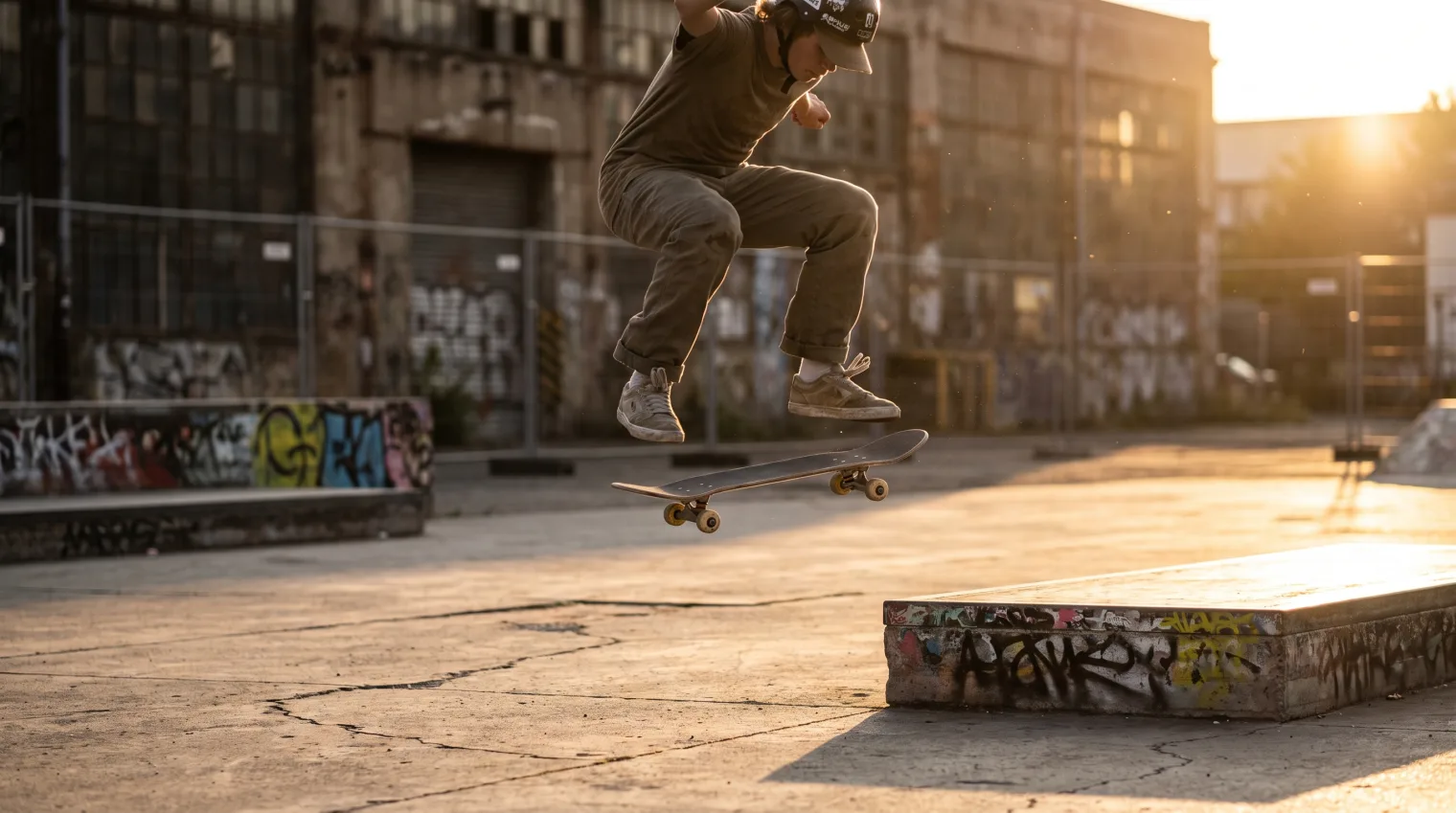
The order you learn tricks in matters more than how many tricks you know. Onbolts' skill tree data shows a small cluster of beginner tricks, mostly variations that branch off the ollie, forms the base of nearly every trick that comes after it. Learn them out of order and you will spend months fighting mechanics you have not built yet. Learn them in order and each new trick reuses something your body already knows.
Why Progression Beats Random Trick-Hopping
A lot of beginners treat trick learning like a checklist: watch a video, try the trick, move to the next video if it does not click in a session or two. This works for isolated tricks but falls apart once you reach anything that depends on another skill.
Onbolts' prerequisite data shows the ollie alone is a direct requirement for at least nine other beginner and intermediate tricks, including kickflip, heelflip, 50-50 grind, backside 180, frontside 180, and pop shove-it. If your ollie pop is weak or your landing is inconsistent, every one of those tricks becomes harder than it needs to be. This is the logic behind Onbolts' skill tree: prerequisites are not arbitrary gatekeeping, they are a map of which mechanics actually transfer from one trick to the next.
Step 1: Rolling, Balance, and Foot Position
Before any named trick, you need to be comfortable standing on a moving board, pushing, turning, and stopping without thinking about it. This is not a trick in the Onbolts database, but it is the actual prerequisite underneath everything else. Skip this stage and every later trick becomes a balance problem disguised as a technique problem.
Foot placement matters here more than most beginners realize. Your stance, regular or goofy, determines which foot leads and which foot drives every pop-based trick from the ollie onward. Onbolts tracks tricks by stance for exactly this reason: the mechanics of a regular-stance ollie and a switch-stance ollie are the same motion, just mirrored, and getting comfortable with your natural stance first makes everything that follows more predictable. There is no rush to try switch stance at this point. Build the habit in your natural stance before adding the complexity of a mirrored one.
Step 2: The Ollie Comes First
Not because it looks good, but because its mechanics, a tail pop combined with a front foot drag that levels the board in the air, show up in some form in almost every trick above it. Onbolts' data puts the ollie at beginner difficulty, 1 to 4 weeks of estimated learning time, which is short compared to what it unlocks.
Do not rush past this step. A shaky ollie compounds into shaky everything else. Spend real time here before moving on to the next branch.
Step 3: Branch Into Ollie-Based Beginner Tricks
Once your ollie is consistent, several tricks become available at once because they all share that same pop-and-level mechanic:
- Pop shove-it - beginner, 1 to 3 weeks. The board rotates 180 degrees under your feet while you stay roughly in place. Fast to learn, and it directly unlocks 360 shove-it later.
- Frontside 180 - beginner, 2 to 5 weeks. You and the board rotate together, frontside.
- Backside 180 - beginner, 2 to 5 weeks. Same idea, opposite rotation direction. Many skaters find one direction noticeably easier than the other, which is normal.
- 50-50 grind - beginner, 2 to 6 weeks. Your first grind trick: ollie onto a ledge or rail and balance on both trucks. It unlocks 5-0 grind and nosegrind next.
These four do not depend on each other in the Onbolts prerequisite data, so you can work on more than one in the same session without conflict.
Step 4: Manual, a Parallel Track
Manual (beginner, 2 to 6 weeks) does not require the ollie at all, according to Onbolts' prerequisite data. It is a balance trick: rolling on your back wheels only, without the board's nose touching down. Because it does not share mechanics with the ollie cluster, it is worth starting early and running in parallel rather than saving for later. Once manual feels solid, nose manual (beginner, 3 to 8 weeks) is the natural next step, balancing on the front trucks instead.
Step 5: Your First Flip Trick
This is where difficulty steps up. Kickflip requires the ollie as a direct prerequisite and moves to intermediate difficulty, with an estimated learning time of 1 to 6 months. That range is wide because kickflip consistency depends heavily on how solid your ollie pop already is. Skaters who rushed the ollie step often find themselves re-learning pop mechanics mid-kickflip, which is exactly why the earlier steps matter.
Heelflip sits alongside kickflip: also intermediate, 1 to 4 months, also requiring the ollie directly. The two use mirrored flick directions, so most skaters find one noticeably more natural than the other, similar to the 180 pair above.
Step 6: Where Boardslide Fits
Boardslide is intermediate, 2 to 6 weeks, and like 50-50 grind, requires only the ollie. It is worth picking up around the same time as your flip tricks rather than treating grinds and flips as separate tracks, since both branches share the same ollie foundation.
Common Mistakes That Slow This Progression Down
Chasing a trending trick out of order. Video algorithms surface whatever looks impressive that week, not what your current trick set can actually support. If a trick you saw online is not connected to anything you already have consistent, expect it to take much longer than the creator made it look.
Treating "landed once" as "done." A trick you have caught on camera once is not the same as a trick your body knows. This distinction is why Onbolts separates landed once from consistent on its 5-level scale. Moving to the next branch before you are actually consistent is the single most common reason beginners feel like they are regressing.
Practicing only on smooth ground. Pop-based tricks behave differently on rough asphalt versus a skatepark surface. If you only ever practice on one surface, your first session somewhere else can feel like starting over. Mix in some rougher terrain once your ollie is solid so the skill transfers.
Ignoring your weaker stance direction. If backside 180 comes easily and frontside 180 does not (or the reverse), it is tempting to only practice the one that feels good. Both eventually matter, since later tricks like 360 shove-it and various spin combinations depend on rotation comfort in both directions.
Why the Tree Branches Instead of Running in a Straight Line
A common misconception is that trick learning is linear: master trick 1, then trick 2, then trick 3. Onbolts' skill tree data shows it is closer to a branching structure. The ollie alone feeds nine or more tricks directly. Once you have kickflip, it becomes a prerequisite for varial kickflip and eventually tre flip (advanced, 6 to 18 months), which sits much further out on the tree.
This branching is part of why Onbolts tracks progress on a 5-level scale (learning, landed once, occasional, consistent, mastered) rather than a simple landed-or-not toggle. "Consistent" is the threshold that actually makes the next trick up the tree more approachable, not just a first landing you happened to catch on camera.
A Realistic Beginner Timeline
Stacking the ranges above: ollie (1 to 4 weeks), then one or two ollie-based tricks in parallel (2 to 6 weeks each), then your first flip trick (1 to 6 months). A beginner training a few times a week can realistically expect somewhere around 3 to 8 months from first push to a consistent kickflip. This is not a guarantee, it is a range built from Onbolts' own learning-time data, and individual results vary with session frequency, surface, and board setup.
Track It Instead of Guessing
Guessing at your own progress is a common reason beginners either quit too early or waste time re-learning tricks they thought they already had. Onbolts' progress tracker logs where you stand on the 5-level scale for every trick you have rated, so you can see objectively whether you are ready for the next branch or still building consistency on the current one.
Where to Go From Here
If you want the order laid out visually instead of as a list, the skill tree shows every prerequisite connection by stance, including the ollie-based cluster covered here. For the full trick database with difficulty and category filters, browse all tricks. And once your ollie is landing clean, the natural next read is what specifically opens up after it, covered in the companion post on what to learn after ollie.
Start with the ollie if you have not already, and build from there.
Frequently asked
- What is the correct order to learn skateboard tricks as a beginner?
- Start with balance and rolling basics, then learn the ollie. From there, branch into pop shove-it, frontside 180, backside 180, and manual, all of which use the ollie as a base except manual, which runs in parallel. Once those feel consistent, move into kickflip and 50-50 grind, then heelflip. This is the order the Onbolts skill tree supports, since each trick reuses mechanics from the one before it.
- Do I need to learn the ollie before anything else?
- Yes, for most of the tree. According to Onbolts' skill tree, the ollie is a direct prerequisite for kickflip, heelflip, 50-50 grind, backside 180, frontside 180, pop shove-it, boardslide, tailslide, and impossible. It is the most connected trick in the entire beginner tier, so it comes first for nearly everything except manual.
- How long should a beginner expect to spend before their first flip trick?
- Onbolts' learning data puts the ollie at 1 to 4 weeks and the kickflip at 1 to 6 months, so realistically 2 to 7 months from a standing start to a landed kickflip with consistent sessions. This includes the ollie plus whatever ollie-based tricks you use to build consistency in between.
- Should I learn manual and pop shove-it before flip tricks?
- It helps but is not mandatory. Manual is its own beginner-level branch that does not require the ollie, so you can start it early. Pop shove-it (1 to 3 weeks) is a fast beginner win that reinforces board control and directly unlocks 360 shove-it, a step toward bigger spin tricks later.
- What if I keep failing the ollie and want to skip ahead?
- Skipping ahead usually backfires because most intermediate tricks build directly on ollie mechanics. Kickflip needs the same pop as an ollie plus a flick. 50-50 grind needs a consistent ollie onto a ledge. If your ollie is inconsistent, everything after it inherits that inconsistency, so the extra weeks on the ollie are worth it.
- Is there a visual way to see this progression instead of reading a list?
- Yes. Onbolts' skill tree at /tree maps every trick's prerequisites visually, filterable by stance, so you can see exactly what unlocks what instead of working from a written list alone.