blog-post // Aug 10, 2026
Switch Skating: What It Means to Skate Your Wrong Foot (And How to Start)
Switch means riding your opposite stance on purpose. Onbolts rates switch kickflip advanced at 4–12 months, versus intermediate at 1–6 months regular.
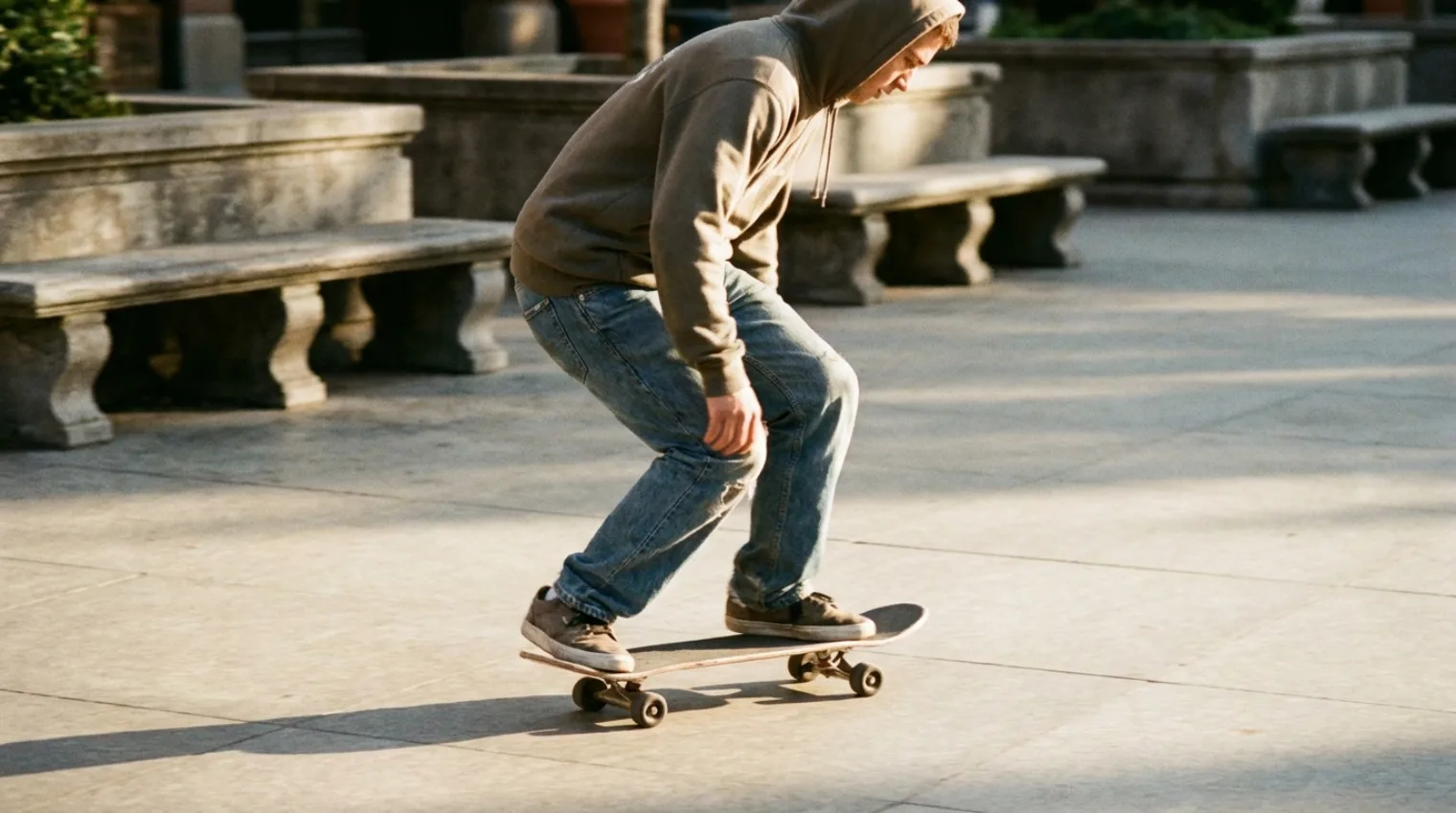
Switch means riding in your opposite stance on purpose, regular skaters riding goofy, goofy skaters riding regular. Onbolts' learning data shows exactly how much that costs you: a regular kickflip sits at 1–6 months and intermediate difficulty, while switch kickflip is rated advanced at 4–12 months, roughly double the upper end of the same trick learned the other way around.
What switch is, and what it is not
If your natural stance is regular, left foot forward, switch has you riding with your right foot forward instead. If you are naturally goofy, switch flips it the other way. This is a deliberate, complete stance swap, not a temporary adjustment.
It gets confused with two other terms constantly. Fakie keeps your stance exactly as it is and only reverses your direction of travel, riding backward with the same foot forward you always ride with. Nollie keeps both your stance and your direction the same, and only changes which end of the board pops. Switch is the only one of the three that changes which foot is forward. On Onbolts, switch tricks carry their own slugs and their own prerequisites, entirely separate rows from their regular-stance counterparts, the same way fakie and nollie tricks do.
Why switch is harder, not just unfamiliar
This is the part that trips people up. Switch is often described as though it is purely a confidence problem, ride switch enough and it will feel normal. That is true eventually, but it undersells the actual gap. Your regular stance has years, sometimes over a decade, of accumulated balance corrections, muscle memory, and pop timing behind it. Switch starts from close to zero on all three, even if you already know the trick cold in your regular stance.
That is why the numbers do not shrink the way people expect. A kickflip is a kickflip mechanically: flick the board with your front foot, catch it, land. But Onbolts' data shows switch kickflip taking 4–12 months against a regular kickflip's 1–6 months, and carrying an advanced rating instead of intermediate. The flick itself is not the reason for the gap. The stance underneath it is that much less practiced.
There is also a perceptual side to this that rarely gets mentioned. Watching yourself skate switch on video often looks close to a mirror image of your regular stance, which can trick you into thinking the gap should close just as fast as any other trick. What that comparison misses is that a mirror image is not the same as lived experience: your brain has to build fresh timing for exactly when to shift weight, exactly how hard to pop, and exactly how a rotation should feel completing, none of which transfer directly just because the movement looks symmetrical from the outside.
Where switch sits on the skill tree
Switch ollie is the entry point for the entire branch. It is rated intermediate on Onbolts and does not list a prerequisite of its own beyond a functioning regular ollie and general board comfort, since it is really about relearning balance in a new stance rather than a new pop mechanic. Once switch ollie is consistent, three tricks open up directly: switch shove-it, switch frontside 180, and switch kickflip.
From there the tree keeps the same shape you would expect from fakie and nollie. Switch 50-50, switch boardslide, and switch noseslide all require switch ollie as their prerequisite, and further tricks like switch tre flip require you to have already landed both switch shove-it and switch kickflip, combining two switch skills you built separately rather than inventing a new one.
Switch kickflip: the clearest data point on how hard switch really is
Look at the kickflip family across every stance variant Onbolts tracks. A regular kickflip is intermediate at 1–6 months. A fakie kickflip is intermediate at 1–3 months, often faster than regular because you already own the flick and only have to adjust for riding backward. Switch kickflip is the outlier: advanced, 4–12 months, the longest window and the only one bumped up a full difficulty tier. That single data point tells you more about what switch costs than a general description could.
How to start switch skating without wasting months
Begin exactly the way you began skating in the first place: just standing on the board switch and rolling. Pushing switch, turning switch, stopping switch, all before attempting a single trick. This feels tedious for skaters who already ride confidently in their normal stance, and it is tempting to skip straight to switch ollie. Skipping it usually costs more time than it saves, because you end up debugging balance and pop timing at the same time instead of one after the other.
Once rolling switch feels unremarkable rather than wobbly, move to switch ollie. Treat it as its own trick with its own timeline, not a shortcut version of your regular ollie, and log it separately on your progress page so you have an honest read on how it is going rather than assuming it will track your regular-stance progress.
What comes after switch kickflip
Once switch kickflip is landing consistently, switch heelflip and switch tre flip open up directly, the latter also requiring switch shove-it as a second prerequisite. Switch hardflip builds further on top of switch kickflip, adding a switch frontside shove-it into the combination. Each of these represents a real step up rather than a quick follow-up, so treat switch kickflip as a milestone worth sitting with, not a trick to rush past on the way to something else.
Switch grinds and slides follow the same curve
The pattern is not limited to flip tricks. Switch 50-50 needs only switch ollie, same as the other first-tier switch tricks. From there, both switch nosegrind and switch 5-0 grind require a landed switch 50-50 before they are realistic, and switch crooked grind sits one step further, needing switch nosegrind specifically. Switch bluntslide needs both switch boardslide and switch noseslide landed first, not either alone, the same combined-prerequisite structure you see with switch tre flip in flip tricks.
None of these grind and slide variants have a published time window in Onbolts' data yet, since terrain access varies too much between skaters to make a tight estimate meaningful. But the prerequisite chain still tells you the order that works: each grind assumes real consistency in the one below it, not a single landed attempt.
Common mistakes learning switch
Underestimating the balance gap. Skaters who already ollie well in their normal stance frequently assume switch ollie will take a fraction of the time their first ollie did. Onbolts' data does not support that assumption, and neither does the experience of most skaters who have gone through it.
Practicing switch only occasionally. Switch skills decay faster than regular-stance skills early on, since you have fewer total reps banked. Skaters who only practice switch once a session, as an afterthought, tend to plateau much earlier than skaters who give it dedicated, regular time.
Trying switch flip tricks before switch ollie is fully consistent. The same rule that applies to fakie and nollie applies here: a plain switch ollie needs to be landing reliably, not just occasionally, before a flip or grind gets added on top of it.
Is switch worth learning at all
Not every skater needs to chase switch tricks, and there is no requirement on Onbolts or anywhere else that says you must. But treating switch purely as an optional bonus undersells what it is. A skater who can ride and pop confidently in both stances has a larger trick vocabulary and more options in a real skate session, not just a party trick for a video part. Switch kickflip specifically, sitting at advanced with a 4–12 month window, is a real marker of a well-rounded skater, not a gimmick.
The takeaway
Switch is riding your opposite stance on purpose, not fakie and not nollie, and it costs real time even for tricks you already know cold the other way. Onbolts' data makes that concrete: switch kickflip's 4–12 months against a regular kickflip's 1–6 months is the clearest single number that shows what switch demands.
Start with switch ollie, treat it as its own trick with its own pace, and once it is consistent, browse the skill tree to see the switch branch open up from there. The full tricks list has every switch variant Onbolts tracks if you want to see how far the branch goes.
Frequently asked
- What does switch mean in skateboarding?
- Switch means riding in your opposite stance on purpose. If you are naturally regular (left foot forward), switch has you riding goofy (right foot forward), and vice versa. It is different from fakie, which keeps your normal stance but reverses your direction of travel, and different from nollie, which keeps your stance and direction the same but pops from the nose.
- Why is switch skating so much harder than it looks?
- Your natural stance has years of accumulated balance, timing, and muscle memory behind it that switch simply does not have yet. You are not doing a mirrored version of something you know, you are building a separate set of reps from close to zero, which is why Onbolts rates the switch versions of tricks meaningfully harder and slower than their regular-stance equivalents.
- How long does switch ollie take to learn?
- Onbolts does not list a specific learning-time window for switch ollie yet, but it is rated intermediate, and it is the single prerequisite the skill tree lists for switch shove-it, switch frontside 180, and switch kickflip. Expect it to take meaningfully longer than your first regular ollie did, since you are rebuilding stance-specific balance from a much smaller base of reps.
- How long does a switch kickflip take compared to a regular kickflip?
- Onbolts' learning data puts a regular kickflip at 1–6 months and rates it intermediate. Switch kickflip is rated advanced at 4–12 months, requiring both a landed regular kickflip and a solid switch ollie as prerequisites. The gap is not really about the flip itself, it is about how much less practiced your switch stance is overall.
- Should I learn switch tricks or focus on progressing my regular stance first?
- There is no rule requiring switch tricks before advancing your regular stance, and most skaters build a solid regular-stance trick list first. But switch is not an optional afterthought either. Tricks like switch kickflip sit on the Onbolts skill tree with their own prerequisites and their own place in a well-rounded trick list, not as a bonus category.
- What is the first switch trick I should try?
- Start with switch ollie, a plain pop and landing in your opposite stance, no rotation or flip. Once it is consistent, switch shove-it and switch frontside 180 are the next tricks the Onbolts skill tree opens up, both listing switch ollie as their only prerequisite.