blog-post // Jul 28, 2026
The Tre Flip: Why It Is a Milestone Trick and How to Get There
The tre flip runs 6-18 months in Onbolts' learning data and needs both pop shove-it and kickflip locked in first. Here's why it's the real skill-tree gate.
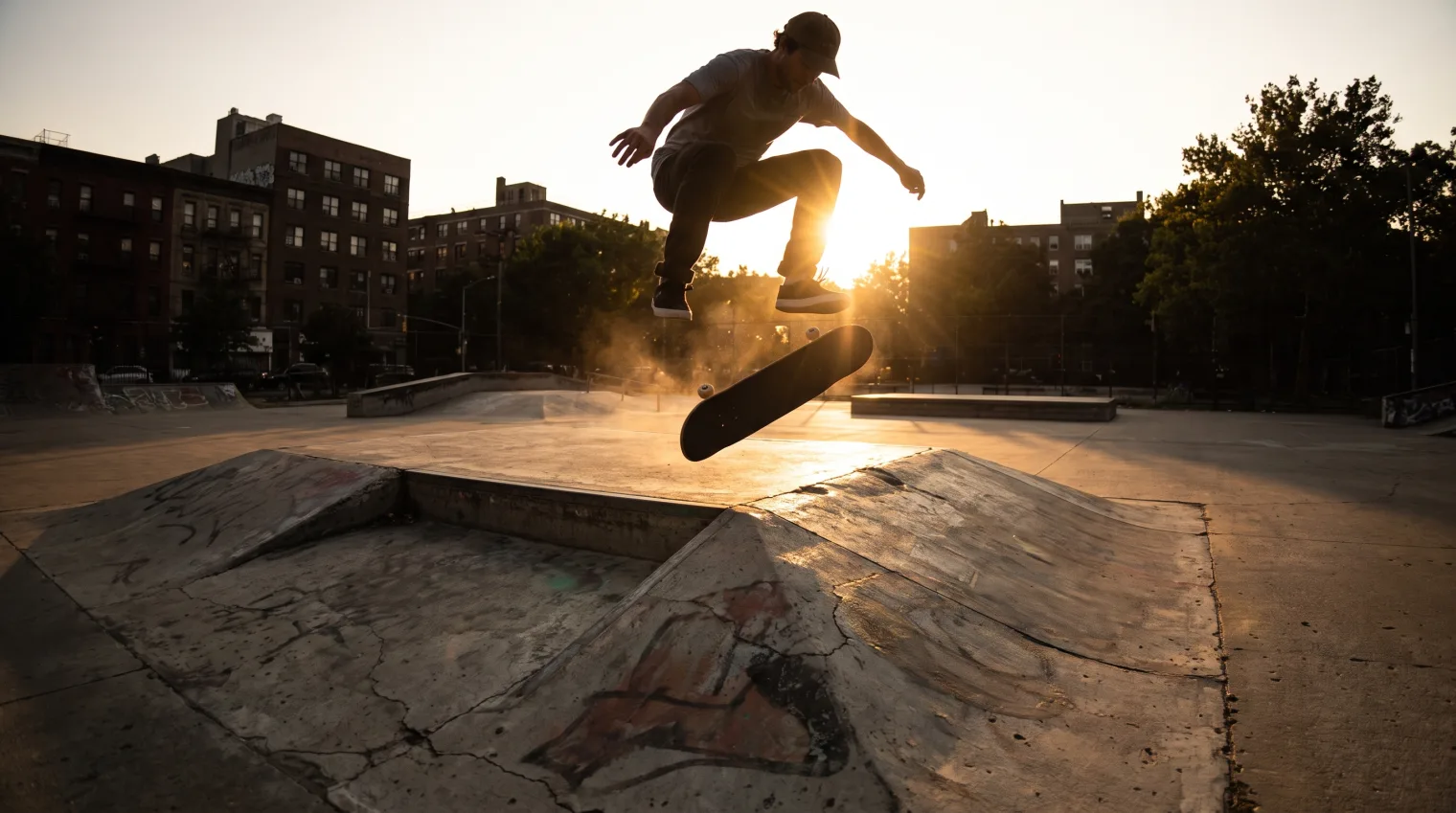
The tre flip takes 6 to 18 months according to Onbolts' learning data, making it the clearest gate trick on the flatground branch: it requires both the pop shove-it and the kickflip as hard prerequisites, and it's genuinely those two tricks happening at once, not a new motion from scratch. If you've landed both prerequisites and you're still stuck, that's normal. This is where most riders spend the longest single stretch of their flip-trick progression.
Why it's called a milestone trick
A lot of tricks on the skill tree build in one direction: more pop, more flip, more rotation, added incrementally. The tre flip is different. It's a true combination trick, a 360 shove-it rotation and a kickflip's flip happening in the same pop. That's why it sits at advanced difficulty while its two prerequisites, pop shove-it and kickflip, are beginner and intermediate respectively. The gap between "I can do the two pieces" and "I can do both at once" is where the real difficulty lives.
Skaters who've landed tricks like the varial kickflip on the way to a tre flip often say the same thing: nothing about landing the individual pieces prepared them for how different it feels to combine them. That's the milestone quality of this trick. It's less a bigger version of what came before and more a genuinely new coordination problem.
The two prerequisites, and why both matter
Onbolts' skill tree lists pop shove-it and kickflip as hard requirements for the tre flip, and this isn't an arbitrary gate. Each one teaches a specific mechanical piece:
- Pop shove-it teaches your back foot to scoop the board into a 360 rotation using a specific angled pop, distinct from a straight-up ollie pop.
- Kickflip teaches your front foot to drag off the edge for a clean flip, and teaches your eyes to track a rotating board through a catch.
A tre flip needs both of those motions from the same pop, at the same time. If either one isn't fully automatic on its own, you're trying to learn a new combined skill while also still cementing one of its parts, which is why rushing into tre flip attempts before both prerequisites hit "consistent" on the 5-level scale almost always backfires.
The two failure modes almost everyone hits
Only spinning, no flip. The board does a clean 360 shove-it rotation but stays flat. This means your scoop is dominating the pop and your flick either isn't happening or is too weak to register against the spin.
Only flipping, no spin. The board flips like a kickflip but doesn't rotate 360 degrees. This is the opposite problem: your flick is doing all the work and your scoop isn't contributing enough rotational force.
Both of these are diagnosable by filming yourself and watching in slow motion. If you consistently get one and not the other, you know exactly which half of the motion to isolate and drill on its own before trying to recombine them.
There's a third, less obvious failure mode worth naming: the board completes both motions but out of sync, so the flip finishes a beat before the spin, or the other way around. This tends to show up once the two failure modes above have mostly been solved individually, and it's a sign you're close. The fix here is less about mechanics and more about timing, and it usually resolves with volume once both pieces are individually strong.
A practical way to bridge the gap
Rather than attempting full tre flips over and over and hoping for a breakthrough, try alternating sessions:
- A pure pop shove-it session, focused on getting the scoop angle and pop timing sharp and automatic.
- A pure kickflip session, focused on flick speed and clean catches.
- A combined session, attempting the tre flip with fresh legs, paying attention to which of the two failure modes above shows up most.
This rotation prevents the common trap of grinding hundreds of failed tre flip attempts without ever isolating which specific mechanic is the actual bottleneck.
How the tre flip differs from the varial kickflip
If you've already landed a varial kickflip, which also combines a shove-it style rotation with a kickflip's flip, it's worth understanding why the tre flip still takes considerably longer for most riders. The varial kickflip's rotation is generally a less demanding spin paired with the flip, and it's often approached as a stepping stone in its own right. The tre flip asks for a full, clean 360 with the flip fully synced, which is a meaningfully higher bar for timing precision even though the individual components (spin and flip) are conceptually the same building blocks.
Why some riders plateau closer to the low end and others closer to the high end
The 6-to-18-month range isn't random variance. Riders who enter the tre flip phase with both prerequisites landing at "mastered," not just "consistent," and who alternate isolated pop shove-it and kickflip reps with combined attempts, tend to land closer to the shorter end. Riders who rush in as soon as both prerequisites hit "consistent," and who drill only full tre flip attempts without returning to isolate the individual pieces when something breaks down, tend to land closer to the longer end. The gap isn't really about talent. It's about how disciplined the practice structure is once the plateau sets in.
Rolling versus stationary attempts
Like most flip tricks, a tre flip attempted while rolling behaves differently than one attempted from a standstill. The added momentum from rolling gives the board a bit more natural stability through the catch, which some riders find makes the combined rotation easier to control. Others prefer starting stationary specifically because it removes one variable (managing speed) while they're still isolating the flick-scoop timing. Neither approach is objectively correct. If you've been drilling exclusively one way for a long stretch without progress, switching to the other for a session or two is a low-cost experiment worth trying.
Patience is part of the trick
Onbolts' 6-to-18-month window for the tre flip is wide because progress here is genuinely non-linear. Riders often report weeks of no visible progress followed by a sudden jump once the flick and scoop finally sync up. This is different from most earlier tricks in the skill tree, where progress tends to feel more incremental. Don't read a flat few weeks as a sign you're doing something fundamentally wrong. It's often just the timeline this specific trick runs on.
Where the tre flip leads next
Once it's consistent, the tree suggests two next tricks: the hardflip, which actually pulls from a different prerequisite pair (kickflip plus frontside shove-it, not pop shove-it), and the laser flip, which builds more directly on tre flip mechanics. Neither is a small step up. The tre flip earns its milestone reputation in part because everything past it on the flatground branch assumes you can combine flip and spin motions on demand.
Common gear tweaks riders try, and whether they help
When a tre flip plateau drags on, it's natural to look at equipment. Slightly looser trucks can make the combined flip-and-spin motion easier to initiate, since less force is needed to get the board moving through both rotations. Some riders also find a touch more grip tape wear (a slightly rougher, more broken-in board) helps the front foot's drag stay consistent rep after rep. Neither of these is a substitute for the mechanical fixes above, and changing gear mid-plateau can also muddy your ability to tell whether a fix worked because of technique or because of the equipment change. If you do experiment, change one variable at a time.
Log it honestly
Given how long the tre flip timeline runs, this is a trick where the 5-level scale (learning, landed once, occasional, consistent, mastered) really earns its keep. "Landed once" after eight months of attempts is a real, legitimate milestone, distinct from being able to do it whenever you want. Track it on your progress page rather than mentally rounding your first successful clip up to "I have this trick."
If you're not yet at pop shove-it and kickflip both consistent, that's the actual starting point, not the tre flip itself. Check the full tricks list to confirm where you stand on both prerequisites, and browse the video library for tutorials that break the flick-scoop combination down piece by piece rather than just showing the finished trick.
Frequently asked
- How long does it take to land a tre flip?
- Onbolts' learning data puts the tre flip at 6 to 18 months, by far the longest window of any trick in the flatground branch below advanced grinds. That range assumes you're starting from consistent pop shove-it and kickflip, not from zero, since both are hard prerequisites.
- What tricks do I need before attempting a tre flip?
- The Onbolts skill tree lists two hard prerequisites for the tre flip: pop shove-it and kickflip. You need both, not either, because a tre flip is genuinely a combination of the shove-it's 360 rotation and the kickflip's flip, happening at the same time.
- Is the tre flip the same as a 360 flip?
- Yes, tre flip and 360 flip are the same trick under different names. Onbolts' database lists it as tre flip, which is the more common name skaters use, but you'll see both terms interchangeably in tutorials and skate media.
- Why does my board only spin, or only flip, but never both?
- This is the single most common tre flip plateau. It usually means your flick and your scoop are happening sequentially instead of together, so your brain (and your feet) are executing one motion, pausing, then the other. The fix is isolating each motion separately until both are fast enough to blend into a single flick-scoop.
- What should I focus on if I've been stuck for months?
- Go back to your pop shove-it and kickflip individually and check they're still landing at 'consistent' or better on the 5-level scale, not just 'occasional.' A tre flip plateau is very often actually a consistency problem in one of the two prerequisite tricks that's bleeding into the combined trick.
- What comes after the tre flip?
- Once your tre flip is consistent, Onbolts' skill tree suggests the hardflip and the laser flip as the next tricks. The hardflip pulls from a different combination (kickflip plus frontside shove-it), so it's a distinct set of prerequisites rather than a direct extension of the tre flip's motion.