blog-post // Jul 29, 2026
Weight Over the Board: The One Thing Most Tutorial Videos Skip
Most tutorials show foot placement and pop, but skip weight distribution. Here is why staying centered over the board fixes more tricks than any single tip.
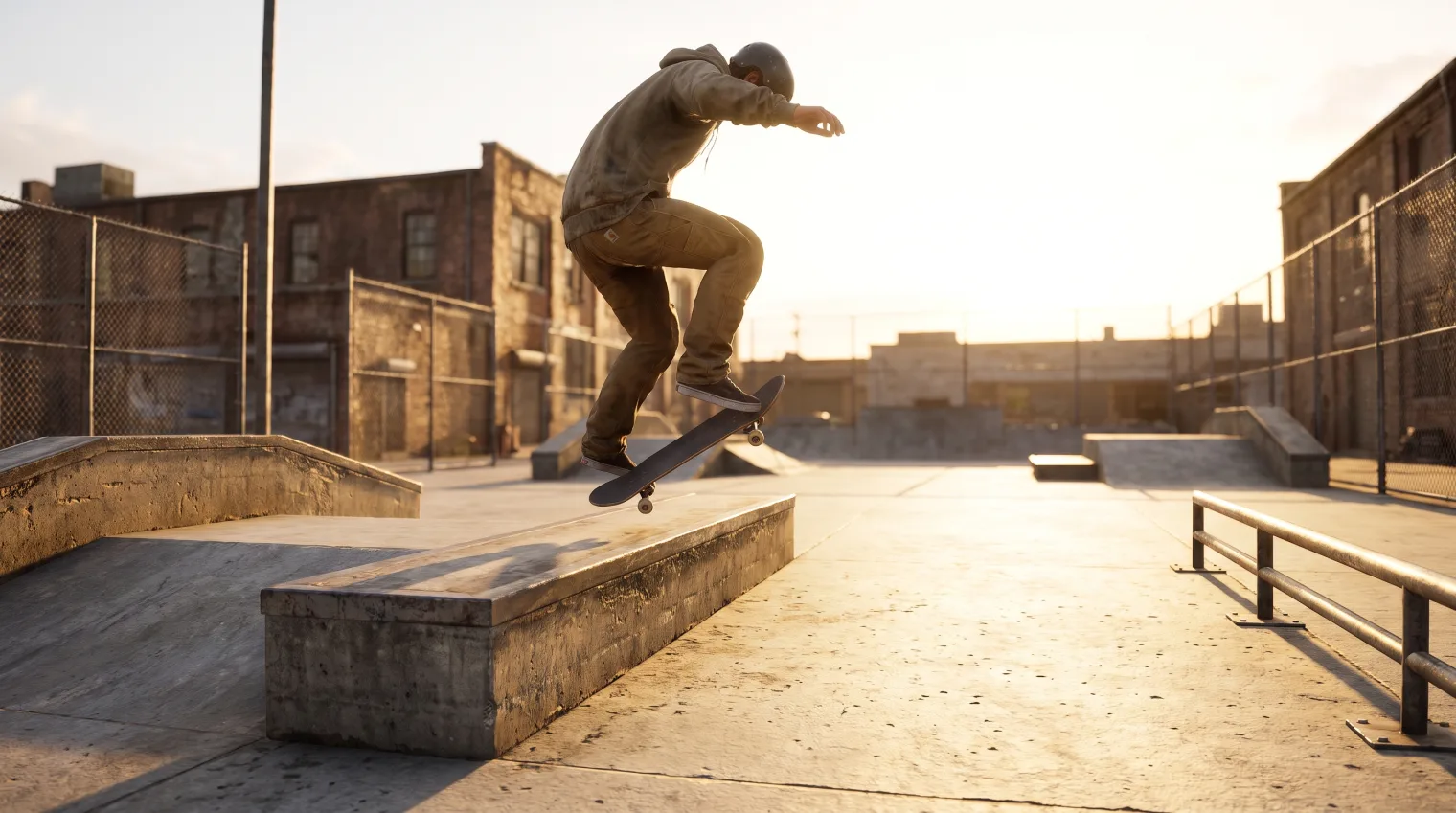
Most tutorials teach foot placement and timing. Almost none of them teach where your weight needs to sit while you do it, and that gap is why so many tricks stall out at the same point: technically correct footwork that still falls apart.
Watch ten tutorial videos for any trick and you will see the same pattern. An arrow points at the back foot. Another arrow points at the front foot. A slow-motion clip shows the pop. What you almost never see is a clear explanation of where the skater's center of mass is sitting through the whole motion, because it is the part that is hardest to film and hardest to describe in a caption.
Why weight gets left out of tutorials
Foot placement is a position. Weight distribution is a process. A still frame can show you exactly where to put your back foot on a kickflip, but it cannot show you that your hips need to stay stacked over the board through the flick, not drifting backward as you commit. That is a felt sense, not a snapshot, and most video content is built around what is easy to freeze-frame.
The result: skaters copy the foot positions exactly, feel like they are doing everything right, and still can't land the trick. The missing piece usually is not their feet. It is their weight.
The single biggest mistake it causes
Leaning back at takeoff. This is the most common mistake tracked across Onbolts' beginner tricks, and it shows up almost identically on the ollie, the kickflip, and anything built on the ollie's pop mechanic. The instinct makes sense: your board is about to leave the ground, and some part of your brain wants to lean away from that uncertainty. But leaning back does three things at once, and none of them help. It kills pop height, it tips the nose down on the way up, and it sets you up to land tail-heavy.
The fix is not complicated to describe, only to do under pressure: keep your spine vertical and your weight centered through the entire pop, not just at the start. Skaters who fix this one habit tend to see the fastest jump in consistency of any single correction, more than any tweak to foot position.
One-shot weight shifts versus continuous balance
Not every trick asks the same thing of your weight, and this is where a lot of beginners get confused moving between trick types.
Pop tricks are one-shot. The ollie, the kickflip, the pop shove-it (beginner, 1 to 3 weeks estimated) all ask for the same shape: centered, a brief committed shift through the pop, then centered again on landing. You load, release, and re-stabilize. It is closer to a jump than a balance exercise.
Balance tricks are continuous. The manual (beginner, 2 to 6 weeks estimated) is the clearest example. You are not making one weight shift, you are making dozens of tiny corrections per second to keep the board from tipping forward onto all four wheels or dropping the tail. It is closer to riding a see-saw than snapping a pop, and skaters who only have reps in one-shot tricks often feel unstable the first time they try to hold a manual, because their body has never practiced ongoing correction.
Slides and grinds sit in between. A boardslide (intermediate, 2 to 6 weeks estimated) or a 50-50 (beginner, 2 to 6 weeks estimated) needs an initial weight shift to get locked onto the ledge or rail, then continuous small adjustments to stay balanced across it, then a weight shift again to pop off cleanly. Skaters who treat it as a single static position tend to slip out mid-slide.
Recognizing which category a trick falls into changes how you should practice it. One-shot tricks reward repetition of the same clean motion. Continuous-balance tricks reward time spent just holding the unstable position, independent of whether you land the full trick.
How to feel your own weight distribution
You cannot see your own center of mass, so you need proxies:
- The shadow check. Skate under a light with a clear shadow and glance down mid-trick. A shadow that shows your head behind your back wheels means you are leaning back.
- The landing spot. On pop tricks, mark a spot on the ground and try to land on the exact spot you took off from. Landing behind that spot almost always means backward weight; landing ahead of it usually means you jumped forward instead of popping.
- The wobble test for balance tricks. On a manual, notice which direction you fall out first. If you consistently drop the nose, your weight is sitting too far back; if you loop out onto the front wheels, it is too far forward.
None of these require a coach or a camera rig. They are ways to turn an invisible internal sense into something you can observe and correct.
Practicing weight distribution without a board
Standing in your stance on flat ground and shifting your weight forward and back, shoulders and hips square, builds the raw sense of centered versus off-centered before you add the complexity of popping or rolling. Standing on an unstable surface like a piece of PVC pipe or a 2x4 adds a version of the wobble a manual or grind creates, without the consequence of a bail.
This matters most for beginners who are trying to learn balance and mechanics at the same time. Isolating the balance piece first means that when you get back on the board, you are only troubleshooting one variable instead of three.
Why this connects to stance too
Weight distribution interacts with your natural stance in a way that surprises a lot of beginners. If you are still working out whether you skate regular or goofy, get that settled first, because every weight cue in this guide (centered, leaning back, drifting forward) assumes you already know which foot is your back foot. Mixing that up mid-practice makes every correction backward.
Why weight distribution problems show up later than you expect
A trick can look solved and still have a weight distribution problem hiding underneath it. This is one of the more frustrating patterns in learning to skate: a skater lands a kickflip a handful of times, moves it from "learning" to "landed once" on Onbolts' 5-level scale, and then stalls for weeks trying to get from occasional to consistent. Often the cause is not a mechanical error in the flip itself, it is that the landing worked by accident on a body position that was not centered, and it only takes a slightly different approach speed or a slightly off pop for the same weight error to cause a bail instead of a save.
This is why "landed once" and "consistent" are treated as different milestones rather than the same achievement. A single clean landing can happen with imperfect weight distribution if everything else lines up. Consistency requires the weight to be right often enough that small variations in your pop, your speed, or the surface do not throw the whole trick off. If you notice a trick you have landed before suddenly failing more often, checking your weight distribution before assuming you have forgotten the trick is usually the faster path back to consistency.
Weight distribution mistakes that mimic other problems
A skater troubleshooting a stalled trick will often blame the wrong thing, because weight distribution errors produce symptoms that look identical to other issues. A kickflip that is not flipping all the way around is frequently blamed on a weak flick, when the real cause is weight sitting too far back, which shortens the time the board spends in the air and cuts the flip short regardless of how hard the flick was. A grind that keeps sliding off the ledge early is often blamed on speed, when the actual issue is weight drifting forward mid-grind rather than staying centered over the trucks.
Before changing something you are confident about (flick strength, approach speed, pop timing), it is worth ruling out weight distribution first, since it is the variable most tutorials skip and therefore the one beginners are least likely to have already checked.
The takeaway
Foot placement gets you into position. Weight distribution is what makes a trick work once you are there. If you have the footwork down for a trick and it still is not clicking, stop drilling the same motion and start checking where your weight is sitting through it, not just where your feet are.
Onbolts tracks the mistakes tied to specific weight-distribution errors on step-by-step trick pages, alongside the standard 5-level progress scale (learning, landed once, occasional, consistent, mastered) so you can see exactly where a trick tends to stall. Browse the full skill tree or start from the tricks list to find where your next weight-distribution lesson is hiding.
Frequently asked
- Why do skateboarding tutorials rarely mention weight distribution?
- Weight distribution is hard to film and hard to point at. A tutorial can show foot placement with an arrow and show the pop with a slow-motion clip, but the way a skater's center of mass shifts over the board is an internal, felt thing rather than a visible position. Most videos default to what is easy to demonstrate, which is where your feet go, not where your weight sits.
- What does 'weight over the board' mean?
- It means keeping your center of mass stacked over the deck's contact points with the ground, adjusting as the board tilts, pops, or slides. On a flat trick like the ollie, that means staying centered through the pop instead of leaning back. On a manual or a grind, it means constantly rebalancing as the board's angle changes underneath you, not locking into one static position.
- What is the most common weight-distribution mistake in skateboarding?
- Leaning back at takeoff on pop tricks. It shows up on the ollie, the kickflip, and every trick that builds on the ollie's pop mechanic. The instinct to lean away from the board right as you commit to the trick is one of the most persistent habits beginners carry, because it feels safer even though it kills height and control.
- How is weight distribution different for a manual versus an ollie?
- The ollie is a one-time weight shift: centered, then a brief compress-and-pop, then centered again on landing. The manual (beginner, 2 to 6 weeks estimated on Onbolts) is continuous: you are constantly making tiny adjustments to stay balanced on two wheels, closer to riding a see-saw than snapping a pop. Skaters who only practice one-shot weight shifts often struggle when they first try to hold a manual, because it demands ongoing correction instead of a single committed motion.
- Can bad weight distribution cause injuries?
- Yes, indirectly. Leaning back on landings is a common cause of slipping out backward, and over-compensating forward on slides or grinds can pitch a skater off the front of the board. Weight distribution problems do not usually cause dramatic injuries on their own, but they are frequently the underlying reason a trick feels unstable or unpredictable even after the footwork looks correct.
- How do I practice weight distribution off the board?
- Stand in your stance on flat ground (no board) and practice shifting your weight forward and back while keeping your shoulders and hips square. Then try it standing on a 2x4 or a piece of PVC pipe to simulate instability. This isolates the balance skill from the mechanics of popping or rolling, which is useful because most beginners are trying to learn both at once.