blog-post // Jul 30, 2026
What to Learn After Ollie: The 8 Tricks That Open Up Skating
Landed your first ollie? Onbolts' skill tree shows 8 tricks unlock directly: pop shove-it, both 180s, kickflip, heelflip, 50-50, boardslide, tailslide.
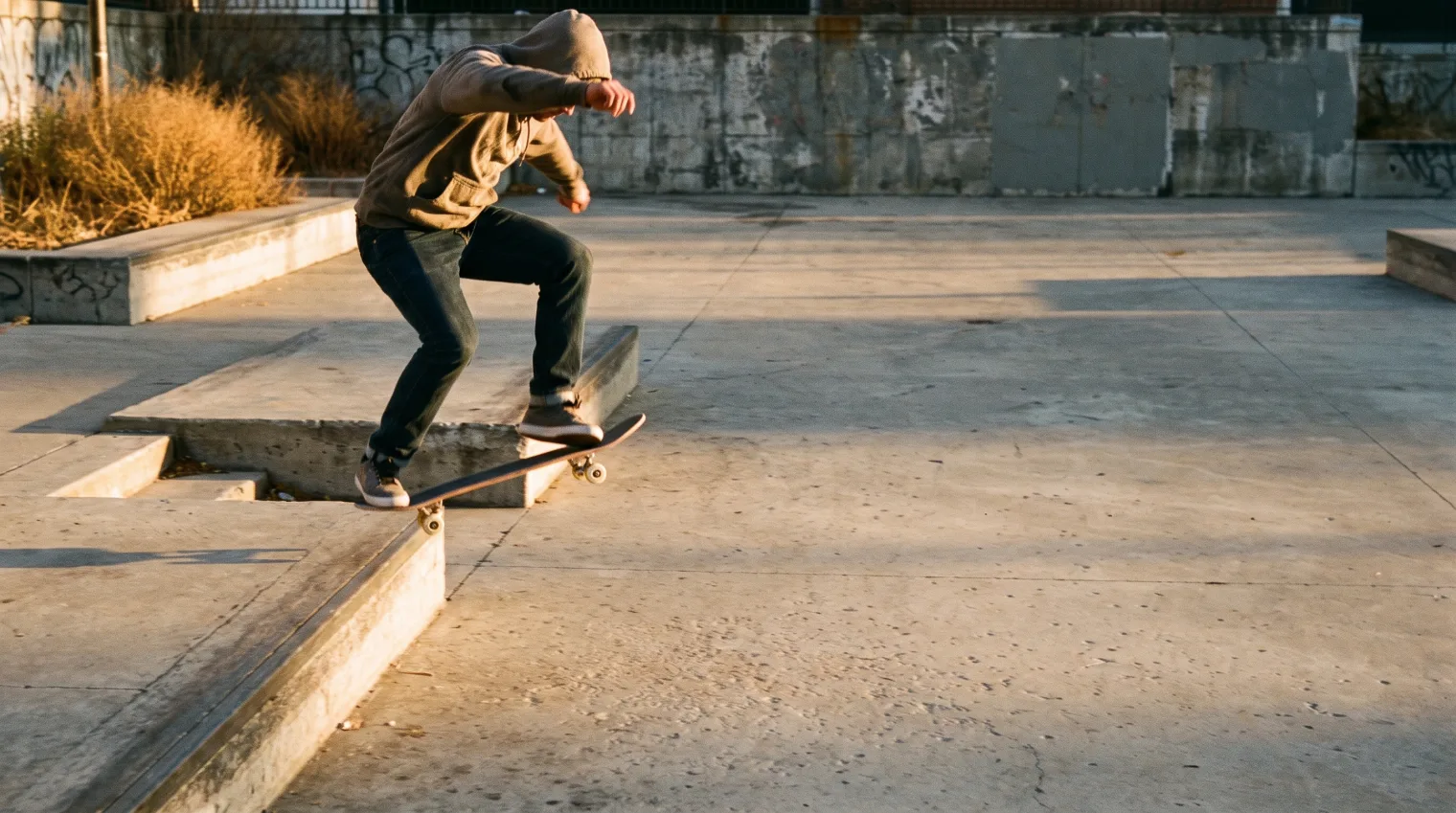
Once your ollie is consistent, eight tricks become directly available: pop shove-it, frontside 180, backside 180, kickflip, heelflip, 50-50 grind, boardslide, and tailslide. Onbolts' skill tree lists the ollie as a direct prerequisite for all eight, more than any other trick in the beginner tier. This post breaks down what each one demands, roughly how long to expect, and which order makes the transition smoothest.
Why the Ollie Unlocks So Much
The ollie is a beginner trick with an estimated learning time of 1 to 4 weeks in Onbolts' data, but its mechanics (a tail pop paired with a front foot drag that levels the board mid-air) are reused, modified, or built on top of in nearly every trick that follows. That is why the skill tree shows it feeding directly into so many branches: it is not that the ollie is required by convention, it is that the pop and the airborne board control are the actual mechanical foundation of everything else.
If you just landed your first clean, consistent ollies, here are the eight tricks Onbolts' prerequisite map opens up, grouped by what they actually train.
First, Confirm Your Ollie Is Actually Ready
"Landed once" and "ready to build on" are different things. If your ollie only clears a few inches, drifts sideways, or only works when you are not thinking about it, the tricks below will expose that inconsistency fast, especially kickflip and heelflip, which add a flick on top of the same pop. A reasonable bar before moving on: you can ollie ten times in a row over a crack or small gap without a miss, and you can do it without a run-up if needed. If you are not there yet, more ollie reps now will save you time on every trick in this list.
Group 1: Rotation Tricks (Same Pop, New Spin)
Pop shove-it - beginner, 1 to 3 weeks. The board spins 180 degrees under your feet while your body stays mostly still. This is usually the fastest win after the ollie because the pop mechanic barely changes, you are just adding a scoop with your back foot instead of a straight snap. It is also a direct prerequisite for 360 shove-it later, so it is worth prioritizing early.
Frontside 180 - beginner, 2 to 5 weeks. Now your body and the board rotate together, frontside, off an ollie pop. This trains shoulder and hip rotation timing that shows up again in bigger spin tricks much later on the tree.
Backside 180 - beginner, 2 to 5 weeks. The mirror of frontside 180, rotating the opposite direction. Most skaters land one of the two 180s noticeably faster than the other. That asymmetry is normal and usually tracks with which direction feels natural when you turn on the ground.
Learning tip: work pop shove-it and one of the two 180s in the same sessions. They do not depend on each other in the prerequisite data, so there is no reason to sequence them strictly.
Group 2: Your First Flip Tricks
Kickflip - intermediate, 1 to 6 months. This is the biggest jump in difficulty on this list, and it is the one most beginners are impatient to reach. The wide time range reflects how much kickflip consistency depends on ollie quality. If your pop is inconsistent, the flick timing becomes nearly impossible to repeat. Give your ollie more reps before diving in if it still feels shaky.
Heelflip - intermediate, 1 to 4 months. Same pop mechanic as kickflip, opposite flick direction (heel instead of toe). Many skaters find heelflip's flick more awkward to learn even though its estimated range is shorter, because the ankle motion is less natural for most people than a toe flick.
Between kickflip and heelflip, there is no required order in Onbolts' data. Some skaters land heelflip faster because the flick feels more intuitive; others get kickflip first because it is the more commonly practiced motion. Try both and follow whichever clicks.
Group 3: Grinds and Slides
50-50 grind - beginner, 2 to 6 weeks. Your first grind: ollie onto a ledge or rail and balance evenly on both trucks. This is a different skill category from the flip and rotation tricks above (it tests pop height and landing precision onto an object, not in-air board control), so it is worth starting even if your kickflip is not there yet.
Boardslide - intermediate, 2 to 6 weeks. Ollie onto a ledge or rail and slide on the deck itself, perpendicular to the obstacle. Like 50-50 grind, this only needs the ollie, not any of the other tricks on this list, so it can run in parallel.
Tailslide - intermediate difficulty per Onbolts' trick data, and also unlocked directly by the ollie. It shares the ledge-approach skills from boardslide and 50-50 grind but balances on the tail rather than the deck or trucks.
What About Switch, Nollie, or Fakie Versions?
If you have been skating a while and already have a decent regular-stance ollie, you might be tempted to start mirroring these eight tricks in switch or nollie stance right away. Onbolts' prerequisite data shows this is possible in parallel, but it is not free: switch kickflip, for example, requires both switch ollie and your regular-stance kickflip, not just one or the other. The flick mechanics from your regular kickflip do transfer conceptually, but your body still needs the switch-stance ollie built independently before the combination becomes realistic.
A practical approach: get your regular-stance version of a trick from this list to consistent first, then start switch or nollie practice on the same trick once the regular version is not taking active concentration to land. Trying to build both stances at once on a brand-new trick usually just slows down the regular-stance version without meaningfully speeding up the mirrored one.
A Sensible Order If You Only Pick a Few
You do not need to chase all eight at once. A practical order, based on which tricks share mechanics and which unlock the most afterward:
- Pop shove-it first, because it is the fastest and reinforces pop control with minimal new variables.
- One of the two 180s next, whichever direction felt more natural when you tested both.
- 50-50 grind or boardslide, if you have access to a ledge or low rail, since these develop a different skill (obstacle approach) that flip tricks do not touch.
- Kickflip and heelflip once your ollie feels bulletproof, not just landable. These take the longest and reward a strong foundation.
Why Some Skaters Get Frustrated Right After the Ollie
There is a common dip in motivation right after the ollie because the next tricks do not feel like small steps, they feel like a wall. Pop shove-it and the 180s are genuinely close in difficulty to the ollie itself, but kickflip and heelflip both jump to intermediate and take months, not weeks. If you go straight for a flip trick without the easier ollie-based tricks first, that jump can feel discouraging.
Working the beginner-level tricks in this list first, pop shove-it, one of the 180s, and 50-50 grind or boardslide if you have access to a ledge, gives you visible progress while your flip trick attempts are still slow and inconsistent in the background. You are not wasting time on the beginner tricks. You are building a base that makes the flip tricks land sooner, and you get the confidence boost of new tricks landing along the way.
What Comes After This Layer
Once kickflip is consistent, it becomes the gateway to varial kickflip and eventually tre flip (advanced, 6 to 18 months). Once 50-50 grind is consistent, it opens 5-0 grind and nosegrind. The pattern repeats up the tree: each trick you land becomes a prerequisite for something further out.
How to Know You Are Actually Ready to Move On
A trick landed once is not the same as a trick you can build on. Onbolts tracks progress on a 5-level scale, learning, landed once, occasional, consistent, and mastered, specifically because the jump from "landed it on camera" to "consistent" is where the trick actually becomes a reliable foundation for the next one. If you are still at landed once on your ollie, expect the tricks in this post to take longer than the ranges above suggest.
Log your ratings in the progress tracker so you are making that call based on your actual history, not a hopeful guess.
Related Reading
For the full picture of how beginner and intermediate tricks connect, see the right order to learn beginner skateboard tricks and browse the skill tree to see every prerequisite laid out visually by stance. If you are past this stage already and wondering what comes after your first flip tricks, the intermediate trick order guide picks up exactly where this one leaves off.
Start wherever your ollie consistency allows, and check the full trick list to filter by difficulty as you go.
Frequently asked
- What tricks can I learn right after landing an ollie?
- Onbolts' skill tree lists eight tricks that require the ollie directly: pop shove-it, frontside 180, backside 180, kickflip, heelflip, 50-50 grind, boardslide, and tailslide. Pop shove-it and the two 180s are usually the fastest wins, while kickflip and heelflip take the longest.
- Which is easier after the ollie, kickflip or heelflip?
- Onbolts' data puts kickflip at 1 to 6 months and heelflip at 1 to 4 months, so heelflip's range is shorter on paper. In practice it depends on the skater: some find the heel flick more natural, others find the toe flick from kickflip easier to control. There is no required order between the two.
- Should I learn pop shove-it or a 180 first after the ollie?
- Pop shove-it (1 to 3 weeks) is usually the fastest of the ollie-based tricks and is a good first pick because it barely changes the pop mechanic you just built. Frontside 180 and backside 180 (2 to 5 weeks each) add body rotation on top, so many skaters find them slightly harder than pop shove-it.
- Do I need 50-50 grind before I can try boardslide?
- No. Onbolts' prerequisite data shows both 50-50 grind and boardslide require only the ollie, not each other. You can work on either, or both, independently once your ollie is consistent.
- How do I know when I am ready to move past this group of tricks?
- Readiness is about consistency, not a single landing. Onbolts tracks progress on a 5-level scale (learning, landed once, occasional, consistent, mastered), and reaching consistent on your ollie and at least one or two tricks in this group is a reasonable signal you are ready to branch further, into varial kickflip or 5-0 grind for example.
- What comes after this group of eight tricks?
- Once kickflip is consistent, it becomes a prerequisite for varial kickflip and eventually tre flip (advanced, 6 to 18 months). Once 50-50 grind is consistent, it opens 5-0 grind and nosegrind. The tree keeps branching the same way from each trick you land.