blog-post // Aug 1, 2026
Why Skateboard Tricks Take Longer Than You Expect (It Is Not Just Practice)
Skateboard tricks routinely take longer than beginners expect. Here is why, backed by Onbolts' learning-time ranges, and what actually shortens the gap.
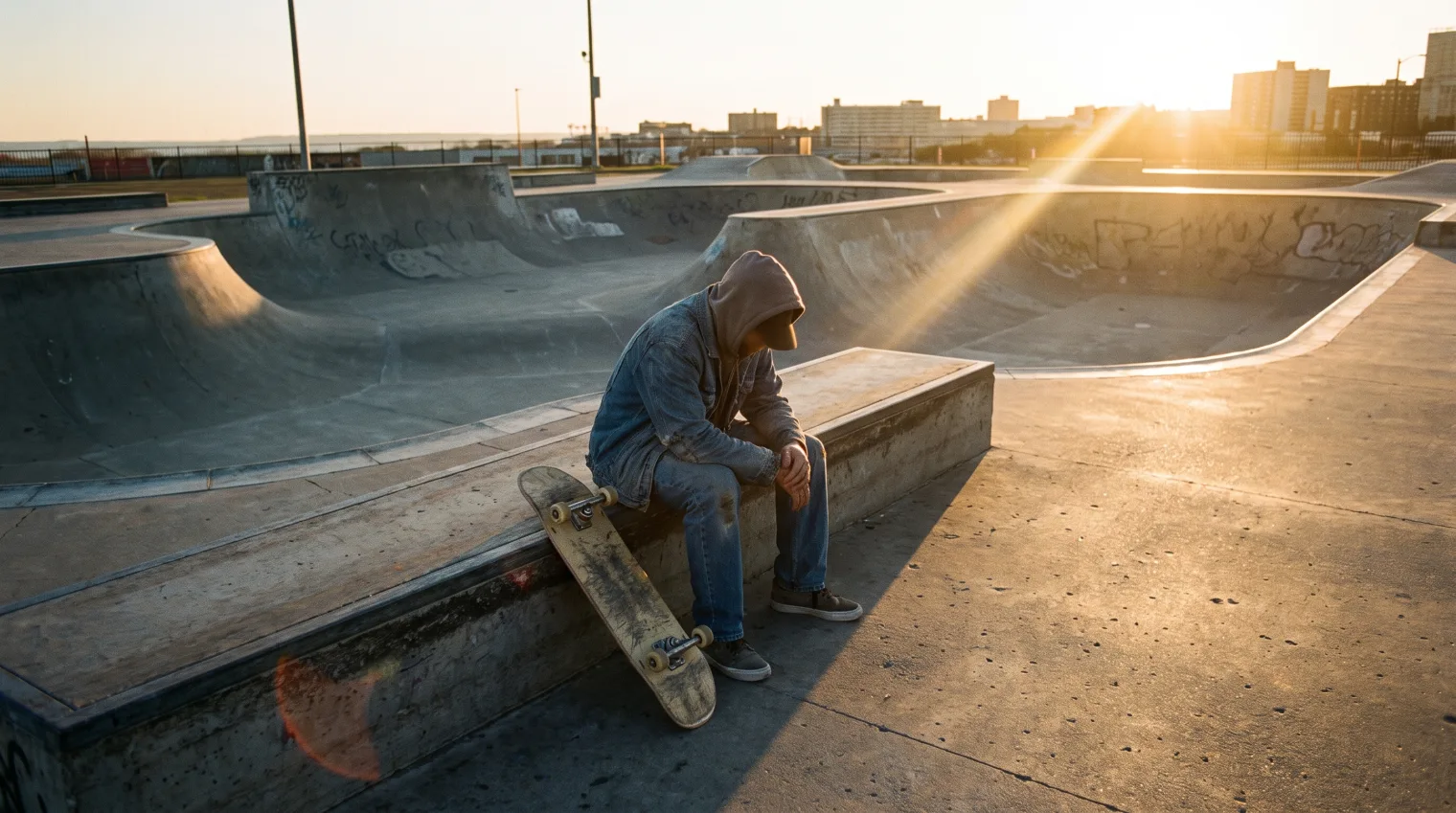
Skateboard tricks take longer than beginners expect because the visible version of "learning a trick" is a highlight reel, not a record of the actual process. Onbolts' learning-time data reflects real ranges, not best cases: a kickflip spans 1–6 months, a tre-flip spans 6–18 months. Those windows are wide because skateboarding progress is not linear, and understanding why changes how you handle the slow stretches.
This post breaks down the actual reasons tricks take longer than expected, using real learning-time data from the Onbolts skill tree, and what you can do about the parts that are actually in your control.
The highlight reel problem
Every trick you see landed online is one successful attempt out of however many it took to get there. A ten-second clip of someone stomping a kickflip does not show the two hundred attempts before it, the sessions where nothing clicked, or the weeks of plateau in the middle. Beginners calibrate their expectations against the clip, not the process, and then feel like they are failing when their own timeline does not match a highlight reel that was never a fair comparison in the first place.
Onbolts publishes learning-time ranges specifically to correct for this. A kickflip at 1–6 months is not a typo, it is what actually happens across a wide range of riders with different practice frequency and technique.
Difficulty does not scale evenly
One trick does not predict how long the next one takes. Look at the gap between an ollie (1–4 weeks) and a 50-50 (2–6 weeks) versus the gap between a kickflip (1–6 months) and a tre-flip (6–18 months, and it also needs a pop shove-it as a second prerequisite). Both pairs are "one step apart" in the skill tree, but the second jump is roughly ten times larger in raw time. If your last trick took three weeks, there is no reason to expect the next one will also take three weeks. Check the actual estimated range before setting expectations, not the pattern from your last trick.
Small technique errors compound, they do not average out
A trick like a kickflip or hardflip (4–12 months) is not one motion, it is several motions stacked: pop, flick, rotation, catch, landing. A small error in any one of those does not stay small, it throws off everything after it. This is why attempt count alone is a bad predictor of progress. Ten attempts with the same flick error teach your body the same wrong pattern ten times; ten attempts where you isolate and fix one variable at a time teach ten different things.
This is also why filming yourself matters more as tricks get harder. You cannot feel the difference between a flick that is five degrees off and one that is dead on, but you can see it on video.
Plateaus are part of the process, not a sign of failure
Most riders hit at least one stretch where nothing seems to change for a week or two, even inside a normal learning window. This is common enough that it should be expected, not treated as evidence you are doing something wrong. The Onbolts 5-level scale (learning, landed once, occasional, consistent, mastered) exists partly to make plateaus visible instead of invisible: moving from "landed once" to "occasional" can take just as long as the initial landing, and that stage often feels like a plateau even though it is real progress toward consistency.
What actually shortens the gap
Isolating the specific failure point. "I keep bailing" is not specific enough to fix. "My board is not rotating fully before I catch it" is. The more precisely you can name what is going wrong, the faster you can target practice at it.
Slowing down before speeding up. For most flip and flick tricks, learning the motion at a slower, more controlled speed before adding full board speed shortens the overall timeline, even though it feels slower in the moment.
Session frequency over session length. A short session every day beats one long session per week for motor-skill tricks. Skateboarding tricks rely heavily on muscle memory, which decays between sessions, so frequency matters more than total hours logged.
Comparing yourself to the range, not a person. Onbolts' learning-time windows exist because individual variation is real and large. Landing a kickflip in five weeks and landing one in five months are both inside the normal 1–6 month range. Neither means you are unusually gifted or unusually behind.
Using the data to set your own expectations
Before starting a new trick, check its estimated learning time in the full trick list or on the trick's own page, and treat the upper end of the range as normal, not a worst case. If you are working toward a heelflip (1–4 months) or anything further out in the tree, knowing the real range up front means a slow week three weeks in reads as "on schedule" instead of "failing."
Log your attempts honestly in progress rather than only marking a trick once it is fully consistent. Watching your own status move through the 5-level scale over real weeks is the most accurate picture you will get of your actual learning curve, and it is a far better reference point than someone else's highlight clip.
Tricks take as long as they take. The Onbolts data exists so you are working from real ranges instead of guesswork, and so a long stretch without visible progress reads correctly: normal, not broken.
Survivorship bias in skate content
Video content skews the picture of trick difficulty in a specific, predictable direction. A rider who lands a hardflip in three weeks is far more likely to post that clip than a rider who is still working on it four months in, simply because the fast timeline is more exciting to share. Over time, the tricks that circulate online are disproportionately the fast outliers, not the typical case. This is not a conspiracy, it is just what gets shared. Onbolts' 4–12 month range for the hardflip is the actual distribution, and the three-week clip you saw is real but sits at the extreme fast end of it, not the middle.
Equipment and body changes also shift the timeline
Learning-time estimates assume relatively stable conditions, but real timelines get disrupted by things that have nothing to do with skill: a new deck with different concave, worn-down grip tape that changes foot grip, growth spurts in younger riders that shift balance and proportions, or simply skating in shoes with a different sole thickness. Any of these can knock a rider's timing off for a session or two even on a trick they had close to consistent. Recognizing when a setback is equipment-related rather than a skill regression prevents you from restarting your mental clock on a trick you had actually nearly finished learning.
The role of terrain in perceived difficulty
The same trick can feel wildly different in difficulty depending on where you are practicing it. A 50-50 on a smooth, low skatepark ledge with good runway is a different task than the same grind attempted on rough, cracked pavement with a short approach. When a trick suddenly feels much harder than it did the session before, check whether the surface, the obstacle height, or the approach distance changed before assuming your skill regressed. A lot of apparent plateaus are actually terrain mismatches, not stalled progress.
Reframing the wait as normal, not exceptional
The single biggest mindset shift that helps riders push through a long learning window is treating the estimated range itself as the plan, not as a worst case to beat. If a trick is estimated at 1–6 months and you are at month three with steady but incomplete progress, you are on schedule, not behind. Skaters who internalize the full range going in report less frustration and, anecdotally, tend to stick with a trick longer through the plateau stretches that would otherwise cause a rider expecting a two-week timeline to give up entirely.
The one variable most riders never test
Beyond frequency and technique, sleep and physical fatigue quietly affect trick timelines more than most riders account for. Motor skill learning consolidates during rest, particularly sleep, which means two identical sessions on consecutive tired days often produce worse results than one focused session followed by a rest day. If a trick that was improving steadily suddenly stalls, checking whether recent sessions have been rushed, tired, or squeezed in between other commitments is worth doing before concluding the trick itself is unusually hard.
Frequently asked
- Why do skateboard tricks take so much longer than I expect?
- Mostly because the online version of learning a trick, a clip of someone landing it, skips every failed attempt that came before. Onbolts' learning-time ranges (for example 1–6 months for a kickflip, 6–18 months for a tre-flip) reflect real distributions of riders, not best-case outliers, and most beginners only ever see the best case.
- Is it normal to not land a trick after weeks of practice?
- Yes, and it is expected for most intermediate and advanced tricks. Onbolts' data shows a kickflip alone spans a 1–6 month range and a tre-flip spans 6–18 months, so weeks of failed attempts on either is well within a normal timeline, not a sign something is wrong.
- Does more practice always mean faster progress?
- No. Repeating the same mistake at high volume mostly reinforces the mistake. Riders who review footage, isolate the specific part of a trick that is failing, and adjust between attempts progress faster than riders who just log more attempts without changing anything.
- Why did my last trick take way longer than the one before it?
- Because tricks are not evenly spaced in difficulty. Onbolts' skill tree shows this directly: ollie to 50-50 is roughly 2–6 weeks, but kickflip to tre-flip (which also needs a pop shove-it) is estimated at 6–18 months. Some jumps in the tree are small; others are large, and the trick before does not predict the trick after.
- How do I know if I am actually stuck versus just early in a long learning window?
- Check whether your attempts are changing at all, even in small ways: getting closer to full rotation, popping cleaner, landing further into the trick before bailing. If those small markers are moving, you are progressing inside a normal window. If nothing has changed in many sessions, that is the signal to change your approach, not just add more attempts.
- Do learning-time estimates account for skate frequency?
- Onbolts' estimated learning times assume reasonably regular sessions, not daily skating or occasional weekend sessions specifically. Riders skating several times a week tend to land toward the shorter end of a given range; riders skating less often should expect the longer end or beyond it.