blog-post // Aug 8, 2026
The Physics of Flip Tricks: Why Boards Spin the Way They Do
Flip tricks rotate on two axes: a flip axis and a rotation axis. Combining both is why varial kickflip, hardflip, and tre flip take so much longer.
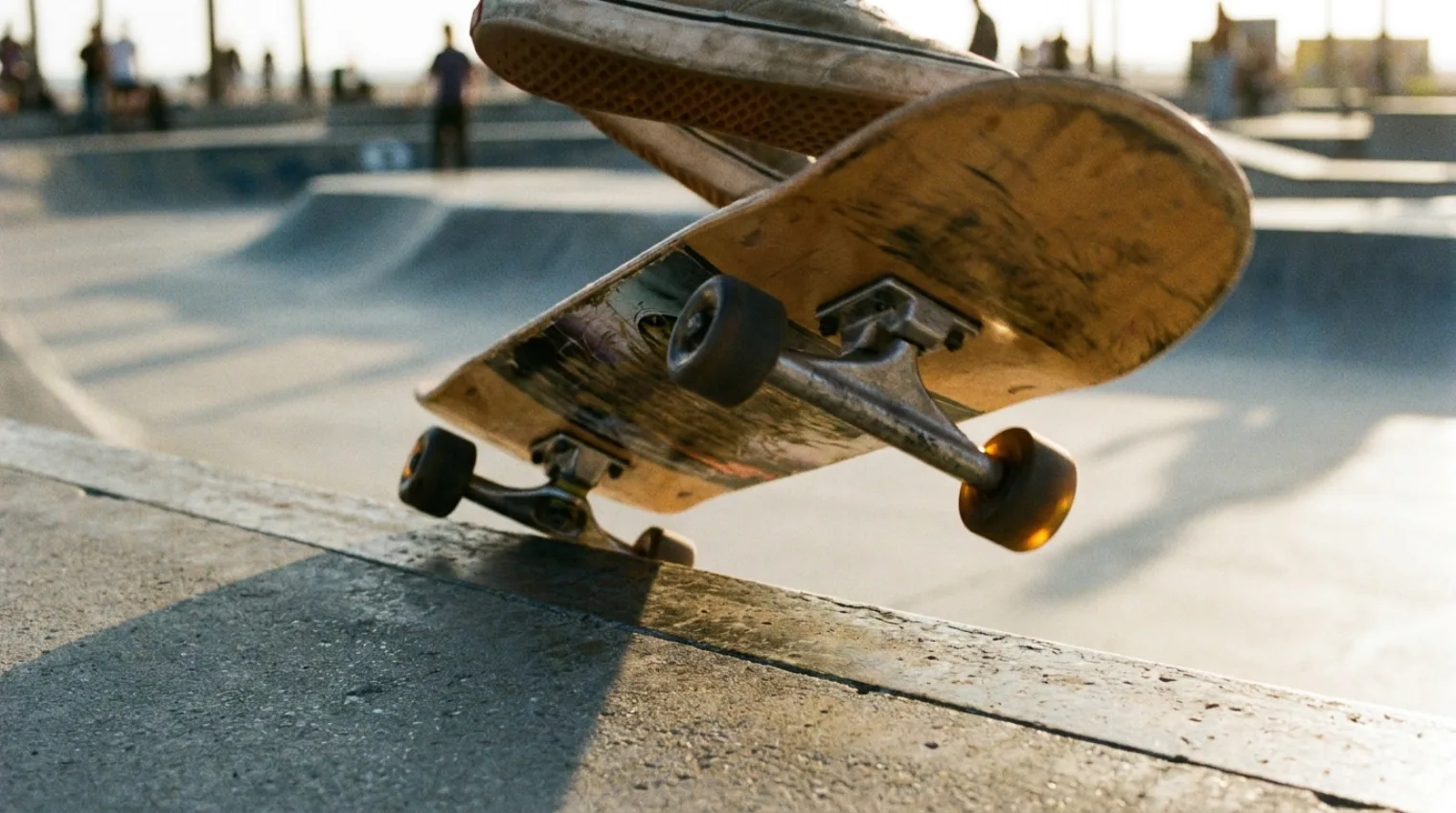
Every flip trick on Onbolts comes down to the same two ingredients: a torque that flips the board end over end, and a torque that spins it flat under your feet. Simple flip tricks use one. Combination tricks like varial kickflip, hardflip, and tre flip use both at once, which is exactly why their estimated learning times stretch out so much further. Understanding the two axes explains a lot of what shows up as difficulty ratings across the skill tree.
The short answer
A skateboard in the air can rotate two independent ways that matter for flip tricks. It can flip along its long axis, nose and tail staying roughly in place while the board rolls over, which is what kickflip and heelflip do. And it can rotate flat, spinning under your feet like a record while staying level, which is what pop shove-it does. Every combination trick on the tree is really a question of how many of these rotations you're asking the board to do at the same time, and how far around each one has to go.
The ollie: where the energy for all of it comes from
Every flip trick on Onbolts sits downstream of the ollie, and that's not just a naming convention on the tree, it's physics. The ollie's pop, snapping the tail down and sliding the front foot up the board, is what generates the vertical lift and the initial energy that flip tricks then redirect into rotation. A weak or inconsistent ollie pop doesn't just make you jump lower, it starves every flip trick built on top of it of the energy needed to complete a rotation before you land. That's a big part of why ollie sits as a direct prerequisite for so much of the tree, including kickflip and pop shove-it themselves.
Flip axis: how kickflip rotates the board end over end
A kickflip's rotation comes from your front foot dragging up and off the edge of the board near the nose, applying a twisting force along the board's long axis. That torque is what sends the board flipping end over end while it's airborne. Heelflip uses the same axis but the opposite side of the foot and the opposite direction of torque, which is why the two tricks feel like mirror images rather than unrelated moves. Onbolts rates kickflip at 1–6 months and heelflip at 1–4 months, close enough that they clearly draw on the same underlying mechanic, just applied from a different edge of the foot.
Rotation axis: how pop shove-it spins the board flat
Pop shove-it works on a completely different axis. Your back foot scoops the tail in a way that applies torque around a vertical line through the board's center, spinning it flat like a coin on a table rather than flipping it end over end. There's no flip torque involved at all, which is exactly why pop shove-it sits at beginner difficulty with a 1–3 week estimate, well below any trick that touches the flip axis.
Why stance changes difficulty even though the physics doesn't
The two-axis model above assumes your body already knows how to generate each torque reliably. Stance is where that assumption breaks down, and Onbolts' own data shows it clearly on a trick that barely qualifies as two-axis at all. Ollie is beginner, 1 to 4 weeks. Nollie, popping off the nose while riding backward instead of the tail while riding forward, is the same basic pop-and-lift mechanic and is rated intermediate at 1 to 3 months, several times longer.
Nothing about the physics of generating vertical lift changes between ollie and nollie. What changes is how much motor familiarity you're borrowing from everyday riding. Regular-stance pop is reinforced by literally every push and roll you do. Nollie's front-foot pop has almost no equivalent outside the trick itself. That's the part combination tricks add on top of pure physics: fakie, nollie, and switch versions of kickflip, varial kickflip, and hardflip all exist on the tree at the same or higher difficulty tier as their regular-stance counterparts, for exactly this reason, even though the underlying torques are identical.
Combining axes: why the combination tricks take so much longer
This is where the estimated learning times start telling a physics story on their own. Varial kickflip, which asks for a kickflip's flip-axis torque and a pop shove-it's rotation-axis torque at the same time, sits at 2–6 months. Hardflip, which pairs the same flip-axis torque with a frontside-shove-it-sized rotation, sits at 4–12 months. Tre flip, which asks for that same flip torque alongside a full 360 degree rotation, sits at 6–18 months.
The pattern across all three isn't a coincidence. Each one asks your body to generate and time two independent torques so they resolve at the same instant, and the estimated time climbs roughly in step with how much rotation the second axis has to complete. More rotation means more time in the air where the two axes have to stay synchronized, and more opportunity for one to finish before the other.
Why bigger rotations amplify small timing errors
A single-axis trick like kickflip has one job: get the flip torque right, and everything else follows. A two-axis trick has to get both torques right and get them synchronized, which is a fundamentally different kind of hard. A small timing error in a short rotation, like the one inside a hardflip, is often still recoverable before you land. That same small error inside a fuller rotation, like tre flip's, has more time and distance to compound before your feet come back down, which is a reasonable physical explanation for why tre flip's window runs longer than hardflip's even though both build on the same kickflip base.
Hang time is the resource every one of these tricks is spending, and it comes from the same source: however much vertical pop your ollie generated in the first place. A weak pop caps hang time low, which caps how much combined rotation you can realistically complete before gravity brings you back down, regardless of how well-timed your torques are. This is one more reason ollie sits underneath so much of the tree: it isn't just a rotation-axis or flip-axis trick prerequisite, it's the energy budget every combination trick has to work within.
What this means for how you should practice
The physics points toward a specific training order rather than just grinding full attempts: isolate the rotation-axis trick until it's automatic on its own, then add the flip-axis torque back in gradually, letting the flip catch up to a rotation your body already trusts. This is the same principle behind the practice plans for varial kickflip, hardflip, and tre flip, and it isn't a coaching cliche, it follows directly from the fact that you're really training two separate torques and only combining them once each one is reliable on its own.
Where this shows up on the skill tree
Onbolts' tree structure reflects this mechanical reality more than it might look at first glance. Combination flip tricks are almost always locked behind one flip-axis trick and one rotation-axis trick as prerequisites, not two arbitrary tricks. Varial kickflip needs kickflip and pop shove-it. Hardflip needs kickflip and frontside shove-it. Tre flip needs kickflip and pop shove-it at a fuller rotation. That pairing pattern is the tree encoding the actual physics of what each trick demands, which is worth keeping in mind the next time a locked node on your progress tracker seems arbitrary. It usually isn't.
Putting the numbers next to the physics
Lined up together, the estimates read like a physics-consistent ladder rather than an arbitrary difficulty list: kickflip alone at 1–6 months, varial kickflip adding a shove-it-sized rotation at 2–6 months, hardflip adding a frontside-shove-it-sized rotation at 4–12 months, and tre flip adding a full rotation at 6–18 months. Each step up the ladder pairs the same flip-axis torque with a larger rotation-axis demand, and the estimated time climbs with it. The full breakdowns for varial kickflip, hardflip, and tre flip go deeper on the mistakes specific to each, once the underlying physics here makes sense.
Browse the full tricks list to see how many tricks build on these same two axes, or check tutorial videos for a visual breakdown of flip-axis versus rotation-axis torque in real attempts.
Frequently asked
- What's the actual physical difference between a kickflip and a pop shove-it?
- A kickflip rotates the board along its long axis (flip axis), while a pop shove-it rotates it around a vertical axis while keeping it level (rotation axis). They use completely different torques, which is why they're rated separately at 1–6 months and 1–3 weeks on Onbolts rather than being treated as variations of each other.
- Why do combination tricks like varial kickflip and hardflip take so much longer than single-axis tricks?
- They ask your body to generate two independent torques and time them to resolve simultaneously, rather than mastering one motion. Onbolts' data shows this pattern clearly: kickflip alone is 1–6 months, but varial kickflip (kickflip plus pop shove-it rotation) climbs to 2–6 months, and hardflip (kickflip plus frontside shove-it rotation) climbs further to 4–12 months.
- Does a bigger rotation always mean a longer learning time?
- Broadly yes, based on the tree's estimates. Tre flip, which combines a kickflip with a fuller rotation than hardflip's frontside shove-it, carries the longest window of the three at 6–18 months, consistent with the idea that more rotation gives timing errors more room to compound before landing.
- Is heelflip physically the same trick as kickflip?
- They use the same flip axis but opposite torque direction and the opposite edge of the front foot, which is why they feel like mirror images. Onbolts rates them close together, 1–6 months for kickflip and 1–4 months for heelflip, reflecting how closely related the underlying mechanics are.
- Why does the ollie matter for tricks that don't look like ollies at all?
- The ollie's pop generates the vertical lift and energy that every flip trick redirects into rotation. Without a consistent ollie, there's less usable energy and airtime to complete either a flip-axis or rotation-axis torque, which is a physical reason ollie sits as a prerequisite across so much of the skill tree.
- Should I practice the flip and the rotation together from day one on a combination trick?
- The physics suggests otherwise. Isolating the rotation-axis motion until it's automatic, then adding the flip-axis torque on top, tends to work better than attempting both together from scratch, since you're really training two separate skills that only get combined once each is reliable alone.