blog-post // Jul 31, 2026
Why You Cannot Kickflip Before You Can Ollie: The Logic of Trick Prerequisites
Skateboard tricks have real prerequisites, not arbitrary ones. Here's why the ollie unlocks the kickflip, and how Onbolts' skill tree maps every dependency.
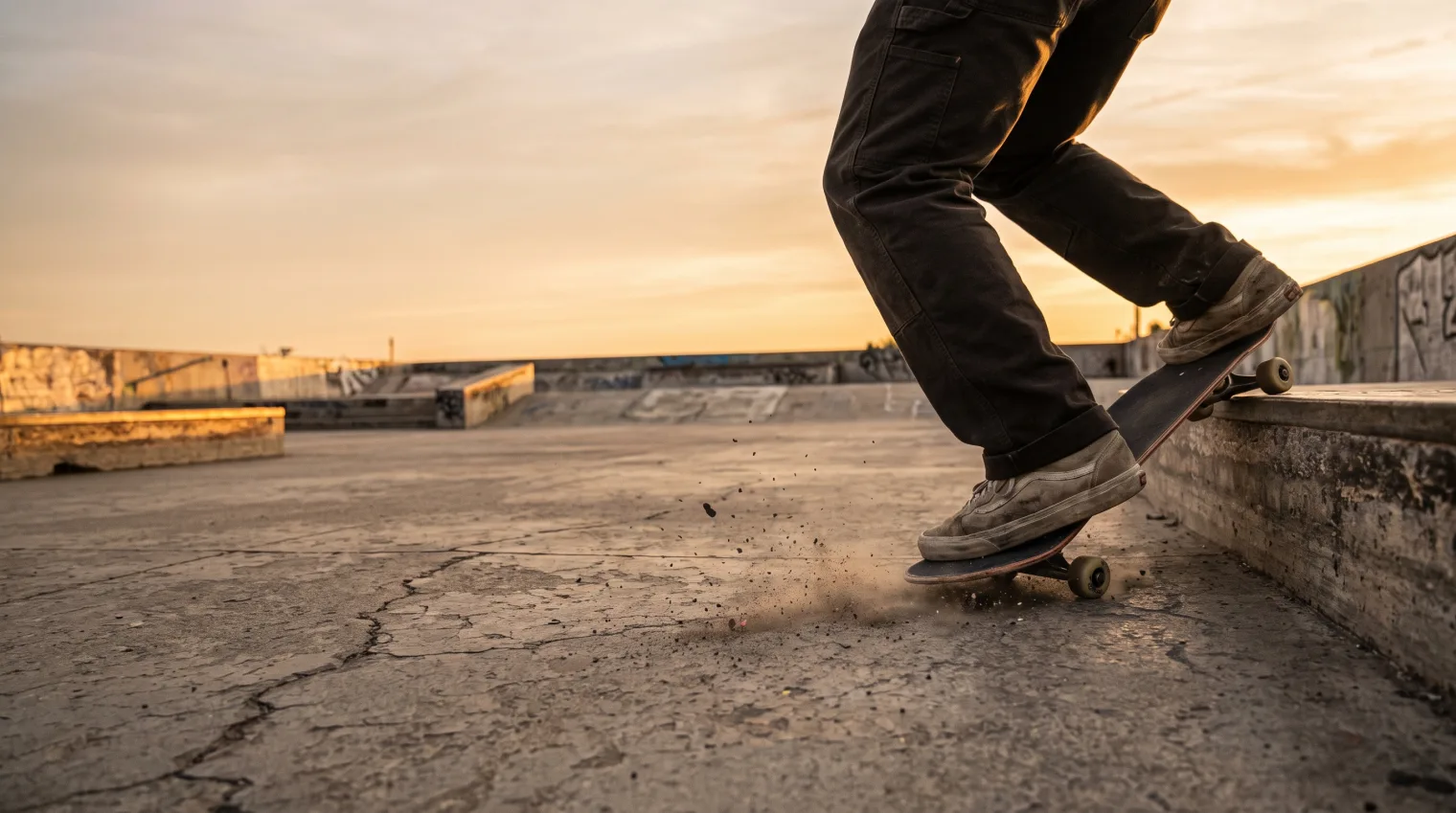
You cannot reliably kickflip without a consistent ollie because a kickflip is an ollie with a flick added on top, not a separate trick. The prerequisite isn't a suggestion or a tradition passed down at the skatepark, it's a description of the actual physics: the pop, the leveling out, and the landing are identical between the two tricks. The only thing a kickflip adds is a flick from your front foot that spins the board. If the ollie part isn't automatic, you're trying to learn two things at once, and that's where most stalled kickflip attempts come from.
This is the logic behind every prerequisite in the Onbolts skill tree, and understanding it changes how you plan your practice sessions.
What a prerequisite actually means
On Onbolts, a prerequisite relationship means the later trick's motion is built directly on top of the earlier one. It's not "this trick is easier so do it first," it's "this trick shares a mechanic with the one you want, and if you don't have that mechanic locked in, the harder trick becomes exponentially harder." The ollie is the clearest example: it's beginner difficulty, 1 to 4 weeks to learn per Onbolts' data, and it's a direct prerequisite for noseslide, boardslide, heelflip, kickflip, 50-50, backside 180, frontside 180, and pop shove-it, among others.
That's not a coincidence. Every one of those tricks needs you to pop the tail and control the board in the air. The ollie is where you build that control in isolation, before you add rotation, flip, or a ledge into the mix.
The physical chain: pop, then flick
Break a kickflip down into its two components and the prerequisite becomes obvious. Component one: pop the tail down, slide your front foot up and off the nose slightly, level the board out, land with your feet over the bolts. That's the entire ollie. Component two: as you pop, flick your front foot off the edge of the board instead of just sliding up, which spins the board along its long axis. That's the addition that makes it a kickflip.
If your pop (component one) isn't consistent, you're adding a rotational flick to a board that's already unstable in the air. The two problems compound instead of adding. This is why Onbolts' data shows kickflip at intermediate difficulty with a wide 1 to 6 month learning window, while ollie sits at beginner with 1 to 4 weeks. The gap isn't really about the flick being that much harder in isolation, it's about how much of that time gets spent re-learning pop control under the new demand of catching a spinning board.
What happens if you try to skip it
Skaters who attempt kickflips before their ollie is solid tend to hit one of two walls. Either the pop is too weak and the board doesn't get enough air time to complete the flip, so it clips the ground and stalls out, or the pop is inconsistent in direction, so even a good flick sends the board flying sideways instead of staying under your feet. Both of these are pop problems wearing a kickflip costume.
The fix isn't a kickflip-specific drill, it's going back to the ollie until landing it feels boring. That's genuinely the advice: if your kickflip attempts feel chaotic, stop attempting kickflips for a week and just ollie. On Onbolts, this shows up as a locked trick in the tree view: kickflip stays greyed out or flagged until ollie is marked as landed in your progress tracking, which is a deliberate design choice, not a UI restriction.
Why some tricks need two prerequisites
Not every trick has a single clean prerequisite. Some sit at the intersection of two trick families and need both. The clearest example is the tre flip (also known as a 360 flip), which requires both pop shove-it and kickflip. That's because a tre flip is literally a kickflip's flip motion combined with a pop shove-it's board rotation, happening at the same time. Miss either prerequisite and you're missing half the trick. Onbolts lists tre flip as advanced difficulty with a 6 to 18 month learning window, among the longest windows in the dataset, which reflects how much coordination it takes to sync two separate rotations.
Hardflip works the same way: it requires both kickflip and frontside shove-it. It's advanced difficulty with a 4 to 12 month window. The pattern holds across the whole tree: whenever you see a trick with two prerequisites, it's almost always because that trick is a combination of two earlier mechanics rather than a harder version of one.
Reading the tree as a decision tool, not a checklist
The temptation with any prerequisite system is to treat it as a checklist to blast through as fast as possible. That's the wrong way to use it. The prerequisite tree is more useful as a diagnostic: when a trick feels impossible, check what it requires and ask honestly whether that earlier trick is actually consistent, not just landed once.
Onbolts tracks this with a 5-level scale: learning, landed once, occasional, consistent, and mastered. A trick you've landed once is not the same as a trick you've mastered, and prerequisites really mean "consistent," not "landed once." If your kickflip attempts are going badly and your ollie is only at "landed once," that's your answer. Go back and get the ollie to "consistent" before troubleshooting the flick.
Building your own dependency map
Once ollie is consistent, you're not just unlocking kickflip, you're unlocking an entire branch of the tree at once: heelflip, 50-50, boardslide, frontside 180, backside 180, and pop shove-it all become viable in parallel. That's the real payoff of understanding prerequisites: instead of grinding one trick in isolation for months, you can spread practice across several tricks that all share the same base skill, which keeps sessions varied and keeps you from burning out on a single move.
From there, the tree branches again. Kickflip unlocks varial kickflip and tre flip. Heelflip unlocks varial heelflip and eventually laser flip. Every advanced trick in the Onbolts tree can be traced back through a chain of prerequisites to a small set of beginner tricks, and the ollie sits at the root of most of them.
A common mistake: treating "close enough" as done
A lot of skaters read a prerequisite chain and assume it means "I did this trick once, so I've satisfied the requirement." That's not how the mechanics work. If your ollie only lands cleanly one attempt out of five, the four failed attempts tell you something real: your pop, your slide, or your landing still has a weak point that hasn't been ironed out. Layering a kickflip's flick on top of that weak point doesn't skip the problem, it just makes the problem harder to isolate, because now you can't tell if a bad attempt was the ollie failing or the flick failing.
This is why Onbolts separates "landed once" from "consistent" on the 5-level scale instead of collapsing them into a single "done" checkbox. The distinction exists because prerequisite readiness genuinely depends on it. A coach watching you skate would give the same advice: don't move on because you got lucky once, move on because the trick has become boring to land.
What this looks like across a full session
In practice, a session built around this logic looks different from one built around "just try the next trick." Instead of alternating between ollie attempts and kickflip attempts hoping something clicks, you'd spend the first block of a session purely on ollies, paying attention to whether your front foot slide is reaching far enough and whether your landing is centered over the bolts every time. Only once that block feels repetitive and automatic would you shift into kickflip attempts, and even then, the first few kickflip attempts are really still ollie attempts with an added flick, so any sloppiness that shows up is worth tracing back to the base trick rather than assuming it's a kickflip-specific issue.
This approach feels slower in the moment. It isn't, in practice, because the alternative, alternating between an inconsistent ollie and kickflip attempts, tends to produce more frustration and a longer overall timeline, not a shorter one. Onbolts' data reflects this indirectly: the 1 to 6 month window for kickflip is wide precisely because outcomes vary this much based on how solid the foundation was going in.
Applying the same logic beyond kickflip
Once this pattern clicks for the ollie-to-kickflip relationship, it applies everywhere else in the tree. Before attempting tre flip, ask whether your pop shove-it and your kickflip are both genuinely consistent, not just landed. Before attempting hardflip, check the same for kickflip and frontside shove-it. The prerequisite logic isn't a one-time lesson about the ollie, it's a general rule for reading any dependency in the skill tree: the listed prerequisite is the trick whose weaknesses will show up first in the harder trick, so it's the first place to look when something isn't clicking.
Where to go next
If your ollie is solid and you're ready for the next branch, the kickflip page has the full breakdown, and the skill tree shows you exactly what unlocks once you land it. Browse the complete list at /tricks to see every prerequisite relationship laid out, or check /progress to see how close your own ollie is to "consistent" before you push into flip tricks.
Frequently asked
- Why do I need to learn the ollie before the kickflip?
- A kickflip is an ollie with an added flick from your front foot that spins the board under you. If your pop is not consistent, adding the flick just makes the board flip out from under you instead of staying beneath your feet. In the Onbolts skill tree, ollie is a hard prerequisite for kickflip because the physical motion is layered on top of it, not separate from it.
- What exactly does a prerequisite mean on Onbolts?
- A prerequisite is a trick that must come before another in the skill tree because the later trick reuses its core mechanic and adds something on top. Onbolts marks these as unlock relationships: until a prerequisite trick reaches a landed status, the dependent trick stays locked in the tree view, since attempting it without the base skill usually just leads to frustration.
- Can you skip the ollie and go straight to flip tricks?
- Not really. Every core flip trick in Onbolts' data, kickflip, heelflip, and the tricks built from them, lists ollie as a direct or indirect prerequisite. You can attempt a kickflip without a solid ollie, but you'll be fighting your pop and your flick at the same time, which is why most skaters who try this way take far longer than the 1 to 6 month window Onbolts' data shows for kickflip.
- What tricks become possible once you can kickflip?
- Once kickflip is landed, it becomes a prerequisite for varial kickflip, tre flip, hardflip, double kickflip, and kickflip backside 180, among others. Tre flip specifically needs both pop shove-it and kickflip, since it combines the flip motion of a kickflip with the board rotation of a shove-it. That's an advanced trick with a 6 to 18 month learning window per Onbolts' data.
- Is the prerequisite system the same as difficulty level?
- No, they measure different things. Difficulty (beginner, intermediate, advanced) is about how hard a trick is on its own. Prerequisites are about what mechanical skill it borrows from an earlier trick. A trick can be intermediate difficulty but still require a beginner trick as its prerequisite, which is exactly the ollie-to-kickflip relationship.
- Why do some tricks have two prerequisites instead of one?
- Because they combine two separate mechanics. Tre flip requires both pop shove-it (the rotation) and kickflip (the flip), since it is literally both motions happening at once. Hardflip requires kickflip and frontside shove-it for the same reason. Multi-prerequisite tricks are usually where two trick families intersect.