blog-post // Jul 27, 2026
The Skateboarding Skill Tree: Why Every Trick Has a Prerequisite
Onbolts' prerequisites are not arbitrary difficulty rankings. Here is how the skill tree's dependency logic actually works, and how to read it to plan ahead.
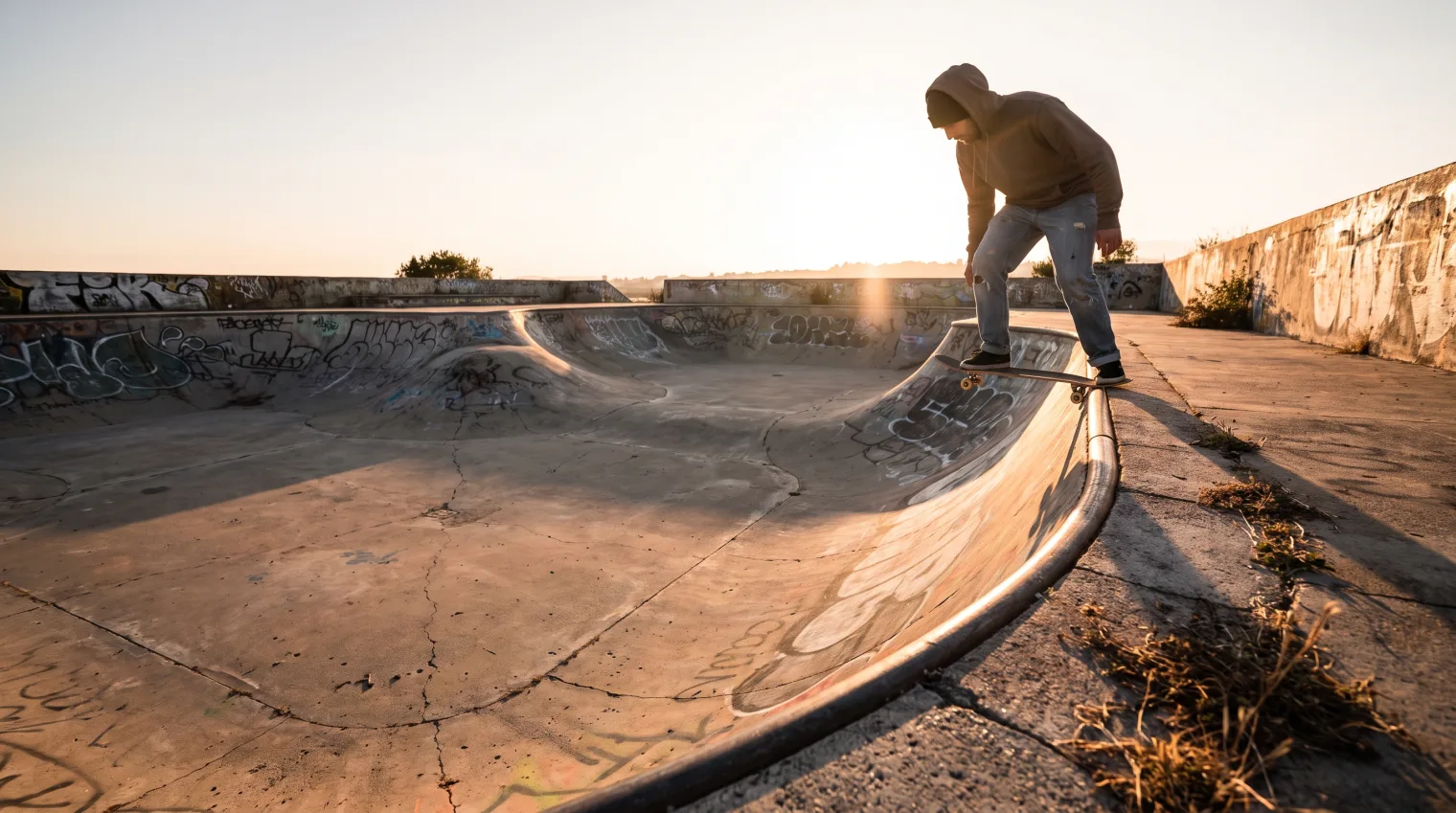
Every trick prerequisite on Onbolts exists because of a real mechanical dependency, not an arbitrary difficulty ranking. The ollie unlocks nine or more tricks because its pop and airborne board control get reused directly in each of them. This post explains how the skill tree is actually built, why prerequisites are not just "do the easier trick first," and how to read the tree to plan your own progression.
What a Prerequisite Actually Means on Onbolts
On Onbolts, a prerequisite relationship means trick A requires trick B: you cannot reliably learn A without the mechanics you build in B already in place. This is different from a "next" suggestion, which is a softer recommendation for what to try after a trick, without a hard mechanical dependency behind it.
For example, kickflip requires ollie as a prerequisite. That is a hard dependency: the kickflip's back-foot pop is the same motion as an ollie's, with a front-foot flick added on top. You cannot separate the flick from the pop. Compare that to ollie's "next" suggestions in Onbolts' data, which include pop shove-it, frontside 180, and kickflip: these are recommended next steps, useful but not strictly required in the same mechanical sense.
Why the Ollie Sits at the Center
Look at how many tricks list the ollie as a direct prerequisite in Onbolts' data: noseslide, boardslide, heelflip, kickflip, 50-50 grind, backside 180, frontside 180, pop shove-it, tailslide, and impossible all require it directly. No other beginner trick comes close to that number.
This is not because the ollie is the "first" trick by convention. It is because the ollie is the only beginner trick that produces a board fully airborne and under control at the same time. Every trick above it that involves getting the board off the ground, whether to flip it, spin it, or land it on an obstacle, needs that same airborne control as a starting point.
Prerequisites Can Stack
Some tricks need more than one prerequisite at once. This is where the tree stops being a simple line and starts branching in a way that matters for planning.
- Tre flip (advanced, 6 to 18 months) requires both pop shove-it and kickflip. It is combining the shove-it's board rotation with the kickflip's flip rotation, which is why it needs both source tricks independently solid first.
- Hardflip (advanced, 4 to 12 months) requires kickflip and frontside shove-it together.
- Laser flip (advanced, 6 to 18 months) requires three tricks: heelflip, frontside 360 shove-it, and varial heelflip. This is one of the most demanding prerequisite chains in Onbolts' database, and it reflects genuinely how technical the trick is.
When a trick needs multiple prerequisites, being consistent on only one of them is not enough. A common trap is assuming a strong kickflip alone should be enough to attempt tre flip, when the shove-it rotation half of the trick is an entirely separate skill that also needs to be solid.
Why Some Tricks Have No Learning-Time Estimate
Not every trick in Onbolts' database has an estimated learning time attached. Boneless, for instance, has an estimated time but requires caveman as a prerequisite, and caveman itself has no time estimate in Onbolts' data. When a prerequisite lacks a number, it usually means the trick has less standardized data behind it or is less commonly logged by skaters using the platform. Treat those as qualitative stepping stones rather than tricks you can put a firm timeline on.
What a Skill Tree Borrows From Games, and Where the Comparison Breaks Down
If you have played a game with a skill tree, an ability upgrade system, or a tech tree, the shape will look familiar: a handful of foundational nodes near the bottom that unlock branching paths above them, and a few nodes with unusually high connectivity that everything seems to route through. The ollie is that node here.
Where the comparison breaks down is that a game's skill tree is a design choice, someone decided a fireball spell requires level 5 first because it felt balanced. Onbolts' skill tree is descriptive, not designed. The ollie is not a prerequisite for kickflip because a developer decided it should gate progress. It is a prerequisite because the kickflip's pop is physically the same motion as the ollie's pop, and there is no way around building that motion first. If you could learn kickflip without ever building ollie mechanics, the tree would not list it as a prerequisite. The dependency reflects the physical skill, not a rule imposed on top of it.
Stance Changes the Tree Without Changing the Logic
Onbolts' prerequisite data also covers fakie, nollie, and switch stance variants, and the same dependency logic applies within each. Fakie kickflip requires fakie ollie and (regular) kickflip together. Nollie kickflip requires nollie. Switch kickflip requires switch ollie plus regular kickflip. The pattern repeats: before you can flip a board in a new stance, you need both the base ollie in that stance and the flip trick in your regular stance already built.
This is why the skill tree view on Onbolts lets you filter by stance. A skater with a strong regular kickflip is not starting from zero on switch kickflip, they already have the flick mechanics, they just need the switch ollie as the missing piece.
Prerequisite vs. "Next": Reading the Tree Correctly
Two tricks can be connected on the tree in different ways, and the distinction matters for how you plan:
- Prerequisite (hard requirement): You need this trick, consistently, before the next one is realistically learnable. Example: ollie before kickflip.
- Next (soft suggestion): A commonly recommended next step after a trick, based on what tends to build well from it, without a strict mechanical gate. Example: after landing indy grab, method air is a suggested next trick in Onbolts' data, but it is not a hard blocker in the way a prerequisite is.
If you are choosing what to learn next and see a "next" suggestion for a trick you have not fully consistent-rated yet, it is worth checking whether that next trick actually lists a hard prerequisite elsewhere in the tree. Some tricks appear in both lists for different source tricks, and the prerequisite relationship should always take priority in your planning.
Using the Tree to Plan Backward From a Goal Trick
The most useful way to read the skill tree is backward from a trick you actually want to land. Pick your goal, for example crooked grind (advanced), and trace its prerequisites back: crooked grind requires nosegrind, nosegrind requires 50-50 grind, 50-50 grind requires ollie. That gives you a concrete four-step path instead of a vague "get better at grinding" goal.
The same works for flip tricks. Laser flip traces back through varial heelflip and heelflip to the ollie, plus a separate branch through frontside 360 shove-it and frontside shove-it. Mapping it out this way shows you exactly which tricks are shared infrastructure (heelflip shows up in two of the three prerequisite branches) and worth prioritizing.
The Grind Branch Is a Clean Example of How the Tree Compounds
Grinds are one of the easiest branches to follow because the chain is mostly linear rather than requiring multiple prerequisites at once. 50-50 grind requires only the ollie. Nosegrind requires 50-50 grind. Crooked grind requires nosegrind. That gives you a clean four-node chain from ollie to crooked grind, each step adding one new balance skill (front trucks only, then front trucks at an angle) on top of the last.
Compare that to the flip-trick branch, where tre flip needs two separate source tricks (pop shove-it and kickflip) and laser flip needs three (heelflip, frontside 360 shove-it, and varial heelflip). The grind branch compounds in a straight line. The flip branch compounds by combination. Both are valid ways to build difficulty, but they require different practice strategies: linear chains reward steady, sequential reps on one trick at a time, while combination tricks reward keeping multiple prerequisite tricks warm simultaneously so none of them lags behind when you attempt the combination.
Why This Matters More Than a Difficulty Label Alone
Onbolts rates every trick beginner, intermediate, or advanced, but that label alone does not tell you whether you are actually ready to attempt it. A trick can be labeled intermediate and still be unreachable if you are missing one of its two prerequisites. Reading the actual prerequisite chain, not just the difficulty tag, is what tells you whether a trick belongs on your list this month or six months from now.
Track Your Position on the Tree
Because prerequisites depend on consistency, not just having landed a trick once, Onbolts' 5-level scale (learning, landed once, occasional, consistent, mastered) exists specifically to give the tree an honest input. The progress tracker records where each of your tricks actually sits, so when you plan your next move using the tree, you are working from real status instead of memory.
Explore the Tree Yourself
The skill tree at Onbolts renders this entire structure visually, filterable by stance, so you can trace any trick's full prerequisite chain back to the ollie or forward to everything it eventually unlocks. For a written walkthrough of the beginner layer specifically, see the right order to learn beginner skateboard tricks, and for the step right after your ollie clicks, the what to learn after ollie guide picks up from there. Browse the complete trick database, with difficulty and category filters, at all tricks.
Frequently asked
- What does it mean when a trick has a prerequisite on Onbolts?
- A prerequisite means the trick requires another trick's mechanics to already be in place. Kickflip requiring ollie is a hard dependency, since the kickflip pop is the same motion as an ollie pop with a flick added. This is different from a 'next' suggestion, which is a softer, non-required recommendation for what to try afterward.
- Why does the ollie unlock so many other tricks?
- Onbolts' data shows the ollie is a direct prerequisite for noseslide, boardslide, heelflip, kickflip, 50-50 grind, backside 180, frontside 180, pop shove-it, tailslide, and impossible, more than any other beginner trick. It is the only beginner trick that gets the board fully airborne under control, which is the base requirement for nearly everything that follows.
- Can a trick have more than one prerequisite?
- Yes. Tre flip requires both pop shove-it and kickflip. Hardflip requires kickflip and frontside shove-it. Laser flip requires three tricks: heelflip, frontside 360 shove-it, and varial heelflip. When a trick lists multiple prerequisites, all of them need to be consistent, not just one.
- Does switch or nollie stance need different prerequisites?
- Yes, but the same logic applies. Onbolts' data shows switch kickflip requires switch ollie plus your regular-stance kickflip together, and nollie kickflip requires nollie plus your regular kickflip. You need both the base ollie in the new stance and the flip mechanic you already built in your main stance.
- Why do some tricks have no estimated learning time?
- Some tricks in Onbolts' database, like caveman, do not have an estimated learning time attached, usually because they have less standardized data behind them. Their prerequisite relationships still apply. For example, boneless requires caveman even though caveman has no time estimate. Treat those as qualitative stepping stones rather than tricks with a firm timeline.
- How should I use the skill tree to plan my own progression?
- Pick a goal trick and trace its prerequisites backward. Crooked grind requires nosegrind, which requires 50-50 grind, which requires ollie, giving you a concrete four-step path instead of a vague goal. The visual skill tree at /tree lets you do this tracing for any trick, filtered by stance.