blog-post // Aug 3, 2026
Fakie Kickflip: Why It Feels Backwards and How to Land It
Fakie kickflip means kickflipping while riding backward in your normal stance. Onbolts rates it intermediate at 1–3 months, faster than the 1–6 month regular version.
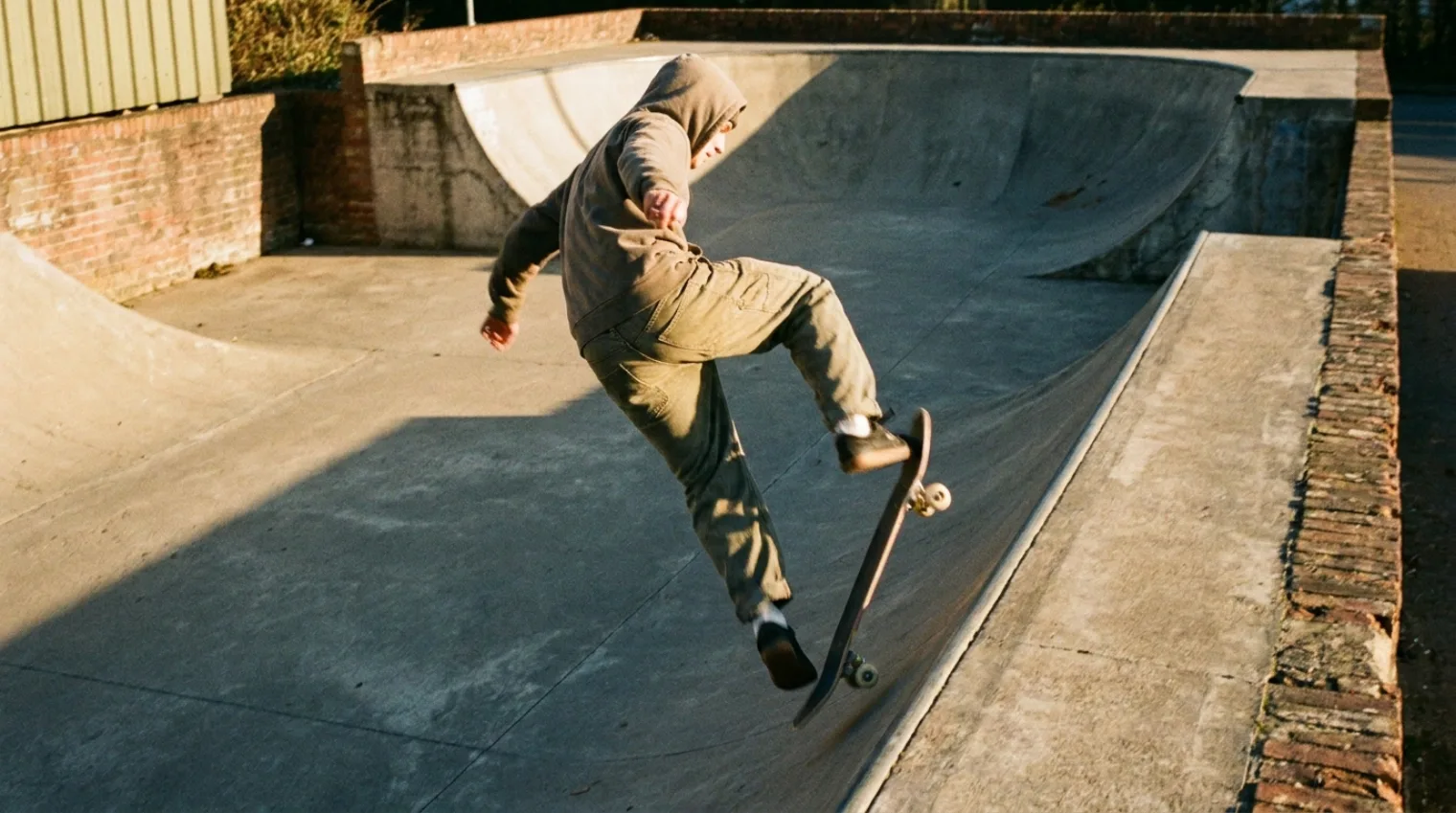
A fakie kickflip is a regular kickflip performed while riding fakie, backward, in your normal stance, with your feet exactly where they always are. Onbolts' learning data rates it intermediate at 1–3 months, which is often faster than the 1–6 months a regular kickflip takes, because the trick you are landing is not new, only your orientation is.
What a fakie kickflip is
Take the kickflip you already know, front foot flicks the board off its edge, board rotates once under your feet, you catch and land, and perform it while riding fakie instead of forward. Your feet do not move to new positions. Your flick does not change. The only thing that changes is that you are traveling in the direction your tail normally points, not your nose, and your whole spatial sense of the board is flipped as a result.
This is worth stating plainly because it explains something that confuses a lot of skaters attempting this trick for the first time: the flick feels wrong even though it has not changed. That mismatch, correct mechanics paired with wrong-feeling execution, is the entire story of why fakie kickflip is disorienting.
Why it feels backwards even though the flick has not changed
Riding fakie reverses your spatial map of the board. Which way is forward relative to your vision, where the nose sits relative to your eyeline, which way your body naturally wants to rotate on a spin, all of that gets flipped the moment you turn around and ride fakie. A kickflip stacked on top of that reversed spatial sense means your brain is trying to run a familiar motor pattern inside an unfamiliar frame of reference.
This is different from what happens with switch, where your stance itself changes and you are rebuilding balance from close to zero, or nollie, where the pop mechanics change because you are working off a different end of the board. Fakie kickflip keeps both your stance and your flick mechanics identical to what you already know. The difficulty is disorientation, not new mechanics, which is exactly why it tends to click faster once it clicks at all.
What the numbers say
Onbolts' learning data puts the regular kickflip at 1–6 months, intermediate difficulty. Fakie kickflip sits at 1–3 months, also intermediate, tighter and generally shorter than the regular version despite feeling harder in the moment for a lot of skaters. That is not an inconsistency in the data, it reflects that most of the work, the flick, the catch, the pop, is already done by the time you attempt this trick. What remains is comfort riding fakie, which most skaters have already built some of by the time they are ready for a fakie flip trick.
Grind and slide variants in the fakie branch do not carry specific time windows in Onbolts' data the way flatground flip tricks do, since they depend more on terrain access than raw repetition count.
Prerequisites: what you need before trying it
The Onbolts skill tree lists exactly two prerequisites for fakie kickflip: a fakie ollie and a regular kickflip. Not one or the other, both. This matters more than it sounds like it should. Skaters who already have a rock-solid kickflip but a shaky fakie ollie tend to spend their early attempts fighting the fakie disorientation instead of the flip, and mistakenly conclude the flip itself has gotten harder. Skaters with a solid fakie ollie but an inconsistent kickflip run into the opposite problem, the flick falling apart under the added disorientation.
Get both pieces separately solid first. A fakie ollie that only lands sometimes, or a kickflip you are still thinking through consciously, will make fakie kickflip take considerably longer than the 1–3 month window above assumes.
How the half-cab and cab relate, and how they do not
The half-cab, a 180-degree rotation from fakie back to forward facing, shares the fakie ollie prerequisite but is otherwise unrelated to fakie kickflip, it is a rotation trick, not a flip trick. Cab, the full 360-degree version, is rated advanced at 3–9 months and requires a landed frontside 180 plus a fakie ollie. Neither is a required step toward fakie kickflip, but skaters commonly learn half-cab around the same period, since both sit just past the fakie ollie foundation and both reinforce the same fakie comfort that makes the kickflip land cleaner.
Common mistakes learning fakie kickflip
Attempting it before the fakie ollie is automatic. If your fakie ollie still needs conscious thought, adding a flick on top of it means you are managing two unstable things at once instead of one.
Flicking too hard, trying to compensate for the unfamiliar feeling. The disorientation is real but the flick itself has not gotten harder. Over-flicking to fight through the strange feeling usually just sends the board spinning past the catch window.
Rushing straight to fakie varial kickflip or fakie kickflip backside 180. Both build directly on fakie kickflip and add a shove or a 180 on top of it. Give the plain fakie kickflip time to feel consistent, not just landed, before adding rotation to it.
Looking the wrong way while flicking. Fakie already flips which shoulder naturally checks for obstacles. Adding a flip trick on top can make skaters revert to their forward-riding spotting habits mid-trick, which throws off the catch.
A practice sequence that avoids the common traps
Start every session with a handful of plain fakie ollies before touching the kickflip attempt, even if your fakie ollie already feels solid. This resets your spatial orientation before you ask anything harder of it. Only once a few clean fakie ollies land in a row should you add the flick. If early attempts feel like the board is flipping too fast or too slow relative to a regular kickflip, that is usually a sign the disorientation is still present, not that your flick technique has changed, and another round of plain fakie ollies is a better next step than adjusting your flick.
How fakie kickflip compares to the other stance variants
Onbolts tracks a kickflip across four stance variants, and fakie is the fastest of the three non-regular versions by a wide margin. Nollie kickflip is rated intermediate with no published time window yet, since it depends on relearning the pop from the nose. Switch kickflip is rated advanced at 4–12 months, the slowest and hardest of the four, since it asks you to rebuild your entire stance rather than just your orientation or your pop point. Fakie kickflip's 1–3 months sits well below both, which lines up with the underlying mechanics: fakie is the only variant that changes neither your stance nor your pop point, only your direction of travel.
This is useful context if you are deciding which stance-variant kickflip to chase first. Fakie kickflip is the natural entry point into stance-variant flip tricks precisely because it asks the least of you mechanically, even though it does not feel that way in the first few sessions.
What comes next
Once fakie kickflip is consistent, Onbolts' skill tree opens two direct next tricks: fakie heelflip and fakie tre flip, the latter combining fakie shove-it and fakie kickflip, both of which you will already have in your list by that point. Fakie varial kickflip and fakie kickflip backside 180 also build directly from it, each adding one additional element, a shove or a 180, to a flick you already own. Fakie tre flip then continues on toward fakie hardflip and fakie laser flip for skaters chasing the more advanced end of the fakie branch.
The takeaway
A fakie kickflip is not a harder kickflip, it is the same kickflip performed inside a flipped spatial frame, which is exactly why Onbolts' data shows it landing faster than the regular version once both prerequisites, a solid fakie ollie and a solid kickflip, are in place. The disorientation is real, but it fades with reps faster than most skaters expect going in.
Track your fakie ollie and fakie kickflip separately on your progress page rather than assuming one implies the other, and check the skill tree to see where fakie heelflip and fakie tre flip sit once this one is locked in. The full tricks list has every fakie variant Onbolts tracks if you want to browse further.
Frequently asked
- What is a fakie kickflip?
- A fakie kickflip is a standard kickflip performed while riding fakie, backward, in your normal stance, feet unchanged. The flick mechanics are the same as a regular kickflip, what changes is your direction of travel and the disorientation that comes with popping and flicking while facing backward.
- Is fakie kickflip harder or easier than a regular kickflip?
- By Onbolts' data it is often faster to land once you already have a solid regular kickflip: fakie kickflip is rated intermediate at 1–3 months, against 1–6 months for the regular kickflip. It requires both a fakie ollie and a landed regular kickflip as prerequisites, so the flick itself is not being relearned from scratch, only reoriented.
- Why does a fakie kickflip feel backwards even though the flick is the same?
- Riding fakie flips your spatial read of the board, which way is forward, where the nose is relative to your eyes, which shoulder naturally checks for obstacles. Layering a kickflip's rotation and catch on top of that reversed spatial sense is what makes a trick you already know cold suddenly feel unfamiliar.
- What should I learn before attempting a fakie kickflip?
- Onbolts' skill tree lists two prerequisites for fakie kickflip: a fakie ollie and a regular kickflip, both landed and reasonably consistent, not just landed once. Trying a fakie kickflip before either is solid usually means troubleshooting the fakie disorientation and the flip mechanics at the same time.
- What comes after fakie kickflip?
- Onbolts' skill tree opens two tricks directly from fakie kickflip: fakie heelflip and fakie tre flip. Fakie varial kickflip and fakie kickflip backside 180 are also built directly on top of it, combining the same flick with an added shove or 180 rotation.
- Is fakie kickflip related to the half-cab or cab?
- Not directly, though they share the same fakie ollie foundation. Half-cab is a 180-degree rotation from fakie back to forward and only needs a fakie ollie, while cab is a full 360-degree rotation rated advanced at 3–9 months, requiring both a frontside 180 and a fakie ollie. Fakie kickflip stays facing backward the whole trick and adds a flip rather than a rotation.